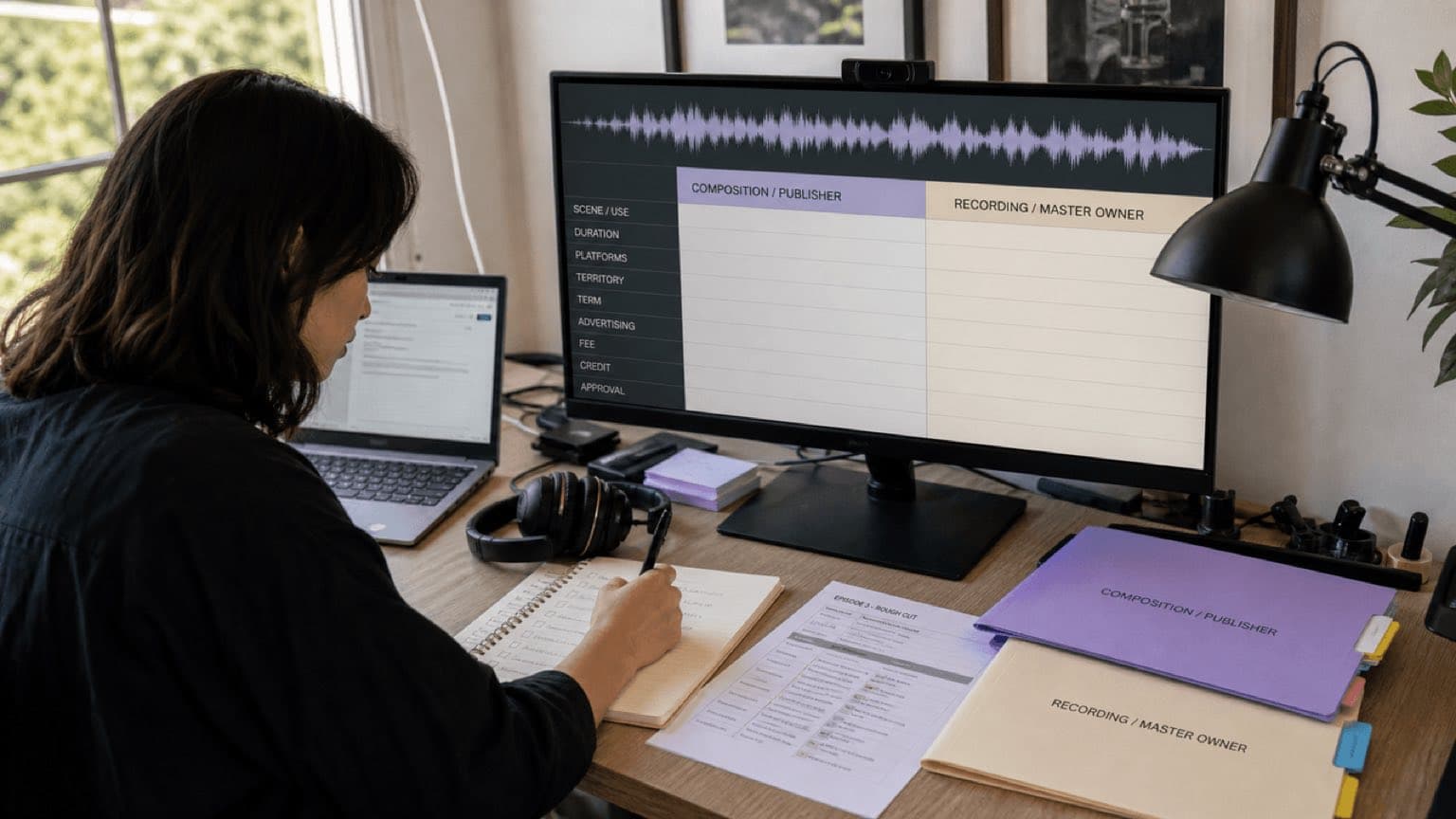
Sonilo publishes this guide and appears as an alternative when a preexisting song cannot be cleared. The U.S. Copyright Office, WIPO, The MLC, BMI, ASCAP, SESAC, labels, publishers, and artists did not sponsor or review it. Rights, controllers, shares, fees, and terminology vary by country and agreement. This is a production workflow, not legal advice, a quote, or confirmation that any named organization can license a specific song. Use a music-clearance specialist or qualified lawyer for consequential releases.
Last verified: August 21, 2026. The U.S. Copyright Office continues to distinguish musical works from sound recordings. WIPO’s 2026 independent-filmmaker clearance guide identifies publishers and record labels as usual channels for preexisting recorded music and stresses scene, distribution, territory, promotional use, credit, and cue-sheet terms. The MLC and PRO repertoire tools remain useful composition-data leads, not automatic sync or master licenses. No live Sonilo English or Spanish page existed at this URL.
Clear both sides before you lock the edit
Ask for synchronization permission
Contact the publisher, publishing administrator, self-administered writer, or other controller authorized to license the underlying music and lyrics for the specific audiovisual use.
Ask for master-use permission
Contact the label, artist, producer, distributor, or other controller with authority over the exact recording used in the timeline.
Describe the complete exploitation
Scene, duration, prominence, media, platforms, monetization, client, advertising, trailers, territories, languages, term, edits, soundtrack, archive, and sublicensing.
Do not proceed on informal approval
Use executed written licenses or permissions that identify the work, recording, project, rights granted, controllers, conditions, fees, credits, signatures, and dates.
A useful release gate is simple: both rights columns show executed, every condition is satisfied, the final file matches the licensed version, and the approved scope matches the actual release. “Requested,” “artist approved,” “publisher found,” and “invoice paid” are intermediate states—not clearance by themselves.
01
Identify the exact song, recording, and planned use
Do not begin with “Can I use this song?” Begin with a version-specific record. Songs can have identical titles, multiple writers, several publishers, covers, remasters, clean edits, live versions, remixes, sampled elements, translations, and recordings controlled by different companies. Clearing one version and delivering another can invalidate the workflow.
| Field | Composition side | Recording side |
|---|---|---|
| Identity | Title, alternate titles, writers, publishers, ISWC/work code | Primary artist, featured artists, version, label, release, ISRC, duration |
| Controller | Publisher, administrator, self-administered writer, co-owner | Label, master owner, artist company, producer or authorized distributor |
| Requested permission | Sync, lyric display, adaptation or translation where relevant | Use of the exact master, edits and extracts |
| Open issue | Unclaimed shares, conflicting splits, direct-license restrictions | Samples, featured performances, old/new master, territory split |
Save the source URL, audio file and hash, release credits, timestamped reference, metadata, and screenshot of the exact version. Use the previous copyright verification guide to separate protection, ownership, and permission before contacting anyone.
Write the use map before the email
Creative
- Project title and format
- Scene description and context
- Background, feature, theme or performance
- Exact duration and edit points
Distribution
- Film, TV, streaming, YouTube and social
- Theatrical, festival and educational
- Podcast, app, game or website
- Territories and languages
Commercial
- Monetization and sponsorship
- Client and brand identity
- Paid media and out-of-context ads
- Budget, fee structure and exclusivity
Lifecycle
- Term and start date
- Trailers, teasers and cut-downs
- Edits, localization and archive
- Sublicensing and distributor delivery
Rights holders price and approve based on context as well as duration. A ten-second background use in a student short, a recurring opening theme, a political documentary allegation, and a global paid campaign are not interchangeable requests. Disclose sensitive or potentially controversial context accurately; approval can depend on how the song and artist are associated with the scene, brand, cause, product, or character.
02
Find every party that can authorize the use
Search the composition side
Start with official credits and publisher data. The MLC Public Work Search lets anyone inspect musical-work data it has compiled. BMI/ASCAP Songview and SESAC repertory can show writers, publishers, represented shares, alternate titles, affiliations, and contacts. These systems have defined coverage and disclaimers. They are research tools; a public-performance organization or mechanical-data system does not automatically issue the synchronization permission your video requires.
Search exact and alternate titles, writer names, performing artist, publisher, ISWC, IPI/CAE, and known aliases. If multiple publishers control shares, record each share and contact. WIPO warns that songs commonly have several authors and publishers and that authorization from one coauthor may not be enough. Treat incomplete or conflicting totals as a stop condition.
Search the recording side
Inspect official release pages, liner notes, label and artist sites, ISRC metadata, distributor credits, copyright notices, trade databases, and the recording’s Copyright Office record where relevant. A distributor can deliver a recording without necessarily owning all master-use authority; ask the contact to confirm it can grant the requested audiovisual rights and bind any performers, producers, samples, or territorial partners implicated.
| Contact | Useful for | Do not assume |
|---|---|---|
| Publisher / administrator | Composition control and sync negotiation | It controls every writer share or the master |
| PRO repertoire | Writer, publisher, affiliation and share leads | A performance license includes sync |
| The MLC | U.S. musical-work ownership data and recording matches | Its database is a master-ownership or sync-clearance service |
| Record label | Master ownership and licensing contact | It controls the composition, every sample, or every territory |
| Artist / manager | Approval path and controller referrals | The artist can bind publisher, label and co-writers |
| Distributor | Release metadata and possible master contact | Distribution equals ownership or sublicensing authority |
Verify authority before negotiating price
Ask: Which right and share do you control? In which territories? Can you approve the scene, trailers, ads, edits, client, term, and sublicensing? Does another party have approval, consultation, matching-fee, most-favored-nations, sample, performer, or union rights? Who signs, and in what legal entity? A correct email domain is helpful, but authority must appear in the agreement.
03
Send one complete permission request to both rights sides
Subject: License request — [song / recording] for [project]. We request permission to synchronize the musical composition “[title],” written by [writers], and/or use the master recording performed by [artist], [version / label / ISRC]. The music appears for [duration] as [background / visual vocal / theme / featured performance] in [accurate scene description]. The project is [format and runtime] produced for [producer/client], with [monetization/sponsorship/advertising]. Requested media: [list]; territories: [list]; term: [dates/perpetuity request]; languages: [list]. Please include [trailers, teasers, social cut-downs, paid ads, edits, localization, embeds, festival/theatrical/broadcast/streaming, archive, client/distributor sublicensing] where applicable. Proposed launch: [date]; response requested by [reasonable date]. Budget: [range or request for quote]. Please confirm the rights/share you control, required approvals, fee, credit, cue-sheet data, reporting, Content ID/claim process, restrictions, and contracting entity.
Send the same material scope to composition and master contacts so the quotes can be compared. Attach a private scene link or watermarked cut only through an approved method, explain confidentiality, and do not send unreleased client material to an unverified address. For sensitive context, provide sufficient scene and narrative information; hiding it can create approval and contract problems later.
Use a rights-request tracker
| Side | Status | Owner | Next gate |
|---|---|---|---|
| Composition share A | Contact verified | Clearance producer | Scene approval and quote |
| Composition share B | Research conflict | Music supervisor | Resolve publisher/administrator |
| Master | Quote received | Producer | Match scope and MFN language |
| Sample in master | Unknown | Label contact | Written confirmation of clearance |
| Client approval | Pending | Account lead | Budget and context sign-off |
| Final release | Blocked | Legal/producer | All licenses executed and conditions met |
Use dates, names, legal entities, and document links—not only “waiting” or “approved.” A project manager should be able to see which precise right blocks release and which person owns the next action.
See how the request changes across three projects
Thirty-second sponsored product video. A twelve-second chorus appears under the product reveal and will run on the brand’s YouTube channel, organic social, paid social, retail pages, and localized cut-downs for eighteen months. The request must identify the brand and product, in-context and out-of-context advertising, media buying, client ownership, territories, versions, edits, influencer reposts, embeds, term, and claim-release process. A normal creator or personal-social approval is too narrow.
Feature documentary with a historical recording. The track plays for forty-five seconds under archive and returns for fifteen seconds in a trailer. Research composition and master separately, including the exact old recording, restoration/reissue, writers, publisher changes and territories. Describe the factual scene honestly. Ask about festival, theatrical, broadcast, streaming, education, publicity, trailer, subtitles/dubs, E&O documentation, cue sheet, credit, term, and soundtrack exclusions.
Independent artist’s unreleased track. The artist may be the writer, performer, producer and master owner, but verify co-writers, beats, samples, producer agreements, publishing administration, distributor terms, featured performers and any label option. Use a written agreement with the artist’s correct legal entity. The low profile of a song does not make chain-of-title optional.
Follow up without manufacturing consent
Send a concise first request, confirm receipt through a verified channel, and follow up with the project title and original date rather than opening parallel threads. Keep a contact log. Escalate to a known publisher, label licensing department, manager, lawyer or clearance agent only with accurate context. State the decision deadline, but do not write that silence will be treated as approval. If launch cannot move, narrow media, duration, territory or term—or activate the replacement cue.
Handle self-administered writers explicitly
A database may show no conventional publisher or use a placeholder indicating the writer retains administration. Verify with the writer or authorized administrator who controls each share and can sign. The MLC explains that self-administered shares are not subject to a publisher or publishing-administration agreement, but its role and data concern statutory digital mechanical licensing—not your synchronization permission. Obtain a project-specific sync grant from the actual controller.
04
Negotiate identical scope, not just a headline fee
A quote may change with popularity, duration, prominence, scene, project budget, territories, term, media, advertising, soundtrack, trailers, exclusivity, and approval burden. There is no reliable universal price or legally required matching price. Some deals use most-favored-nations clauses that align certain terms across composition and master sides; read what the actual clause covers rather than assuming informal “MFN” language.
| License field | Questions to resolve | Failure if omitted |
|---|---|---|
| Grant | Which composition share/master and which rights? | Wrong asset or incomplete authority |
| Context | Which scene, character, product, cause and edit? | Use exceeds approval |
| Media | In-context program plus trailers, ads, social, soundtrack? | Marketing or platform cut-down blocked |
| Territory / term | Worldwide? Named countries? Fixed years? Renewal? | Regional block or expired release |
| Edits | Trimming, looping, instrumental, lyrics, translation, stems? | Normal editorial change breaches restrictions |
| Client / sublicense | Can producer, client, distributor and platforms exploit it? | License stays with wrong entity |
| Fee / payment | Amount, taxes, schedule, refund, kill fee, options? | Approval exists but is not effective |
| Credits / cue sheet | Exact wording, placement, identifiers and reporting? | Delivery condition missed |
Use conditional approval carefully
A rights holder may give creative approval subject to fee, contract, other co-owner approvals, payment, cue-sheet delivery, credit, edit restrictions, or a final cut. Do not mark the song cleared until every condition precedent is met. If one side says “approved subject to publisher” and the publisher declines, the master approval does not rescue the use.
Plan a replacement deadline
Set a clearance deadline before picture lock, sound mix, client launch, media booking, distributor delivery, and trailer release. WIPO notes that music negotiations can take substantial time. If a rightsholder cannot be found, splits conflict, the quote exceeds budget, context is rejected, or contracts stall, replace the song while the edit is still flexible. Keep an alternate cue with comparable duration and structure.
05
Special cases that change the permission path
Cover recording
A new performance avoids using the commercial master but still requires analysis and permission for the composition in audiovisual use. Arrangement, lyric, performer and new-master agreements also matter.
Live performance in scene
The production may create its own recording, but the underlying composition, performers, venue, unions, releases, broadcast and soundtrack uses still need review.
Lyrics on screen
Displaying, translating, animating or adapting lyrics can require rights beyond playing a recording. State the exact text, treatment, media and language in the request.
Sample or interpolation
Approval for the new song does not necessarily clear third-party sampled recording or composition. Ask for written chain-of-title confirmation and qualified review.
Public-domain composition
A composition may be public domain in one territory while the selected modern recording or arrangement remains protected. Verify both, country by country where needed.
Platform music feature
Music supplied inside Shorts or another editor may be licensed only for that account, format, country, platform, or use. Do not treat it as a portable master license.
A mechanical license for distributing an audio cover, a public-performance license for a venue or business, and a synchronization license for pairing music with picture solve different uses. Do not purchase the easiest license category and rename it. State the actual exploitation and let the authorized licensor or counsel determine the required grants.
06
Create an alternative before clearance delay owns the project
When a song is unavailable, unaffordable, too narrow, or too slow to clear, generate a soundtrack candidate around an authorized cut with Sonilo Video to Music. This changes the sourcing path and can preserve edit timing without depending on a famous master. It does not automatically guarantee exclusivity, copyrightability, no resemblance, no platform claim, or fitness for every client and distribution contract.
Remove the uncleared temp
Export a reference with dialogue and authorized production sound, not the commercial song you are trying to replace.
Describe the scene job
Give duration, entry, exit, transitions, energy, density, instrumentation, voice space, emotional limit, ending and prohibited elements.
Avoid artist imitation
Translate the editorial need into musical behavior rather than naming a living artist, label, protected song, recording or recognizable signature.
Review candidates
Check timing, dialogue, similarity, embedded speech, artifacts, cultural fit, brand safety, endings, stems/edits where available, and fallback.
Verify and retain
Read current Sonilo licensing, plan and Terms; save input authority, prompt, output, account, invoice, terms version, approvals and final destinations.
Use the business licensing guide for commercial scope and the licensing-fit checklist for film, client, trailer and distribution requirements. For AI-output ownership questions, consult the AI-generated music copyright guide.
07
Resolve clearance problems before final delivery
| Problem | What it does not mean | Next action |
|---|---|---|
| No response | Permission by silence | Follow up, verify contacts, narrow scope, extend schedule or replace |
| Artist says yes | Publisher and label are cleared | Map artist authority and obtain every remaining approval |
| One publisher approves | All composition shares approve | Resolve all controllers and conflicting shares |
| Master quote arrives first | The song is ready | Keep release blocked until composition license is executed |
| Quote exceeds budget | The rights holder must discount | Reduce duration/media/term, negotiate options, choose cover where lawful, or replace |
| Scene changes | Old approval covers new context | Disclose material context, duration, media and edit changes for written approval |
| License signed but unpaid | Grant is effective | Check conditions, invoice, payment and countersignature |
| Claim after licensing | The license is necessarily invalid | Match file, claimant and scope; use licensor/platform release process with evidence |
Archive the final clearance packet
Keep request, scene link, exact audio and hash, composition/master IDs, ownership research, all contacts and shares, quotes, approvals, executed agreements, invoices and payment, credit, cue sheet, conditions, term/renewals, client/distributor sublicensing, final use report, platform claims, amendments, final video and every localized or promotional version. Reconcile the packet after every material edit.
If the exact recording, all required controllers, granted media, client, territories, term, context, fee effectiveness, and written signatures cannot be verified, keep the item blocked or replace it.
Sources
Sources
- U.S. Copyright Office: What Musicians Should Know
- Copyright Office: Musical Works and Sound Recordings
- WIPO: Rights Assessed During Clearance
- The MLC Public Work Search
- BMI/ASCAP Songview
- SESAC Repertory
Human review required: a named music supervisor or clearance professional should reproduce identity, share, authority, request, quote, condition, signature, cue-sheet and delivery checks for a real project. A qualified copyright lawyer should verify the required rights, co-owner rules, samples, adaptations, international scope and contract language. Sonilo should maintain named author, corrections, terms history, security and product-claim evidence.
FAQ
Frequently asked questions
Identify the exact composition and recording, define the complete use, locate every party authorized to license those rights, request synchronization permission from the composition side and master-use permission from the recording side, negotiate written terms, sign both approvals, pay required fees, and retain the license with the final edit.
For an existing recording in video, the usual starting points are the music publisher or administrator for the composition and the record label or master owner for the recording. Writers, artists, PROs, The MLC, distributors, and repertoire databases can provide leads but may not control the required synchronization or master-use rights.
Only if that artist controls every relevant right or the other controllers separately approve. A performer may not control the publisher’s composition share, the label’s master, co-writers, samples, or client and advertising rights. Obtain written confirmation of authority and scope.
Silence is not permission. Follow up professionally, try verified representatives, allow realistic lead time, narrow the request, or replace the song. Do not publish on the theory that an unanswered email grants consent.
There is no universal price. Fees can depend on song and artist prominence, duration, scene prominence, media, audience, territories, term, exclusivity, advertising, trailers, soundtrack use, and negotiating leverage. Ask both rights sides for quotes tied to identical scope.
Sonilo can generate a soundtrack candidate around an authorized video edit. Verify current plan and licensing terms, authorized inputs, final output, client and distribution scope, and keep the project record; generation does not remove every legal or platform review.
Related
Keep reading
Keep the scene timing without waiting on an uncleared master
Generate a soundtrack candidate around your authorized cut.
Brief the scene function, compare directions, verify current commercial scope, and retain the output record.