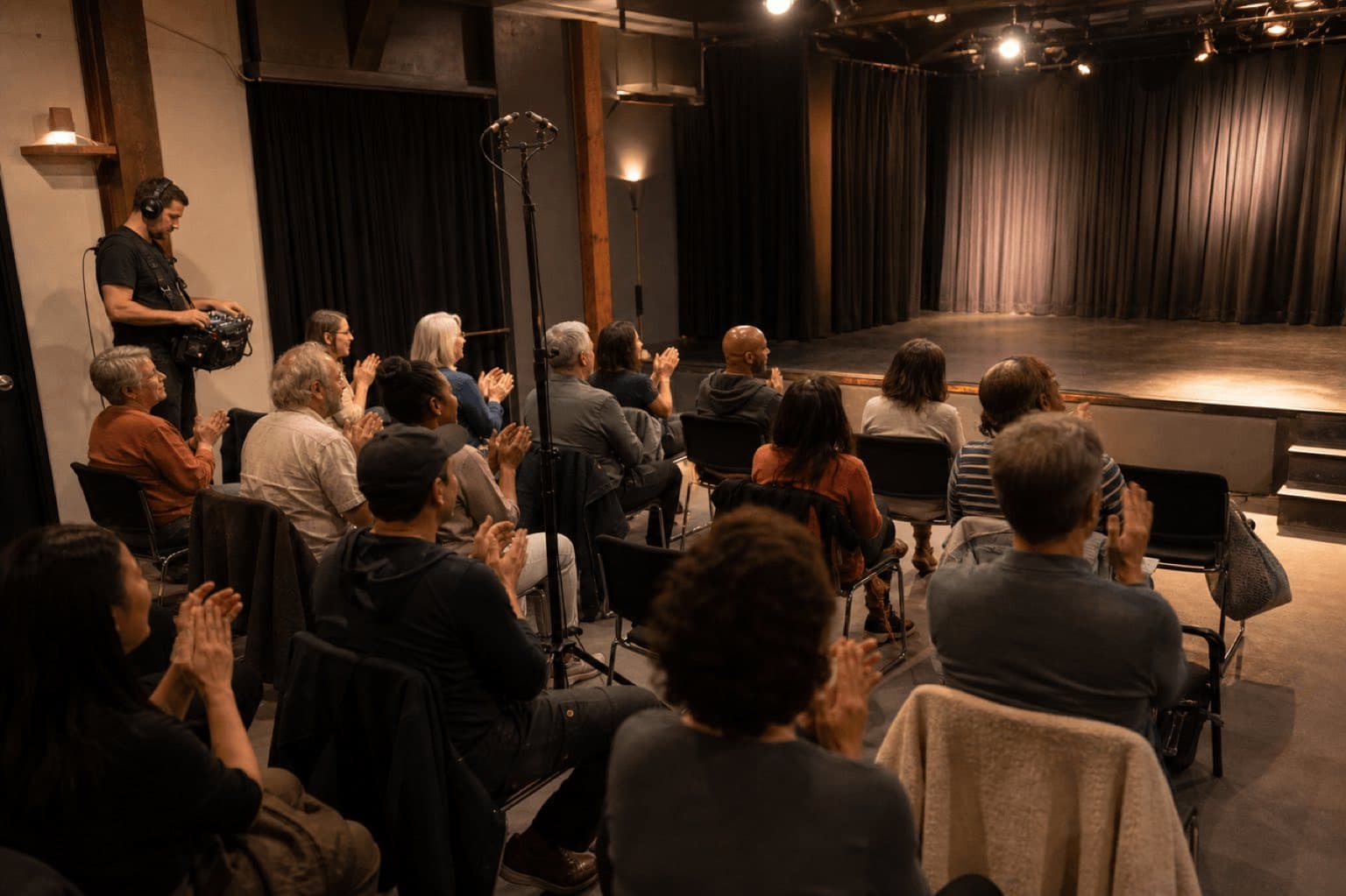
Sonilo publishes this guide and appears as an original sound-effects option. It receives no affiliate commission from cited sources, and no third party sponsored or reviewed the production advice. This is sound-design and general rights information, not legal advice.
Last verified: August 21, 2026. Product features, plan rights, platform policies, privacy requirements, and licenses may change. Verify current terms for the people, recording, and release.
Use applause only when the moment earns group recognition
| Scene or product moment | Starting direction | Common mistake |
|---|---|---|
| Small workshop presentation | 8–15 people, polite medium density, close dry room | Large theater tail |
| Conference speaker finishes | Medium crowd, coordinated start, restrained cheering, hall reflections | Instant full stadium peak |
| Theater curtain call | Broad audience, sustained waves, room bloom, optional isolated cheers | Perfectly even clapping loop |
| Product launch on stage | Audience response timed after reveal and presenter pause | Applause that starts before people understand the reveal |
| Private task completion | Ding or silence | Inventing a crowd that does not exist |
| Documentary footage | Use location sound when cleared, or a clearly designed response that matches reality | Changing the perceived public reaction |
Applause is narrative evidence: it tells the viewer that a group approved, appreciated, or acknowledged something. In factual work, adding it can alter meaning, so treat editorial truth as part of sound quality.
01
Six dimensions define the crowd
How many people
Small groups expose individuals; large crowds merge into a continuous texture with less local detail.
Polite to ecstatic
Hand intensity, rate, posture, voices, stomps, and duration communicate emotional commitment.
Sparse to continuous
Clap spacing and overlap determine whether the response feels tentative, settled, or overwhelming.
Dry to reverberant
Classrooms, studios, theaters, halls, and outdoor spaces produce different early reflections and tails.
Inside or outside
Audience-seat, stage, backstage, distant hall, and broadcast positions change balance and width.
How it develops
Onset, build, stable body, waves, and release make applause feel performed rather than switched on.
Write all six dimensions before choosing a sound. “Thirty-person theater audience, warm but not ecstatic, recorded from stage, 5.5 seconds with a quick rise and clean presenter re-entry” is a production brief; “big applause” is not.
02
Match the response to the space
Individuals remain audible
Use close hand transients, mild seat or clothing detail, short decay, and uneven timing. Too much stereo width makes a workshop feel fabricated.
Reflections support the body
Blend broad audience texture with hall response and occasional local claps. The decay should match the visible architecture.
Voices and scale dominate
Longer buildup, diffuse high-frequency texture, crowd voices, stomps, and large reflections may belong—but only when the picture proves the scale.
Less enclosed bloom
Perspective, barriers, PA spill, wind, and distant reflections matter more than a generic indoor reverb.
Do not add a hall impulse response to rescue a close small-group recording unless the target scene actually occupies that hall. The tail can be believable while the clap density remains wrong; room and crowd must agree.
03
Record a controllable applause group
- Obtain permission and explain the release. Tell participants what is recorded, how it may be used, whether voices are included, and how long files are retained.
- Choose a representative room. Record the acoustic you need or keep the space dry enough to design later.
- Set stereo plus safety capture. Use a stereo pair for width and a mono or narrower reference that survives downmix.
- Record energy passes. Polite, warm, strong, and ecstatic performances should differ in body and behavior—not only level.
- Record arcs. Quick start, slow build, stable sustain, waves, and natural release create edit choices.
- Separate voices. Capture hands-only first, then optional approved cheers, whistles, or calls as distinct passes.
- Capture isolated layers. Small subgroups, single claps, seats, clothing, and room tone help repair transitions without cloning the same crowd.
- Log every take. Note participant count, room, perspective, energy, arc, voices, microphones, take, consent record, and date.
Direct a performance without making it robotic
Give the group a reason and a cue, then let timing vary naturally. For a polite pass, ask for contained hands and no voices. For a warm pass, allow small tempo and intensity changes. For a large response, stagger subgroups or conduct waves rather than asking everyone to start at maximum level on the same frame.
04
Edit the applause as a four-part arc
Recognition
A brief reaction gap lets the achievement register before the first hands.
Build
Individuals join at different times; density and room energy rise.
Body
The stable section supports the visual, cutaways, or presenter pause.
Release
Density falls unevenly and the room tail clears the next line.
Mark the reveal, first visible clap, presenter pause, cutaway, and next spoken line. Move the onset a few frames in both directions and watch at normal speed. Applause that begins too early feels manufactured; applause that reaches full density instantly can feel like a button.
Loop without exposing the edit
Choose a stable middle section, avoid repeated identifiable cheers, and crossfade across several clap events rather than at a silent point. A loop should not create a new tempo, pulsing stereo field, or recurring “hero clap.” Keep separate onset and ending files so the final result retains a human arc.
05
Layer and mix without washing out the scene
Core hands
Provide density and rhythm. Control narrow transients that become tiring in headphones.
Room and distance
Establish scale and perspective without turning every venue into the same hall.
Voices and extras
Cheers, whistles, stomps, seats, and clothing add identity but must remain justified and cleared.
Editorial foreground
A few local claps can connect camera position; do not let one repeat reveal the loop.
- The crowd size agrees with the visible audience.
- Speech remains intelligible when it resumes.
- Mono keeps density without phase holes.
- Phone playback preserves hands without brittle highs.
- Room tail matches the visible or implied venue.
- Voices are intentional, cleared, and not falsely attributed.
- The loop has no repeated cheer or pulse.
- The final codec does not smear clap transients.
Use automation instead of crushing the whole crowd with compression. Pull the body under a presenter, preserve the visible front-row claps, and let the room decay naturally. Compare loudness-matched versions; a larger crowd should not win merely because it is louder.
06
Generate an applause sound effect with Sonilo
Use the exact Applause Sound Effect page for standalone audience variants. Use the broader Sound Effects workspace for coordinated hands, room, and optional crowd layers, or Video-to-SFX when the reveal, reaction, and next line determine timing. For a private completion rather than social recognition, use Ding or silence.
Original 4.2-second applause from twelve adults in a dry rehearsal room: warm medium energy, uneven natural onset after a short reaction gap, clear individual hand textures merging into a stable body, no cheering, whistles, stomps, voices, or stadium tail, gentle release with room tone.
Original 8-second theater applause heard from stage: 180-person audience, strong appreciative energy, 900-millisecond build, broad natural clap density, two subtle nonverbal cheers placed deep in the room, realistic hall bloom, no chanting, no celebrity name, no music, editable clean tail.
Generate controlled variants, level-match them, reject implausible room/crowd combinations or recognizable voices, and save prompt, output, date, account/plan, terms, edit, and export. Review commercial-use terms for the exact release.
07
Rights, consent records, and sources
A crowd behavior is not owned, but a particular recording and its production can be protected. The U.S. Copyright Office explains that sound-recording protection can cover the fixed series of sounds and production contribution. YouTube tells monetizing creators to secure commercial-use rights for every audio element. Keep participant releases when applicable, recording log or source URL, creator/account, license version and date, project/client/channel, edit session, and published export.
Sources
Sources
- U.S. Copyright Office: Sound Recordings.
- YouTube Help: content that can be monetized.
- Sonilo official: Applause, Ding, Sound Effects, Video-to-SFX, and Licensing.
Human review checkpoint: before publication, a named crowd-recording engineer or sound designer should repeat the group, arc, loop, perspective, mono, phone, and export tests; qualified privacy and rights reviewers should verify consent, voices, licensing, and commercial-use language.
FAQ
Frequently asked questions
Believable applause has a crowd size, enthusiasm level, clap density, room, microphone perspective, and time arc that agree with the picture. Variation between people matters more than simply making the file louder.
There is no universal duration. Start after the accomplishment is understood, reach the appropriate peak, and leave before it masks the next line or overstays the edit. Build editable handles rather than cutting a ring abruptly.
Yes, if the middle section has enough variation and the loop does not repeat identifiable cheers or create a rhythmic pulse. Crossfade at stable density and keep separate start and ending sections.
Only when the audience, event, and emotional intensity justify it. Voices make a crowd feel larger and more specific, but they also demand consent, rights, and intelligibility checks.
No. Applause implies social recognition by a group. A private completion, correct answer, or interface confirmation may need a restrained ding or no sound at all.
Only if the exact Sonilo plan and terms cover the intended release. Keep prompt, output, date, account or plan, terms record, edit, and published version.
Related
Keep reading
Make the reaction fit the room
Create applause with the right crowd, energy, and arc.
Describe size, venue, perspective, voices, duration, and release—then test it under the scene.