Sonilo publishes this guide and appears as an original sound-effects option. It receives no affiliate commission from cited sources, and no third party sponsored or reviewed the production advice. This is sound-design and general rights information, not legal, emergency, automotive, or stunt guidance.
Last verified: August 21, 2026. Product features, plan rights, platform policies, software behavior, and licenses may change. Verify current terms for the exact project.
Let the collision type specify the sound
| Visible event | Prioritize | Avoid |
|---|---|---|
| Parking-speed bump | Compact contact, plastic flex, short suspension settle | Huge metal crush and long debris |
| Side impact at medium distance | Readable impact, door/body deformation, sparse glass if visible | Close microscopic fragments |
| Vehicle scrapes a barrier | Initial hit, sustained metal friction, intermittent catches, final release | One isolated slam |
| Rollover | Series of changing contacts, body flex, glass/debris, sliding settle | Identical repeated hits |
| Distant off-screen collision | Softened core, environmental reflection, delayed secondary detail | Near stereo glass shower |
| Visible secondary fireball | Crash sequence plus separate explosion only if picture proves it | Turning every collision into a blast |
Write the event in one sentence before sourcing audio: “A compact sedan clips a concrete barrier 35 meters from camera, scrapes for 1.1 seconds, then stops off frame.” That brief is more useful than “epic car crash.”
01
Six stages make the event readable
Warning
Tire scrub, brake texture, horn, engine change, loose gravel, or sudden ambience reduction establishes danger only when the shot supports it.
First contact
The fastest transient marks the perceived collision point and gives the editor a precise sync anchor.
Deformation
Metal flex, plastic crack, panel buckle, frame groan, and low-mid crush explain mass and energy after contact.
Breakup
Safety-glass-like granules, lamp plastic, trim, gravel, and small metal pieces describe what separates.
Motion
Scrape, slide, rotation, suspension movement, tire drag, and repeated contacts show where the vehicle goes next.
Aftermath
Settling parts, alarm, steam-like texture, distant traffic change, room tone, or silence lets the audience absorb the result.
Not every collision contains all six. A light fender bump may need contact, flex, and settle. A rollover needs multiple non-identical contacts and changing perspective. Silence after the event can carry more emotional weight than adding another metallic hit.
02
Design contact and distance together
Close exterior
Detailed transient, recognizable materials, tire and suspension texture, short local reflections, and controlled low end. Avoid painful glass highs.
Inside the vehicle
Cabin resonance, seatbelt movement, interior trim, muffled exterior contact, body vibration, and character reaction may dominate over cinematic debris.
Medium street distance
Combine a readable contact core with reduced fine fragments, street reflections, and a slightly integrated body rather than separate close layers.
Far or off-screen
Soften high-frequency detail, narrow stereo, shorten or blur fragment definition, and let the environment locate the source.
Vehicle and obstacle materials matter. A plastic bumper against a post, steel door against another car, tire against curb, chassis against concrete, and underbody over gravel should not share one generic metal library file. Name both contacting surfaces and the movement after impact.
03
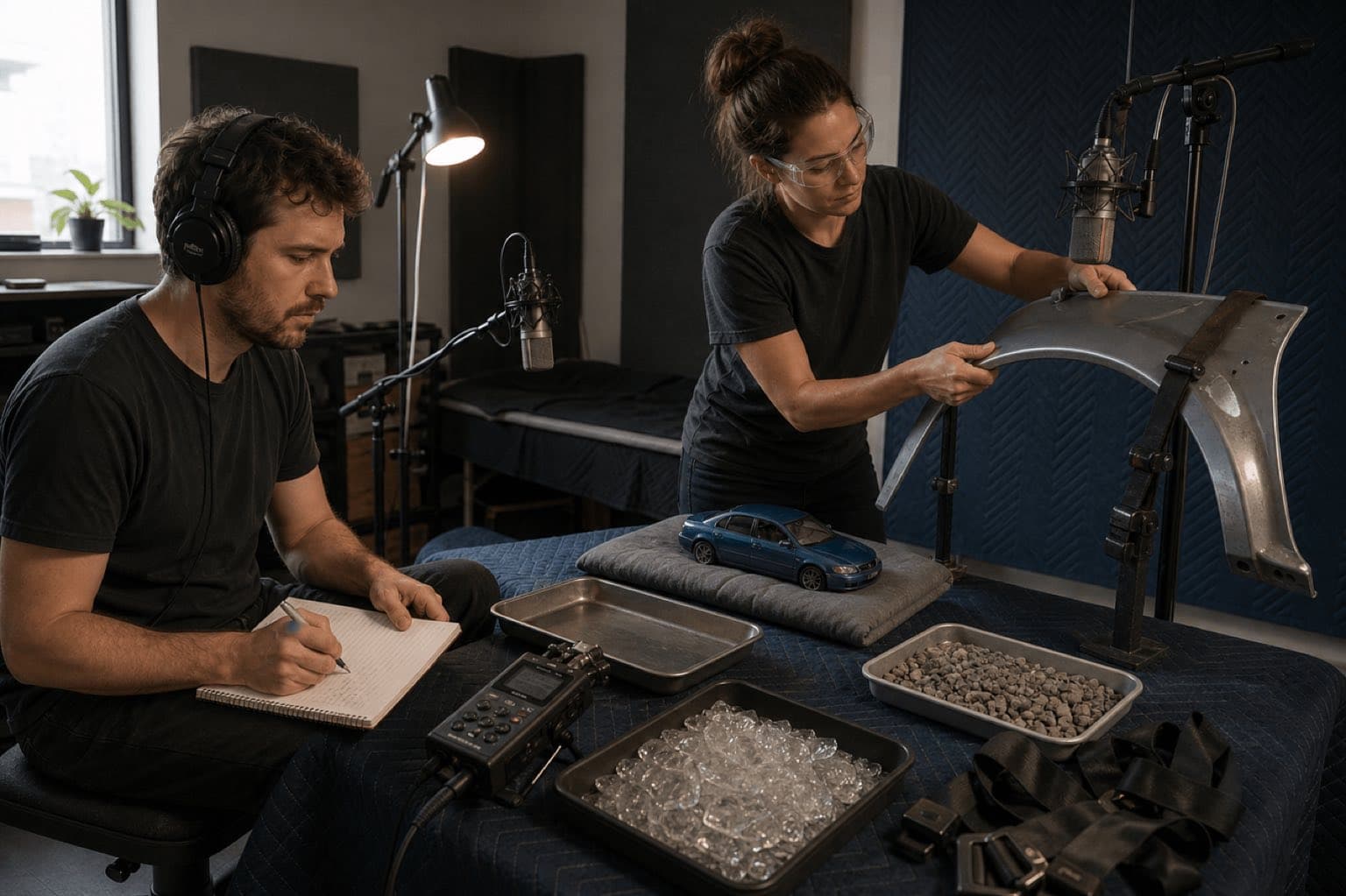
Create safe crash components in a studio
Padded bins and trays
Strike or drop only light, secured objects onto padded surfaces to capture compact hits without uncontrolled projectiles.
Secured lightweight panels
Flex old thin panels, baking trays, foil layers, or plastic sheets slowly with gloves and eye protection. Stop at sharp edges or structural instability.
Safe glass substitutes
Use contained acrylic fragments, ice alternatives, beads, pasta, gravel, or licensed glass recordings. Do not break windows or real glass for the tutorial.
Webbing and trim
Seatbelt material, padded upholstery, loose plastic, fabric, keys, and small compartments supply cabin detail.
Gravel and rubber
Drag weighted fabric, safe rubber pieces, or textured bags across controlled trays to suggest slide and tire scrub.
Settling objects
Release small metal, plastic, gravel, and restrained springs in stages so the tail feels causally connected.
Record every source light, medium, and firm; capture close and medium microphone positions; leave clean handles; and log prop, action, surface, distance, take, and date. The goal is a library of controllable components, not one dangerous “authentic” performance.
04
Build and sync the sequence
- Spot the picture. Mark warning, first contact, peak deformation, secondary contacts, vehicle stop, and aftermath.
- Build the contact core. Start with one transient and one body layer before adding fragments.
- Add material evidence. Choose only the metal, plastic, glass substitute, gravel, or interior detail that picture implies.
- Continue the movement. Shape scrape, roll, slide, suspension, or repeated contacts rather than ending at the first hit.
- Match perspective. Filter, level, early reflections, stereo width, and delay should describe camera position.
- Print variants. Short editorial, balanced realistic, and extended aftermath versions support comparison.
- Test the whole scene. Review lead-in, collision, reaction, next line, and repeated playback.
Move the first-contact core one frame earlier and later, then watch at normal speed. A visual flash, camera shake, and actual panel contact may occur on different frames. When an uploaded shot contains multiple contacts, Video-to-SFX is the most relevant Sonilo route because timing—not a standalone filename—is the primary problem.
05
Mix for force without sensationalizing harm
Preserve dialogue and reaction
Do not let broad metal noise erase the performance that gives the scene meaning.
Build phone-readable midrange
Low-frequency weight can support scale, but the core must remain understandable on small speakers.
Control glass and metal peaks
Narrow bright resonances become painful in headphones and accumulate quickly during repeated contacts.
Maintain hierarchy
First contact, largest deformation, and final stop should not all have identical peak level, width, and tail.
- Mono retains first contact and body.
- Fragments match visible materials.
- Stereo follows perspective rather than spectacle.
- Tail clears emergency dialogue or reaction.
- No layer implies fire or explosion without picture evidence.
- Repeated impacts change with angle and energy.
- Final codec preserves transients without pumping.
- The scene remains understandable at low monitoring level.
For documentary, news, education, or stories based on real events, review tone as carefully as technical quality. Reduce gratuitous detail, avoid using identifiable real distress as decoration, and make sure promotional copy does not promise “real accident audio” when the effect is designed or generated.
06
Generate car crash sound layers with Sonilo
Sonilo does not currently expose a dedicated Car Crash product page, so the honest workflow is to use Video-to-SFX for shot-led timing, Impact Sound Effect for the collision core, and the broader Sound Effects workspace for supporting variants. Use Explosion only when a separate visible blast actually occurs.
Original 3.0-second car collision heard from 30 meters on a dry city street: compact first impact, dense steel door and body-panel deformation, sparse safety-glass-like granules, short tire drag and suspension settle, two restrained street reflections, no explosion, no voices, no siren, no cinematic sub drop, clean aftermath.
Original 1.25-second interior car bump at parking speed: muffled exterior contact, plastic bumper flex, dashboard and seatbelt rattle, one loose item shifting, short cabin resonance, no breaking glass, no tire screech, no injury sound, no music, natural quiet ending.
Generate controlled variants, compare under picture at equal level, reject material or perspective contradictions, and save prompt, output, date, account/plan, terms, edit, and export. Review commercial-use terms for the intended release.
07
Rights, documentation, and sources
A collision event is not owned, but a particular recording or produced soundtrack can be protected. The U.S. Copyright Office explains that sound-recording protection can cover the fixed series of sounds and production contribution. YouTube tells monetizing creators to secure commercial-use rights for every audio element. Keep the recording log or source URL, creator/account, license version and date, project/client/channel, edit session, and published export.
Sources
Sources
- U.S. Copyright Office: Sound Recordings.
- YouTube Help: content that can be monetized.
- Sonilo official: Video-to-SFX, Impact, Explosion, Sound Effects, and Licensing.
Human review checkpoint: before publication, a named Foley artist or vehicle sound designer should repeat the material, timing, perspective, mono, phone, and export tests; qualified safety, ethics, and rights reviewers should verify recording boundaries and commercial-use claims.
FAQ
Frequently asked questions
A useful design can separate warning or tire movement, first contact, body deformation, glass or debris, continued vehicle motion, and aftermath. Use only the layers the shot and perspective support.
No. Glass should appear only when the picture or story supports window or lamp failure. For Foley, use safe substitutes or licensed recordings rather than breaking real glass.
Reduce near-field detail and high frequencies, narrow the perspective, keep the main impact readable, and let environment-specific reflections and delayed aftermath communicate distance.
Do not create a collision or approach an active accident scene for audio. Never obstruct emergency response or record identifiable distress without appropriate permission. Use controlled Foley, licensed assets, synthesis, or generation.
Impact is the contact core. A car crash usually needs a sequence around that core: warning, metal deformation, fragments, vehicle movement, and environmental aftermath.
Use Video-to-SFX when an uploaded collision shot should control timing, or generate impact and supporting sound-effect variants from a detailed description of vehicle type, contact, materials, distance, environment, duration, and exclusions.
Related
Keep reading
Build the collision around the cut
Generate layered crash sound that follows every contact.
Upload the edit, describe materials and distance, then compare controlled variants.