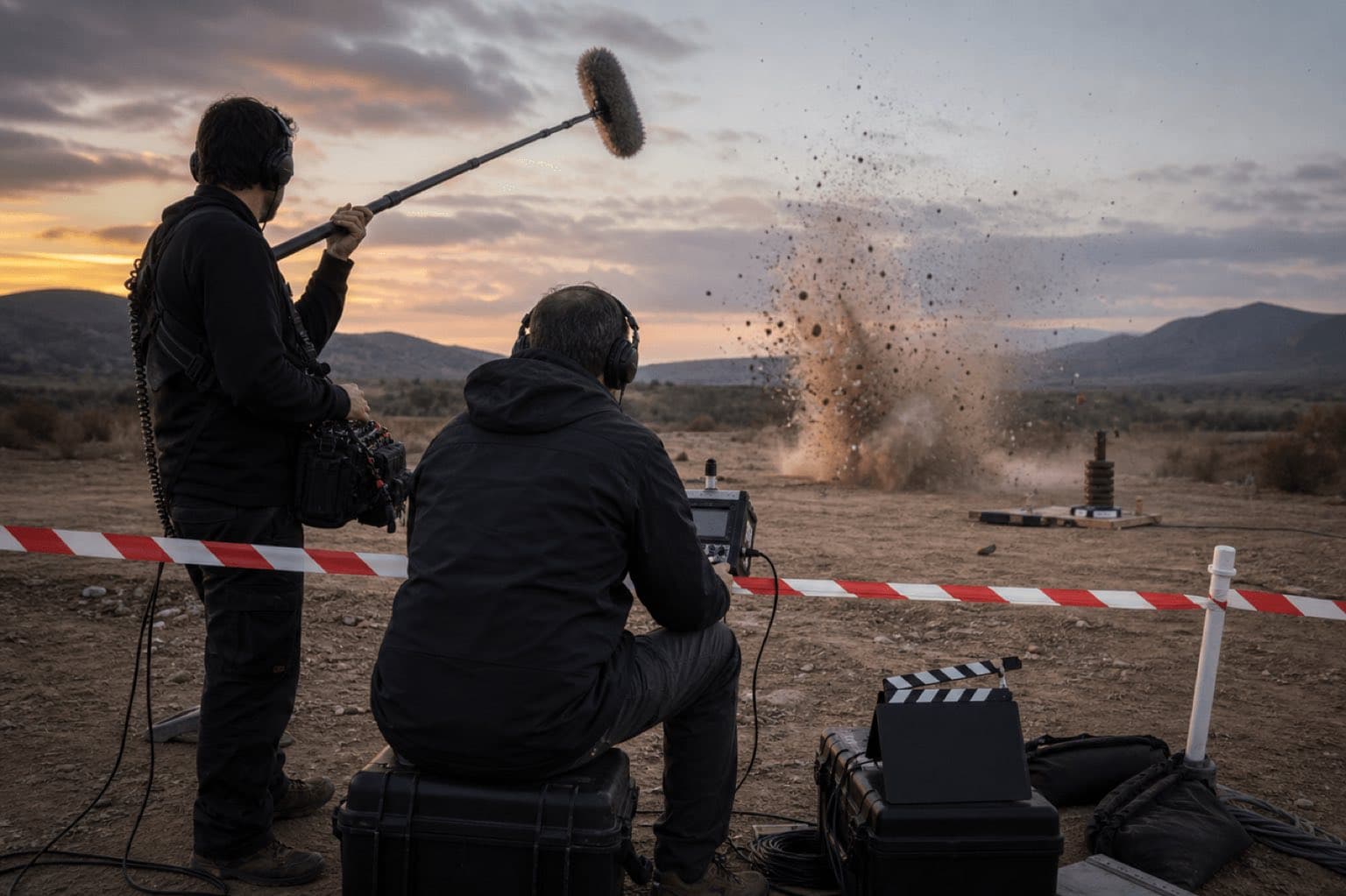
Sonilo publishes this guide and appears as an original sound-effects option. It receives no affiliate commission from sources mentioned, and no third party sponsored or reviewed the production advice. This is sound-design and general rights information, not legal or pyrotechnic guidance.
Last verified: August 21, 2026. Product features, plan rights, platform policies, and licenses can change. Check the current terms for the exact asset and release.
Choose the explosion from what the shot proves
| Visible event | Prioritize | Reduce or omit |
|---|---|---|
| Small enclosed device failure | Sharp crack, metal or plastic fragments, short room slap | Long cinematic sub tail |
| Vehicle blast at medium distance | Pressure body, metal debris, outdoor reflections | Close dry crack if camera is far away |
| Distant hillside event | Delayed arrival, broad low body, terrain echo | Detailed near-field fragments |
| Interior structural collapse | Dust, timber or masonry breakup, dense room decay | Clean open-air tail |
| Stylized game ability | Readable transient, controlled tonal identity, short tail | Realistic debris that obscures gameplay |
| Title or product reveal | Use an impact sound effect unless an actual blast is visible | Literal fire and debris |
The visual event is the specification. A huge library blast under a small spark creates accidental scale; a dry close crack under a distant fireball destroys perspective. If the picture only needs punctuation, an impact may be more honest and more effective than an explosion.
01
The six-layer explosion architecture
Crack
The fastest edge: ignition, rupture, electrical snap, or supersonic-like punctuation. It establishes timing more than size.
Pressure body
The dense midrange mass that lets the blast read on ordinary speakers. Shape it from the material and event, not from a generic boom.
Low weight
A controlled low-frequency swell suggests displaced air and scale. It should support the body, preserve headroom, and remain useful after phone playback.
Debris
Glass, dirt, metal, timber, masonry, or plastic tells the audience what broke. Its density and arrival pattern reveal distance.
Environment
Walls, streets, valleys, forests, and interiors answer differently. Reflections locate the event more convincingly than a generic reverb preset.
Aftermath
Dust fall, settling fragments, alarm, distant reaction, wind, fire texture, or sudden quiet carries the scene beyond the initial hit.
Solo each layer to identify its job, then judge only in context. If two layers perform the same function, keep the one that translates better. Polarity, phase, and timing offsets can erase the low body even when every solo sounds impressive. Check the stack in mono before adding more material.
02
Design scale, material, and distance together
Close and small
Favor a sharp source, brief body, identifiable fragments, and limited decay. Near perspective exposes texture and mechanical detail.
Close and large
Keep the transient readable but allow a slower pressure build, broad body, dense debris, and reflections that extend beyond the frame.
Distant and small
Reduce high-frequency detail, narrow the event, delay the arrival if the geography supports it, and let ambience remain dominant.
Distant and large
Use a softened attack, long low body, terrain or city reflections, and a debris impression rather than dozens of close fragments.
Material matters as much as size. A fuel-like cinematic blast, electrical transformer failure, collapsing wall, bursting tire, pressurized pipe, and magical energy event should not share the same debris vocabulary. Name the failing object and surrounding surfaces before selecting sounds. For storm-like low rumbles or long natural echoes, compare the design with a thunder sound effect so the explosion does not accidentally read as weather.
03
Sync the event to four picture moments
Cause
Ignition, collision, trigger, flash, rupture, or a visible object reaching its limit.
Pressure
The main body reaches the listener. Near shots may nearly coincide; distant shots may justify delay.
Breakup
Fragments, dust, glass, metal, or structure describe the event over tens or hundreds of milliseconds.
Reaction
Camera shake, character response, falling material, alarms, or ambience change closes the beat.
Mark these four moments in the edit before choosing files. Move the crack one frame earlier and later, then compare at normal speed. Do not automatically align every layer to the first white frame: motion blur, exposure, distance, and the viewer’s perceived contact can shift the convincing point. When timing must follow a specific cut, Video-to-SFX provides a more relevant starting route than generating an isolated cue and dragging it blindly.
04
Build one explosion without losing control
- Write a one-sentence brief. Name event, material, scale, distance, environment, dramatic function, and duration.
- Create a dry core. Combine crack and pressure body before adding low weight or reverb.
- Add one material family. Choose metal, dirt, glass, masonry, timber, or synthetic energy—not all of them.
- Build perspective. Filter, delay, level, early reflections, and ambience should describe camera distance.
- Add aftermath selectively. Let debris and decay bridge into the reaction without covering dialogue.
- Print three variants. Short/dry, balanced, and long/environmental versions make editorial comparison possible.
- Test in sequence. Review the preceding quiet, the blast, the next line, and repeated playback—not only the isolated effect.
Safe source ideas for designed layers
Paper bags, heavy doors, padded bins, dropped soil, gravel poured into trays, flexed sheet metal handled safely, low percussion, filtered noise, synthesized envelopes, and impulse responses can suggest components without recreating a dangerous event. Record at conservative levels with headroom. A limiter can protect monitoring, but it does not repair clipped source audio or replace hearing safety.
05
Mix for impact, intelligibility, and delivery
- The pre-blast moment leaves enough contrast for the hit to register.
- Dialogue and critical reactions remain intelligible.
- The midrange body survives phone and laptop playback.
- Low-frequency energy supports scale without consuming all headroom.
- Debris matches visible materials and does not become broadband hiss.
- Reverb describes the location and clears before the next important line.
- Mono playback preserves the main body and transient.
- Codec export does not smear the crack or pump the ambience.
Loudness is contextual. Pulling ambience or music down briefly may create more perceived force than pushing the blast into clipping. Use audio ducking as a starting control when dialogue or music needs space, then automate the actual transition manually. Compare at a comfortable monitoring level, a very low level, and on a small speaker. If only the subwoofer communicates size, the design is incomplete.
06
Generate an explosion sound effect with Sonilo
Use the exact Sonilo Explosion Sound Effect page for standalone blast variants. Use the broader Sound Effects workspace when the project needs several coordinated cues, or Video-to-SFX when an uploaded shot should control timing. Keep prompts physical and editorial instead of asking only for “epic.”
Original 3.2-second exterior vehicle explosion heard from 45 meters: brief softened crack, dense metal pressure body, controlled low weight, sparse sheet-metal and gravel debris arriving after the core, dry open-field perspective with one distant ridge reflection, no music, no voices, no gunshot character, clean tail.
Original 1.4-second electrical cabinet failure in a tiled service room: sharp insulated pop, compact midrange pressure, two light metal ticks and short tile reflection, no cinematic sub boom, no fire roar, no alarm, no recognizable franchise sound, hard clean ending.
Generate controlled variants, compare them under the shot, reject outputs with an implausible environment or recognizable resemblance, and save the prompt, chosen file, date, plan, license record, edit, and export. Review Sonilo commercial-use terms for the actual account and release instead of assuming that “AI-generated” means unrestricted.
07
Safety, rights, and source record
A downloaded effect is a sound recording, not a fact that becomes free because the underlying event is common. The U.S. Copyright Office explains that protection can cover the particular fixed series of sounds, including performance and production contributions. YouTube likewise tells creators to secure commercial-use rights for every audio element and distinguishes its own Audio Library from third-party files merely labeled “royalty-free.” Keep evidence for each source and ask a qualified reviewer about a specific release or jurisdiction.
| Record | Why retain it |
|---|---|
| Original filename and source URL | Identifies the exact recording or generated output. |
| Creator, library, or Sonilo account | Connects the asset to the party and plan used. |
| License or terms version and date | Shows which grant was relied on when the asset was obtained. |
| Project, client, territory, and channel | Tests whether the intended release falls inside the permission. |
| Edit session and final export | Preserves what was actually changed and published. |
Sources
Sources
- U.S. Copyright Office: Sound Recordings.
- YouTube Help: music and sound effects from the Audio Library.
- YouTube Help: content that can be monetized.
- Sonilo official: Explosion, Impact, Thunder, Sound Effects, Video-to-SFX, and Licensing.
Human review checkpoint: before publication, a named sound designer should repeat the layer, sync, mono, phone, and export tests; a qualified safety and rights reviewer should verify practical-recording language, licensing, and commercial-use claims.
FAQ
Frequently asked questions
A useful cinematic explosion often separates the initial crack, pressure body, low-frequency weight, debris, environmental reflections, and decay. Not every shot needs all six; use only the layers the picture can explain.
Usually test the crack on the perceived ignition or contact, then let the body and debris follow. For a distant event, delaying the sound relative to the flash can communicate distance, but the delay should match the story rather than a generic preset.
Increase contrast, extend the low body, widen the debris field, add environment-specific reflections, and create a short pre-impact quiet zone. Preserve headroom instead of clipping the master.
Do not create or approach explosive events for audio capture. Work only with licensed professionals on controlled sets, follow the safety officer, record from approved positions, or create the effect from safe Foley, licensed recordings, synthesis, or generation.
Only when your recording, library license, generated-output plan, and project terms cover the intended commercial use. Save the source, license version, plan, date, and final edit.
Describe the event, scale, materials, environment, camera distance, perspective, timing, duration, and exclusions. Use Sonilo Explosion Sound Effect for standalone variants or Video-to-SFX when the timing must follow an uploaded shot.
Related
Keep reading
Build the blast around the shot
Create an explosion with the right scale, distance, and tail.
Describe the event and environment, generate focused variants, then test them in the edit.