Comparisons
Top 5 AI Music Generation Platforms for Video Teams 2026
- Written by
- Sonilo Team
- Published

The handoff is where a music generator stops being just an app. One editor can remember why “final-v3-really-final.wav” was approved. A team needs that decision to survive a client revision, a staff change, and the next campaign.
For teams researching the best AI music generation platforms 2026, this comparison covers five platforms with current evidence of team, API, scale, or delivery workflows. The “best for” labels describe the strongest documented workflow fit—not a subjective ranking of music quality.
Disclosure: Sonilo publishes this guide and is included in the comparison.
Public product, pricing, API, and licensing pages were checked on July 23, 2026. Features, commercial terms, and availability can change. This article provides workflow information, not legal advice; current vendor agreements and publishing-platform rules remain controlling.
When a team needs a platform instead of a creator tool
My dividing line is simple: if the person generating the music can leave and the project still makes sense, you are building an AI music workflow. The durable system needs identities, job records, approvals, exports, rights evidence, and a clear owner after delivery.
A creator tool may be enough for one editor. A team needs more when it creates campaign variants, localizes cuts, delivers to clients, embeds generation in another product, or must later explain which soundtrack was approved under which account.
Current AI music generation platforms expose different pieces of that system. Your team may still need to provide storage, approvals, naming, and retention.
Top five platforms by team workflow
Each platform below has at least one verifiable team, API, batch, or delivery capability. The categories identify the strongest public evidence, not undisclosed enterprise features.
| Platform | Why it qualifies | Important boundary |
|---|---|---|
| Sonilo | Video-aware API, async tasks, usage endpoints, and enterprise workflow positioning | Public docs do not show a complete approval or asset-management system |
| Mubert | Company and customer identities, license objects, webhooks, track records, and a pre-generated Track Store | API pricing and deployment rights are contract-specific |
| ACE Studio | Team seats, centralized billing, shared credits, and timeline-based Video Composer revisions | Team plans do not by themselves prove a public Video Composer API |
| Stability AI Stable Audio | Managed API, self-hosting, enterprise support, and published model-license routes | It generates from text or audio rather than reading a finished video edit |
| SOUNDRAW | Multi-user API, public usage tiers, custom plans, and embedded generation | Teams must confirm which API license governs their exact deployment |
Platform 1: Best for edit-matched soundtracks — Sonilo
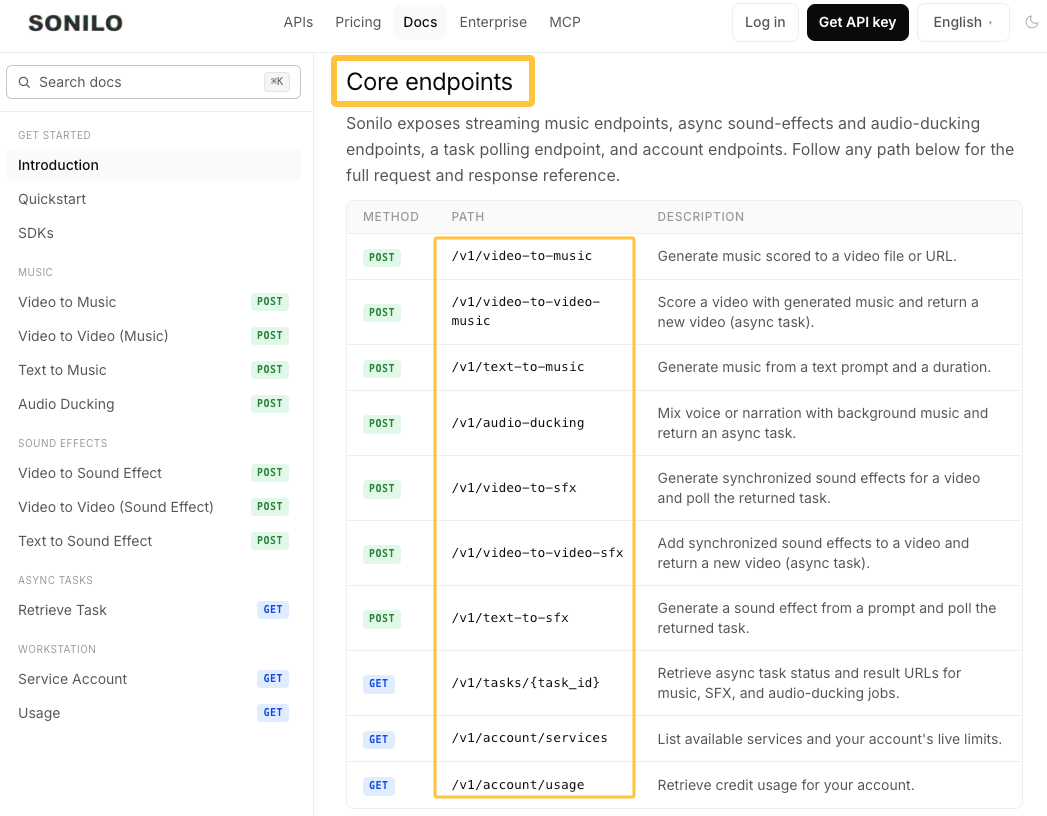
Sonilo earns this workflow label because its video music API accepts video input instead of asking the team to translate a locked edit into a text-only brief. The documentation covers video-to-music, scored-video output, audio ducking, streaming or asynchronous jobs, task polling, live service limits, and usage reporting.
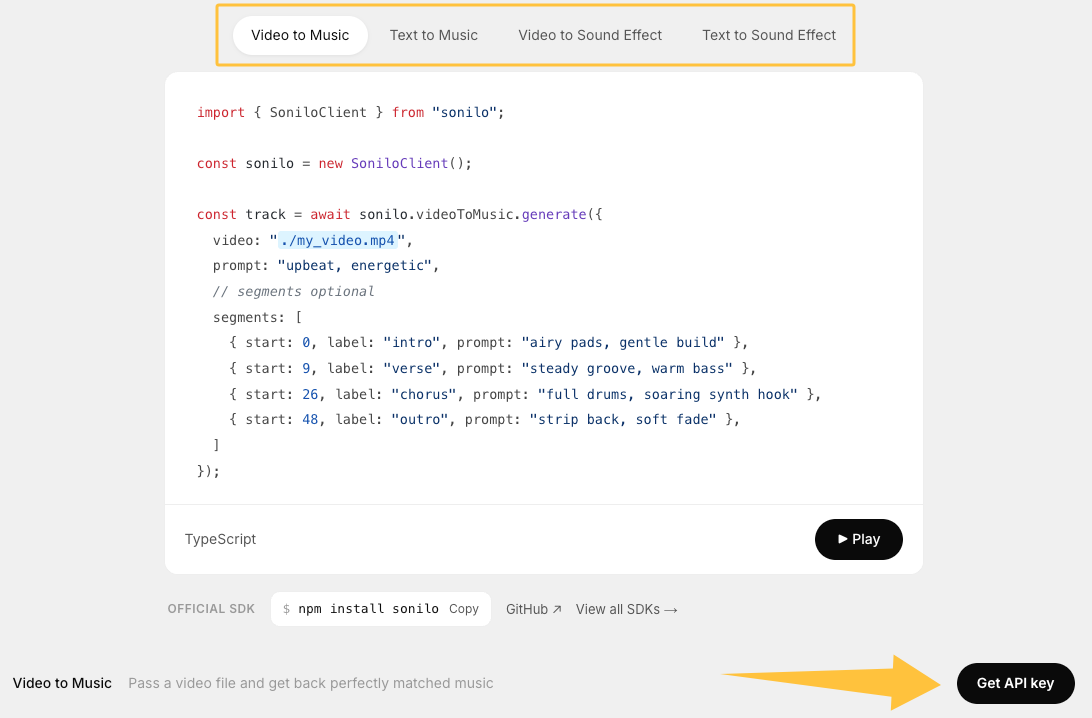
That makes it the clearest fit here for editors who already have a cut. The API returns job and result data; the organization still owns approval and storage.
The current Sonilo pricing page positions Enterprise for seats, custom credits, higher-volume production, procurement, and repeatable video workflows. Commercial use depends on the generating plan or enterprise agreement under the current Terms.
Platform 2: Best for API and batch workflows — Mubert
Mubert has the most explicit public batch-oriented building blocks in this group. Its API v3 documentation separates company and customer identities, exposes license and usage limits, supports webhooks, preserves track objects, and documents a Track Store that can buffer pre-generated music for faster delivery.
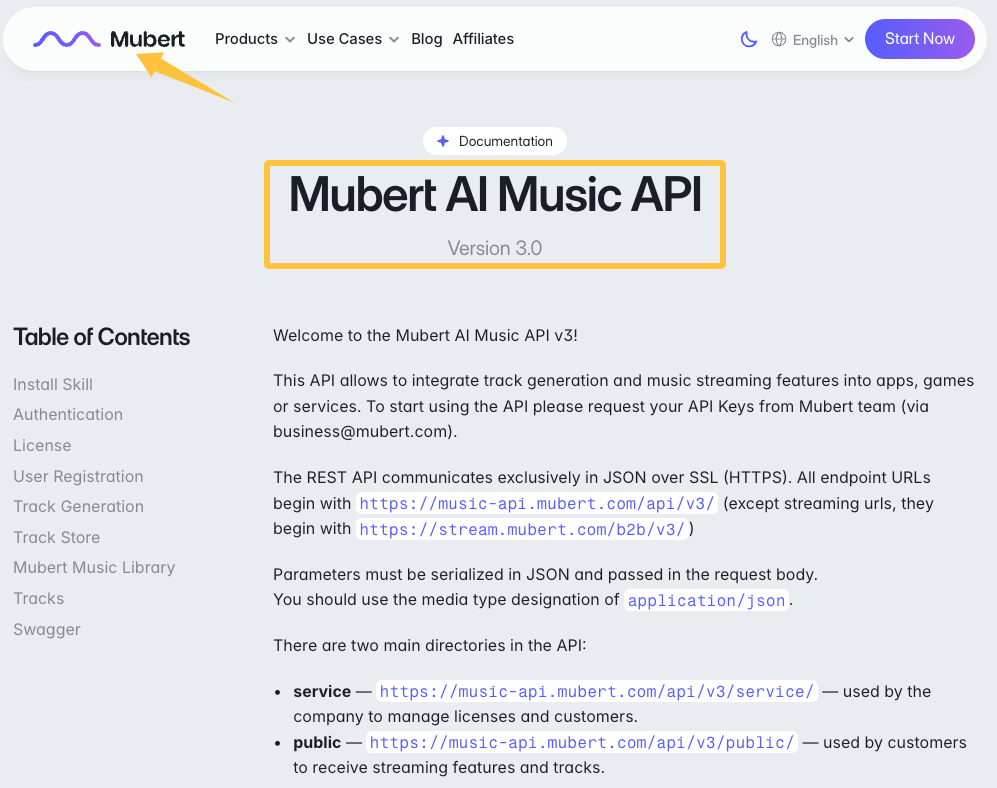
That structure suits an AI soundtrack platform serving many users or jobs. Its identifiers can map to internal projects, customers, requests, and costs.
Mubert does not publish a universal enterprise API price on the documentation page. Its current pricing entry directs product builders to discuss custom terms and limits, while downloads under Render include a plan-specific certificate. Confirm the API agreement and intended synchronization use separately from the consumer Render terms.
Platform 3: Best for team handoff and revisions — ACE Studio
ACE Studio combines team-account evidence with an editable delivery workflow. Its current pricing page says enterprise teams can add or remove seats, use centralized billing and admin controls, and share credits.
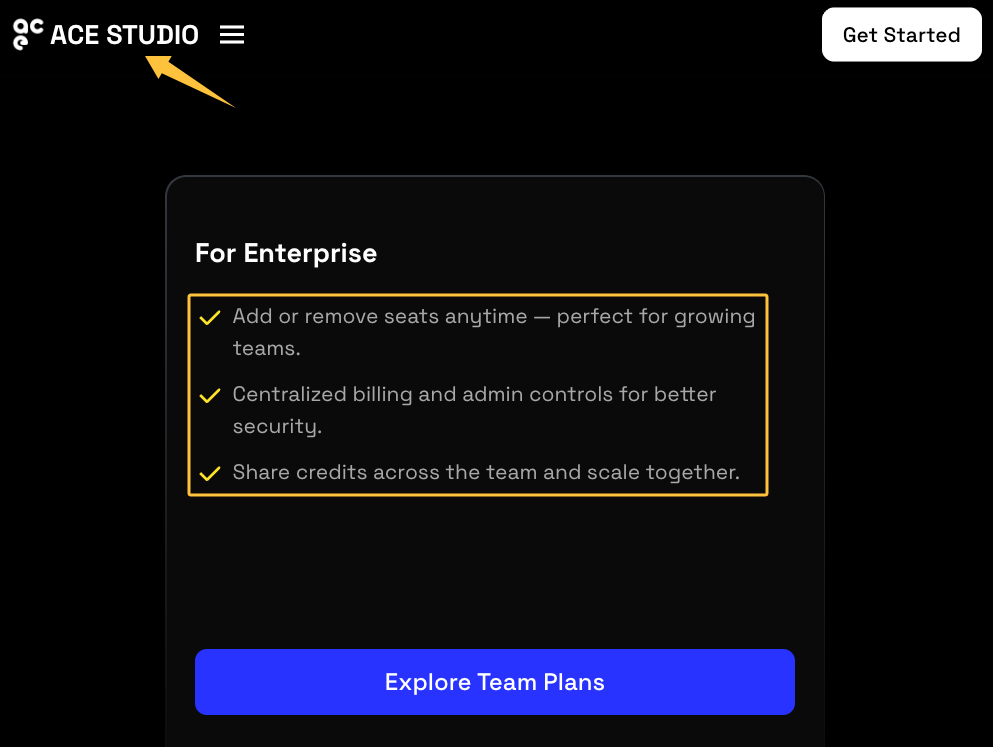
Inside the product, Video Composer analyzes imported video, places generated music or sound effects as editable timeline clips, and retains chat sessions for revisions. The source video, clips, and revision path can remain together.
The boundary matters. The public pages support team accounts and timeline revisions, but they do not prove a complete approval log or a public Video Composer API. Teams should test project transfer, seat removal, archived-session access, and export ownership before adopting it. ACE also maintains a feature-specific license page for Video Composer output and input responsibilities.
Platform 4: Best for rights and source documentation — Stability AI Stable Audio
Stable Audio stands out for publishing separate model, deployment, and license sources. The Stable Audio 3.0 overview describes managed API access, enterprise self-hosting, customization, and full-track generation. The model is prompt- or audio-led, so video teams must still fit its output to the edit.
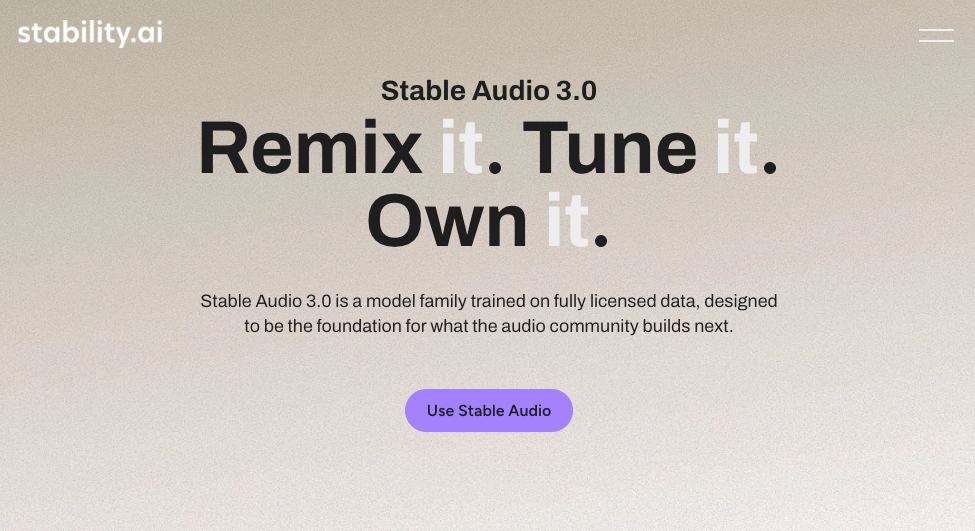
For adoption records, Stability AI provides a public license selector, a Community License route, an Enterprise route with custom pricing, and separate service terms covering the API and Stable Audio. Its current pages also describe enterprise support and additional protection subject to the applicable agreement.
The sources are easier to archive, not automatically suitable for every project. Record the model, deployment route, account, agreement, and intended use.
Platform 5: Best for scalable soundtrack output — SOUNDRAW
SOUNDRAW provides the clearest public capacity ladder among the embedded-generation candidates in this comparison. Its AI Music API page publishes entry and higher-volume plans, custom options, and explicit support for multi-user environments and scalable generation.

This suits video products, agencies, or creator platforms that need repeatable background-music output without routing every request through one editor's account.
Pricing is usage- and plan-dependent. Before adoption, confirm the current volume allowance, minimum commitment, output access, support level, and the API-specific license linked from the chosen plan. Keep that agreement with the general SOUNDRAW terms rather than relying on the product-page summary alone.
Compare the five platforms for team adoption
The five labels point to different starting advantages. The adoption decision still depends on what must remain traceable after generation.
Access and account structure
ACE Studio publicly documents team seats, centralized billing, admin controls, and shared credits. Mubert separates company credentials from customer identities, while Sonilo exposes account service limits and usage through its API. SOUNDRAW supports multi-user generation, and Stability AI offers managed or enterprise deployment routes.
None of that automatically creates an approval owner. Keep service credentials out of personal accounts, record who can revoke them, and store the final approval in a team-owned system.
API or batch generation
Mubert is the strongest documented fit for buffered or high-volume delivery because its API includes webhooks, track records, customer limits, and Track Store. Sonilo is more video-native, with streaming and asynchronous music, scored-video, SFX, and ducking jobs. SOUNDRAW and Stable Audio support programmatic generation at scale.
ACE Studio is the exception: its evidence is a team desktop workflow with editable delivery, not a public batch API. If automation is mandatory, obtain written confirmation before placing it on the engineering shortlist.
Export and version control
Version control begins with one rule: never overwrite an approved master with a new generation. Keep the raw output, edited master, mixed video, vendor job ID, source-cut version, prompt or parameters, reviewer, and approval date under one internal asset ID.
ACE Studio keeps revisions on a timeline. Sonilo and Mubert expose task or track identifiers that can feed a manifest. For SOUNDRAW and Stable Audio, the team should copy completed files and request metadata into controlled storage instead of treating the vendor account as the permanent archive.
Rights documentation
A licensed AI music platform needs more than a “commercial use” badge. The useful record identifies the account and plan, official terms URL, review date, enterprise agreement, intended use, and permission to provide every uploaded video or audio input.
The five vendors organize those sources differently: Sonilo separates use by plan; Mubert combines API license objects with contract-specific terms; ACE publishes a Video Composer license page; Stability separates community and enterprise routes; SOUNDRAW links API plans to deployment-specific license material. These are verification entrances, not legal conclusions.
What to verify before adopting a platform
Run the review with production, engineering, operations, and whoever owns commercial approvals. A successful demo should not replace the checks each group will face after launch.
- Confirm that the required endpoint, team plan, or delivery feature still appears in current official documentation.
- Test authentication, revocation, rate limits, concurrency, retries, failure records, and result retention.
- Map every vendor task or track ID to an internal project, source cut, requester, approver, and cost center.
- Verify export formats and decide where files and metadata move after generation.
- Review input handling, retention, confidentiality, and permissions before uploading client or unreleased footage.
- Save the applicable pricing page, license, terms, and enterprise agreement with the review date.
- Test the exit path without relying on one employee's account or undocumented vendor history.
For a video-native evaluation, teams can compare the same locked cut through Sonilo's API workflow and then score every candidate on fit, failure handling, export effort, record quality, and rights evidence. That is a more useful adoption test than comparing homepage demos.
FAQ
How should audio records transfer after team changes?
Store them in a team-owned repository rather than a departing employee's account. Transfer the asset ID, source-video version, raw and approved exports, prompts or parameters, vendor job ID, approval history, terms snapshot, and final usage locations. Reassign an explicit owner and test access before the person's last day.
What if a vendor page disappears later?
Keep a dated PDF or screenshot, original URL, plan name, contract, and any downloaded license certificate in the project record. The archive shows what the team reviewed; it does not independently determine legal rights. If the missing page affects a live campaign or client delivery, ask the vendor for current written confirmation.
How can old soundtrack decisions be traced months later?
Use one manifest or asset record linking the source cut, platform, prompt, task metadata, generated candidates, review comments, approved master, and release destinations. Stable IDs matter more than clever filenames. A future editor should be able to reconstruct the decision without searching private messages or guessing which “final” file won.
Who updates source records after a project ships?
Assign the task to a named asset owner—often production operations, the project producer, or the editor responsible for delivery. Finalize the record when the approved video ships, then update it if usage, ownership, or vendor terms materially change. “Everyone” is not an owner; put the responsibility in the release checklist.