Comparisons
Epidemic Sound Alternatives for Video Creators (2026)
- Written by
- Sonilo Team
- Published
The useful question is not which music platform has the longest feature list. It is which one removes the part of your soundtrack workflow that currently costs the most time or creates the most uncertainty.
That is how to choose an Epidemic Sound alternative in 2026. A searchable stock catalog, a project-level licensing service, a free creator library, and a video-first music generator can all be alternatives—but they solve different problems. For promotional cuts that need a spotting map, dialogue pockets, and a clean button, use the trailer music selection and licensing guide.
Disclosure: Sonilo publishes this guide and is included as one of the options discussed. Competitor features and licensing information were checked against the cited official pages on July 21, 2026. Terms can change, so verify the current agreement for your plan and project before publishing. This guide is not legal advice.
Quick verdict: what counts as a real alternative
A real alternative should replace the part of Epidemic Sound you actually use. If your routine depends on searching by mood and downloading established tracks, compare other catalog subscriptions. If you deliver client campaigns, compare license ownership, proof of license, and permitted media before comparing music.
The practical shortlist looks like this:
- Artlist combines stock music with other creative assets.
- Soundstripe emphasizes client-project documentation and multiple licensing routes.
- Musicbed fits curated artist music and project-level selection.
- Uppbeat and YouTube Audio Library serve budget-sensitive workflows with usage conditions to check.
- Sonilo generates a soundtrack from the finished video instead of starting with catalog search.
None is a universal winner. The right Epidemic Sound alternatives are the ones that cover your actual distribution, client relationship, search behavior, and editing process with the least avoidable friction.
Why video creators look beyond stock libraries
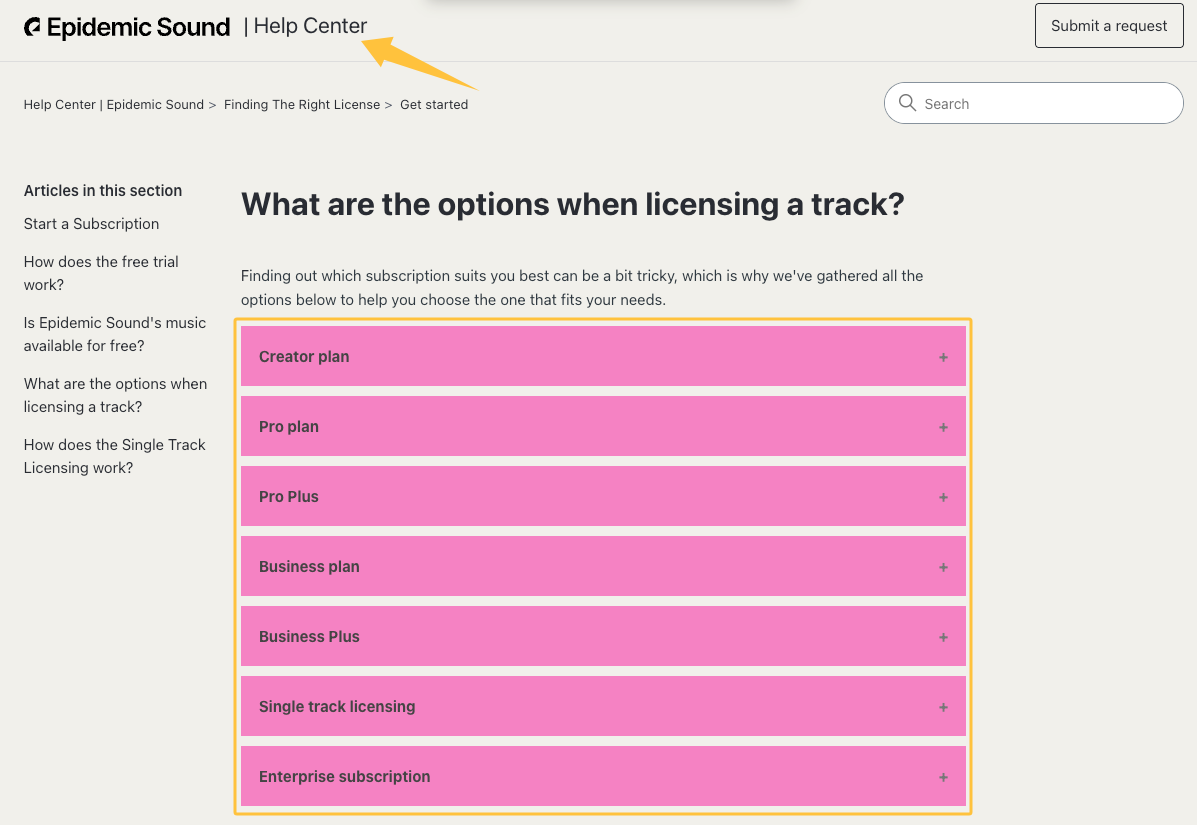
Epidemic Sound remains a capable reference point. Its current official licensing options include Creator, Pro, single-track, and Enterprise routes for different uses. Its help center also explains channel safelisting and publication timing.
Creators still look elsewhere because “find licensed music” is not one job. Weekly channel uploads, client paperwork, and a finished cut with unusually specific timing create different buying requirements.
Filters can narrow a catalog, but candidates still need to be auditioned against the edit. A track may have the right mood yet build too early, crowd voiceover, or end before the final visual.
Licensing creates a different type of friction. The relevant question is not whether a service uses the phrase “royalty-free.” It is whether the selected plan covers the licensee, client, platform, monetization model, advertising use, territory, and publication timing involved in that project.
This is why stock music alternatives should not be judged on catalog presentation alone. The alternative must fit the handoff and release workflow as well as the creative brief.
Compare alternatives by workflow, not just catalog size
Catalog size is easy to market and difficult to translate into editing value. A smaller, more relevant search result can be faster than a larger set of near-matches. A generated soundtrack can remove search but introduce a different review process.
Use the following four workflow tests before changing platforms.
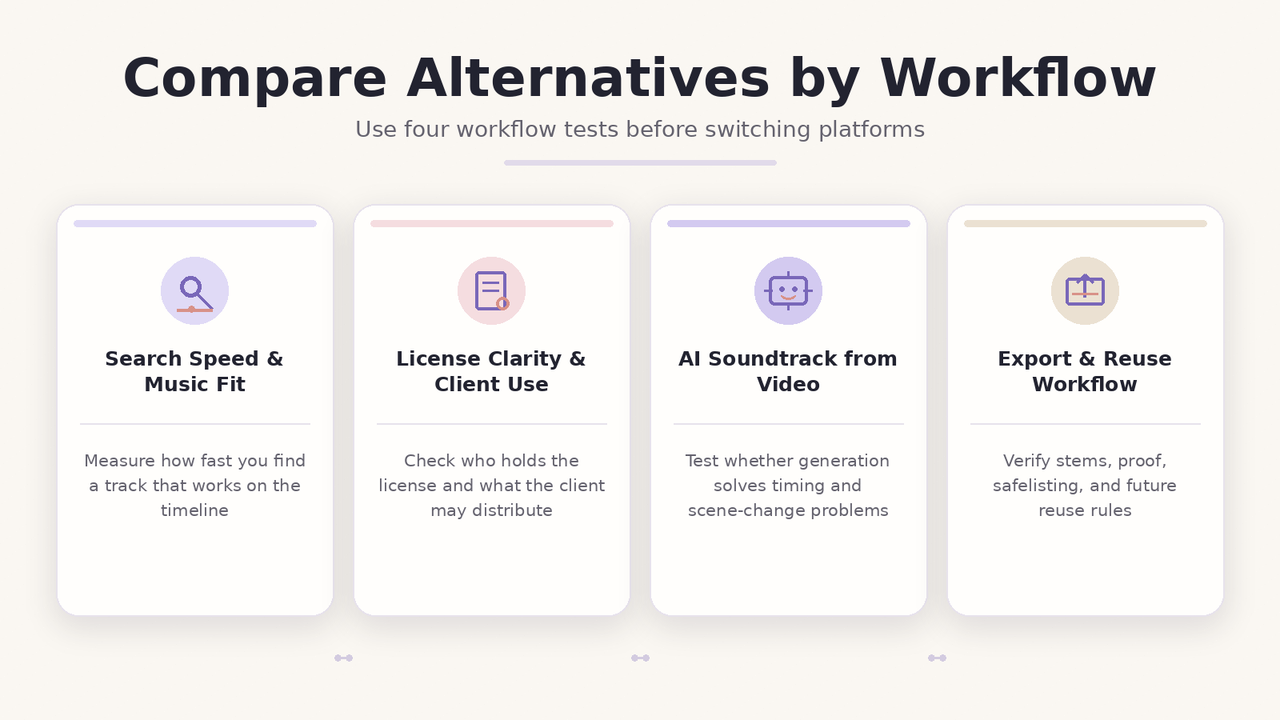
Search speed and music fit
Run the same real brief through every catalog candidate, then record how many tracks you preview before finding one worth placing on the timeline.
These catalog tools begin with existing music, but their discovery experience differs. Compare filters, collections, related-track discovery, alternate versions, and the ease of testing a preview. More results do not necessarily mean a faster decision.
Fit should be judged against the complete timeline. Check whether the track supports the opening, leaves space for speech, reaches key moments at usable points, and gives you an ending you can edit cleanly. Search speed without timeline fit simply moves the work into trimming and rearranging.
License clarity and client use
For client work, identify who holds the license and what the client receives. The current Soundstripe client-project guidance says that, under a plan covering the intended use, the creator retains the license while the client may use the delivered project as permitted by that license. It also recommends downloading proof of license. Other services may assign or document rights differently.
Artlist's current Pro License says a client can use a project created under the license, while also directing business creators to check whether a Business license is required. Musicbed's licensing overview describes both subscriptions and single-song licensing, with a single-use license tied to one song in one edit of one video.
These differences matter more than a generic “commercial use” label. Ask whether the plan covers client work, paid advertising, broadcast, multiple channels, subcontractors, and the client's continued distribution. Save the agreement and project-specific proof available at the time you license the music.
AI soundtrack generation from video
AI soundtrack tools change the first step. Instead of searching an existing catalog, the editor supplies a video or creative direction and reviews newly generated music. This can be useful when exact duration, scene changes, reveals, or voiceover space are the main obstacles.
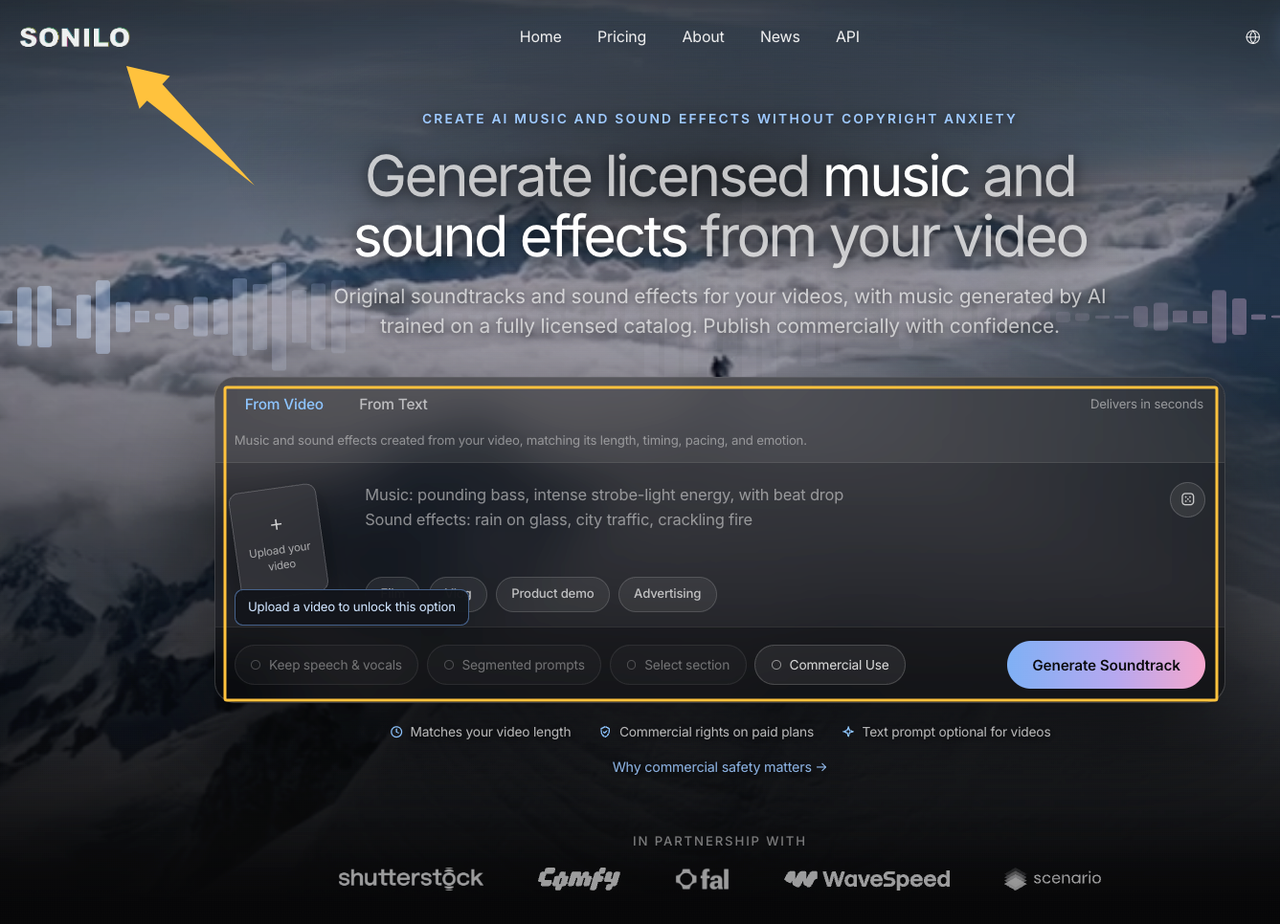
According to Sonilo's current product page, its workflow is designed to read an uploaded video's cuts, pacing, and scene changes, then generate music around key moments. That makes it a workflow alternative for editors whose problem is track-to-timeline fit, not evidence that stock libraries are obsolete. See the frame-synced soundtrack workflow for the timing-specific route.
Generation still requires review. The editor must judge musical quality, emotional framing, mix space, repeatability, export options, and the applicable license. A stock track may remain the better choice when a client wants a recognizable artist-led style, when the same approved cue must support a campaign family, or when stakeholders need to audition fixed options before the edit is locked.
Sonilo's licensing page identifies Pro, Premium, Enterprise, and eligible API users as the commercial-use routes for monetized YouTube videos, ads, and client work, subject to the current Terms and applicable agreement. Free and Creator are personal and non-commercial only. Check the plan under which the output was generated; paying for access alone is not a blanket commercial license.
Commercial-use permission is different from output ownership and copyright protection. Under Terms section 6.1, Sonilo assigns any rights it may hold in output generated for your account, subject to the Terms, applicable law, and plan restrictions. This does not guarantee that AI-generated output is copyrightable, exclusive, or cleared of third-party rights. Sections 7.7 and 8.2 explain the limits; output rights are not ownership of the underlying training catalog or models.
For training-source context, Sonilo's Shutterstock partnership announcement describes using professionally licensed music for model development. That source relationship is separate from the permission to publish a generated soundtrack: evaluate the licensing page and the terms for your output, rather than treating a training-data partnership as clearance for every project.
Before submitting uploaded client material, review Sonilo's Terms of Service and Privacy Policy. You need the permissions required for the footage and other inputs. The Terms also describe use of content for model improvement, subject to applicable product settings, plan terms, or a separate written agreement. Keep the relevant terms and generation records with the client project.
Export and reuse workflow
Test what happens after you choose the music. Does the service provide alternate mixes, stems, cut-downs, loopable sections, or only a finished file? Can you retrieve the license record later? Does channel safelisting happen automatically, manually, or per video?
Reuse needs particular attention. “Downloaded during a subscription” does not always mean “available for any future project.” Epidemic Sound's current safelisting guidance says content published during an active subscription remains cleared, while new content cannot be posted with its music after expiration. Other services define publication and reuse differently.
Also test the handoff: proof of license, shared access, file naming, and a record of which track appeared in each campaign. Good music licensing alternatives make those steps visible rather than leaving them to memory.
Best-fit categories to compare in 2026
The table below is a routing guide, not a ranking. Each official page should be rechecked for the exact plan and use case before purchase.
| Category | Representative options | Best fit when | Verify before choosing |
|---|---|---|---|
| Broad stock and creative-asset ecosystem | Artlist license | You want music alongside other production assets and prefer one discovery environment | Which license applies to personal, client, business, or organizational work |
| Client-oriented catalog licensing | Soundstripe client licensing | You deliver projects for clients and value downloadable proof plus plan-specific coverage | Who retains the license, what the client may distribute, and whether the intended promotion is covered |
| Curated or project-level music licensing | Musicbed licensing options | One carefully chosen artist track or a one-off project matters more than frequent downloads | Whether subscription, single-use, custom, or separately negotiated rights fit the release |
| Free or freemium creator library | YouTube Audio Library and Uppbeat User Agreement | Budget is limited and the publishing workflow matches the library's platform and attribution rules | Attribution, plan eligibility, channel safelisting, client use, paid promotion, and off-platform distribution |
| Video-first generated soundtrack | Sonilo video-to-music | The finished edit needs music shaped around its timing, cuts, and key moments | Output review, export needs, plan coverage, client rights, input permissions, and current data-use terms |
This category view is more useful than asking which service is closest to Epidemic Sound in every feature. Artlist and Soundstripe may be closer music for video creators comparisons at the catalog-workflow level. Musicbed changes the selection and licensing emphasis. YouTube Audio Library and Uppbeat change the budget tradeoff. Sonilo changes how the soundtrack is created.
You may need more than one route: a catalog for recurring formats, a single-song license for a flagship campaign, and generated music for timing-specific edits. Buy for the project mix rather than forcing every video through one source.
What to verify before switching tools
Run a real project from brief to publication before switching, and verify the following:
- Licensee: Is the account holder, employer, agency, or client the licensed party?
- Project scope: Does the license cover one edit, multiple versions, a campaign, or reusable channel content?
- Distribution: Are monetized channels, paid ads, client websites, broadcast, events, and cross-platform reposts treated differently?
- Timing: Must the project be downloaded, created, licensed, or published while the subscription is active?
- Clearance: Is attribution, channel safelisting, video registration, or a claim-dispute code required?
- Handoff: Can you save and share a project-specific license or proof of coverage?
- Editing assets: Are stems, alternate mixes, clean endings, and preview files available when revisions arrive?
- AI terms: For generated music, what rights attach to the output, what permissions are required for uploaded inputs, and how may those uploads be stored or used?
Keep a dated copy of the relevant terms with the project record. Recheck the live page when the plan renews, the client changes, or the distribution expands. A license that worked for an organic channel upload may not answer a later question about paid media or a different platform.
FAQ
Is a free alternative enough for client videos?
Only when the current license explicitly covers the client, intended media, monetization, and any required attribution. Free access alone proves nothing about commercial permission. Check who holds the license and whether paid promotion or off-platform use is allowed; if the language is unclear, obtain written clarification or choose coverage designed for client work.
Can AI soundtrack tools replace stock libraries?
They can replace stock search for projects where timing, scene changes, and exact duration are the main problems. They do not eliminate the need for creative and licensing review, and they may not suit campaigns that require a fixed approved track or artist-led selection. Many creators will use generated and stock music for different jobs.
How often should licensing terms be rechecked?
Recheck before licensing a new client project, changing plans, renewing a subscription, expanding distribution, or reusing music in a new edit. Also check after a service announces licensing changes. Save the dated terms and proof attached to each project rather than assuming that today's agreement matches a download or publication from another year.
What should YouTube creators compare first?
Start with channel clearance and monetization: attribution requirements, safelisting, Content ID handling, the number and ownership of covered channels, and what happens after cancellation. Then compare search speed and fit. YouTube's own Audio Library has track-specific attribution information, while third-party services require their current license and clearance process to be checked separately.