Sonilo publishes this guide and appears as an original SFX option. It receives no affiliate commission from tools or platforms mentioned. No third party sponsored, approved, or reviewed the techniques. This is production and rights guidance, not legal advice.
Last verified: August 21, 2026. Sonilo features, plan rights, platform policies, and third-party licenses change. Review current terms for the exact asset and release.
Choose the effect from the joke—not the other way around
| Comedy need | Sound strategy | Example |
|---|---|---|
| Make something feel smaller | Understate scale | Tiny click after a giant fall |
| Make something trivial feel enormous | Overstate scale | Trailer impact for closing a lunchbox |
| Stop the setup | Interrupt rhythm | Dry scrape, brake, or record scratch |
| Expose awkwardness | Remove expected sound | Room tone followed by one chair squeak |
| Reward a reveal | Clean positive punctuation | Ding, small bell, or two-note chime |
| Land physical comedy | Readable contact plus texture | Soft body thud with rubber squeak |
| Escalate repetition | Repeat with one changing variable | Same pop, then higher, then absurdly small |
Do not add a funny sound merely because an effect is popular. If picture, performance, and edit already communicate the beat, the funniest decision may be silence. Compare with and without the cue before polishing it.
01
Five comedy mechanisms you can hear
Sound and picture disagree
A delicate ping for a bodybuilder’s effort or a massive cinematic hit for a paper cup creates a scale contradiction the viewer resolves instantly.
The rhythm breaks
A scratch, cutoff, mute, squeak, or abrupt ambience change stops the expected flow and tells the audience to reassess the scene.
A rule forms, then changes
The first cue establishes a pattern, the second confirms it, and the third changes pitch, timing, material, or scale.
The reaction arrives late
A tiny wobble, object settle, or distant crash after the main event lets the audience register the action before supplying a second beat.
Expected sound disappears
Dropping music and effects to quiet room tone can expose a stare, failed reveal, or social mistake more effectively than another punch.
These mechanisms are editorial, not universal formulas. Comedy depends on character, power, culture, genre, and context. Avoid effects that turn disability, accent, body type, ethnicity, or real distress into the punchline. The cue should clarify the constructed joke, not target a person’s identity or harm.
02
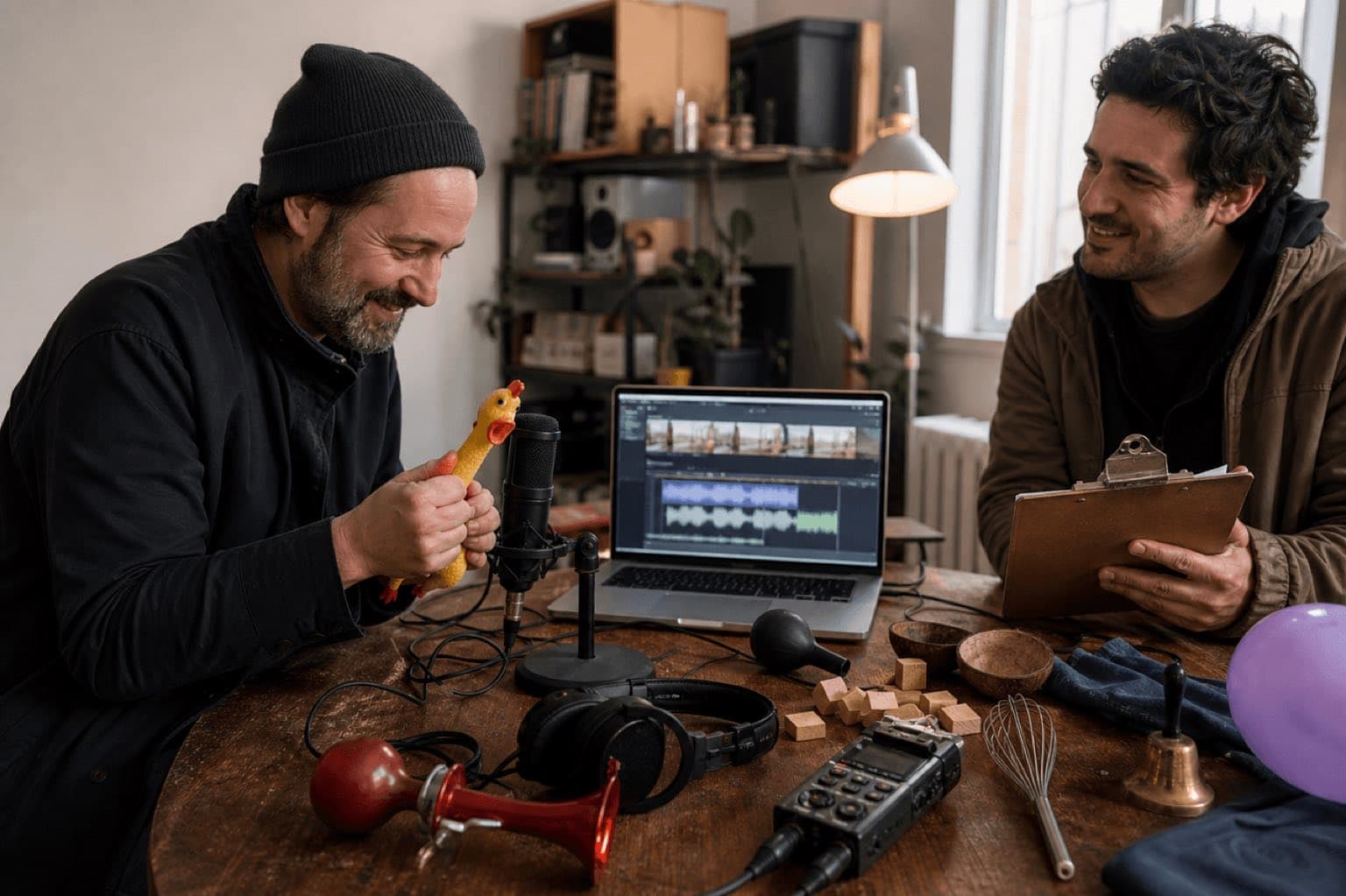
A 12-object home Foley lab
Rubber squeaky toy
Short pressure releases for slips, compression, surprise, or tiny creatures.
Balloon
Stretch, rub, deflate, or tap for tension, wobble, loss of confidence, and soft pops.
Spring doorstop
Pluck near and far for elastic error, reset, confusion, or delayed aftershock.
Cardboard box
Soft body impacts, collapses, hollow knocks, and lightweight falls.
Metal tray
Bright reveal, clang, overstatement, messy collision, or shortened ring.
Kitchen whisk
Wire vibration, small boing, scrape, and delicate mechanical failure.
Wooden blocks
Readable clicks, stacking, toy-scale impacts, and controlled rhythmic patterns.
Paper bag
Crush, inflate, slap, rustle, and pop with a deliberately cheap texture.
Bicycle horn
Classic punctuation; use sparingly and vary distance to avoid stock-cartoon cliché.
Hand bell or glass
Success, realization, sparkle, tiny ceremony, and clean UI-like feedback.
Fabric and towel
Muted falls, body movement, failed flourish, drag, or soft landing.
Keys and cutlery
Small chaos, nervous handling, dropped plans, and busy-but-low-stakes accidents.
Record useful variants
For every object, capture light, medium, and heavy performance; near and medium microphone distance; single event and three-beat sequence; dry take and natural room take. Leave two seconds of silence around each performance and record thirty seconds of room tone. Name the object, action, surface, perspective, intensity, take, and date.
03
A three-part timing model
Prepare
Let the setup become clear. If needed, create anticipation with a tiny pause, inhale, reverse, or movement cue.
Land
Place the main transient on the perceived contact, cut, look, caption, reveal, or realization—not automatically at the clip start.
Release
Choose a short stop, an awkward hang, a wobbling afterbeat, or a bridge into the next scene.
Move the cue one frame earlier and later, then judge at normal speed. A slow attack may make a correctly placed file feel late; trim the front or choose a sharper take before shifting everything. Leave enough tail to communicate material, but do not let the tail cover the next line.
| Problem | Try first | Avoid |
|---|---|---|
| The joke feels announced | Remove anticipation or shorten the rise | Making the cue louder |
| The impact feels late | Inspect attack and peak; trim pre-roll | Blindly dragging the file early |
| The reaction ends too soon | Add a small delayed settle or room event | A long generic reverb |
| The third repeat is flat | Change one variable: pitch, scale, spacing, material | Stacking every possible layer |
| Dialogue loses the punchline | Shorten, notch, or move the cue | Broadband compression on the whole mix |
04
Build escalation without becoming noisy
- Establish one rule. Use the same basic cue for the first appearance.
- Confirm it. Repeat close enough that the viewer recognizes the relationship.
- Change one dimension. Pitch, duration, distance, material, timing, size, or number—not all at once.
- Reserve the largest contrast. The final beat needs somewhere to go.
- End the pattern. A fourth repetition often needs a new consequence or silence.
First failed button press: dry small click. Second: same click plus short spring wobble. Third: silence on the press, then a distant heavy mechanism powers down half a second later.
For looping short-form video, check the boundary from last frame back to first. A tail that crosses the loop can either create a deliberate cycle or reveal an ugly cut. Export and watch several repeats; fatigue appears later than the first preview.
05
Mix funny effects without tiring the viewer
- Speech and the performer’s natural reaction remain intelligible
- Bright horns, bells, and squeaks are controlled for repeated playback
- Low impacts contain enough midrange to read on phones
- Only hero cues receive maximum contrast
- Ambience or room tone prevents sterile gaps
- Mono playback does not cancel wide designed layers
- Platform encoding does not smear tiny transients
- First and last frames remain clean when the video loops
Use audio ducking when voice needs space, but review every transition manually. The broader sound effects guide covers spotting, layering, perspective, and delivery; the meme sounds guide covers platform and copyright risk.
06
Generate original funny sound effects with Sonilo
Start at Funny Sound Effects when you need a standalone comedic cue. Use record scratch, ding, impact, or whoosh when the editorial function is already clear. Use the broader SFX hub or video-to-SFX workflow when timing should follow an uploaded edit.
Original 1.2-second comedy cue: a small cardboard object compresses with a soft rubber squeak, followed 250 milliseconds later by one delicate spring wobble; close dry perspective, playful but not childish, no voice, no melody, no recognizable cartoon or meme sound, clean ending.
Original sound for a tiny plastic lid closing as if it were an enormous industrial machine: brief metal latch, restrained low mechanical body, one short air release, no trailer music, no alarm, complete by 1.6 seconds.
Generate focused variants, compare them against the picture, reject recognizable resemblance or physical impossibility that hurts the joke, and check commercial-use terms. Save prompt, output, plan, edit, and approved export.
Sources
Rights, sources, and editorial limits
- YouTube Help: common copyright myths and reused-content monetization.
- TikTok: commercial use of music.
- U.S. Copyright Office: sound-recording protection.
- Sonilo official: funny SFX, record scratch, ding, impact, whoosh, SFX hub, and licensing.
Human review checkpoint: before production publication, a named comedy editor or Foley artist should repeat the object recipes, timing, escalation, and playback tests. A qualified rights reviewer should verify platform, recording, generated-output, and commercial-use language.
FAQ
Frequently asked questions
Timing and contrast do most of the work. A cue becomes funny when its scale, material, rhythm, perspective, or seriousness conflicts with the visual expectation, or when repetition develops in a surprising but understandable way.
Rubber toys, balloons, spring doorstops, cardboard boxes, kitchen whisks, trays, wooden blocks, paper bags, bicycle horns, fabric, cups, and keys can create useful squeaks, pops, wobbles, collapses, dings, and impacts.
Test around the perceived contact. A short anticipation may begin before the event, while the main transient usually lands on the cut, look, impact, or reveal. A delayed tail can extend the reaction.
Use the fewest cues that make the joke readable. Repeating the same bright or loud cue on every caption creates fatigue and removes hierarchy. Silence is often the strongest contrast.
Only when you created them or the exact license or plan covers the intended commercial use. Platform sounds, libraries, generated output, collaborators, and recognizable third-party clips can have different terms.
Describe the comedic function, physical source, action, material, scale, perspective, timing, duration, and what to avoid. Use video-to-SFX when the cue must follow a specific shot or cut, then review and mix the output.
Related
Keep reading
Build the joke from sound
Create a funny effect that belongs to this exact moment.
Describe the comedic function, physical source, scale, perspective, timing, and clean exit, then test a few controlled variants in the edit.