Sonilo publishes this guide and is included as an original SFX option. It receives no affiliate commission from platforms or libraries mentioned. No platform sponsored, approved, or reviewed this page. This is practical editorial and rights guidance, not legal advice.
Last verified: August 21, 2026. Platform sound licenses, account rules, commercial libraries, copyright policies, and Sonilo plan rights can change. Check the current terms for the exact post and territory.
Choose a meme sound by what it does
| Editorial beat | Original cue idea | Sonilo route |
|---|---|---|
| Sudden reversal | Short brake, vinyl stop, dry object scrape | Record scratch |
| Comedic failure | Soft collapse, spring twang, muted thud | Funny SFX |
| Reveal or realization | Bright two-note chime, bell, tiny shimmer | Ding |
| Hard punchline | Compact transient plus short body | Impact |
| Awkward pause | Room tone, chair squeak, distant appliance | General SFX |
| Fast motion or caption | Paper flick, light whoosh, fingertip swipe | Whoosh |
A meme format can be shared while its audio remains protected. Recreate the function, not the identifiable recording. Your own tray hit can mark the same kind of punchline as a famous clip without reproducing its dialogue, melody, performance, or master.
01
Eight jobs meme sounds perform
Break the previous reality
A scratch, brake, mute, cutoff, or abrupt room-tone change tells the viewer that the setup has collapsed.
Make the mistake readable
A small thud, deflation, spring, wobble, or slide can frame failure without humiliating the person on screen.
Confirm success
Dings, sparkles, coins, claps, and compact stingers mark a correct answer, reveal, upgrade, or satisfying completion.
Land the punchline
A precise transient adds weight to text, zoom, look, cut, object contact, or reaction. Bigger is not always funnier.
Let silence become the joke
Quiet room tone, a chair, fluorescent hum, cough, or distant bird can stretch the social gap without borrowed dialogue.
Repeat with a change
Raise pitch, shorten spacing, add one layer, or increase scale across repetitions so the pattern develops.
Set one expectation, reveal another
A serious rise followed by a tiny pop, or a grand hit followed by household ambience, creates contrast.
Make repetition seamless
A rhythmic click, squeak, pulse, or motion sound can turn a repeating visual into a compact audiovisual pattern.
02
Why “it is only a few seconds” is not clearance
YouTube’s official copyright guidance says that even a few seconds of protected content may create copyright issues. It also explains that credit, “no infringement intended,” non-profit intent, or adding some original material does not automatically make a use fair. Fair use and comparable exceptions depend on facts and jurisdiction; courts, not upload captions, decide them.
The U.S. Copyright Office notes that very short sound recordings can sometimes lack enough authorship to be registrable. That is a narrow, fact-specific principle—not a universal permission to reuse any short quote, movie sting, game cue, celebrity voice, or song fragment. An audiovisual work, performance, music composition, recording, trademark, or publicity right may still matter.
| Source | What may authorize use | What does not authorize it by itself |
|---|---|---|
| Your recording/performance | Your ownership plus permissions from participants and locations as needed | Recording copyrighted media playing in the room |
| Platform sound tool | The platform’s current feature license for the account, post, region, and use | Downloading the audio and reposting it elsewhere |
| Licensed library | The exact license covering commercial/social use and edits | A “royalty-free” label without terms |
| Creative Commons | Compliance with the exact CC license and attribution | Assuming every CC license permits commercial use |
| Copyright exception | A defensible case under the applicable local law | A disclaimer, credit, short duration, or “everyone uses it” |
| Generated/commissioned cue | Current provider/contract terms plus review of inputs and output | Prompting for a copy of a known clip or voice |
03
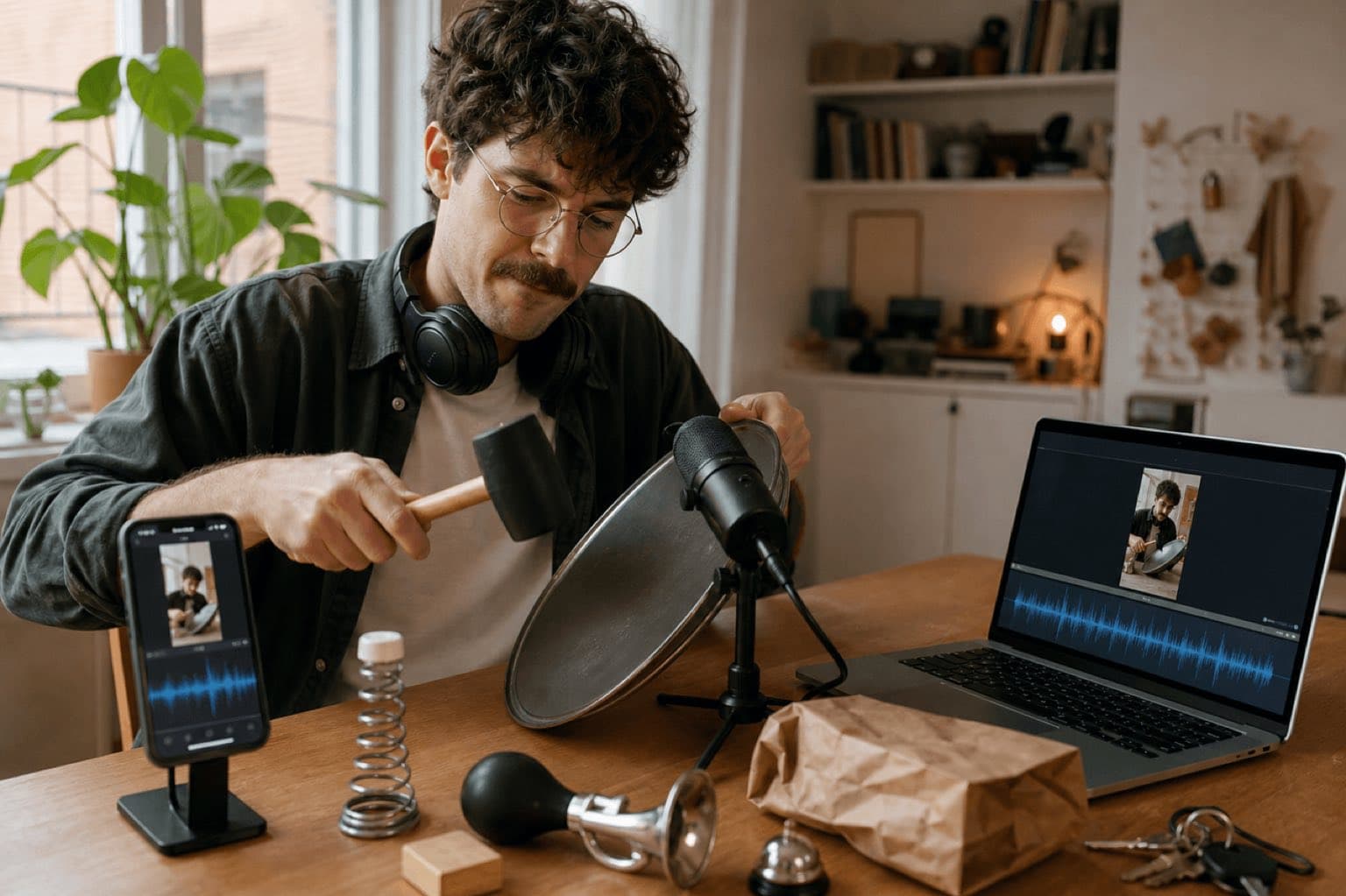
Make original meme sounds with ordinary objects
Begin with a verb and a scale: stop, fail, reveal, shrink, wobble, pop, stretch, or land. Record 3–6 variants, leaving silence before and after each. Change one variable at a time—object, force, surface, distance, or performance—so comparison is useful.
Drop a folded towel onto a cardboard box, add a short spring-doorstop twang at low level, pitch the body down slightly, and end before the visual reaction finishes.
Strike a serving tray softly for bright metal, layer a muted desk thump for weight, shorten the ring, and place the transient exactly on the title or face reveal.
Record thirty seconds of the real room. Add one distant appliance click or chair creak after the reaction begins; do not fill every empty frame.
Tap a small glass or bell, remove low rumble, keep one clean decay, and create three pitches for small, medium, and final confirmation.
Recording checklist
- Turn off avoidable fans, notifications, and appliances
- Record 24-bit WAV when possible and avoid clipping
- Capture room tone and several performance intensities
- Keep microphone position consistent within a family
- Name source, object, surface, perspective, take, and date
- Do not record unsafe impacts or damage property for a joke
04
Timing is more important than novelty
Setup
Let the audience understand the expectation. Too much audio announces the joke before it forms.
Anticipation
A short mute, reverse, inhale, or pause creates space immediately before the beat.
Contact
Place the main transient on the perceived cut, look, title, object contact, or realization.
Release
Choose whether the tail ends quickly, hangs awkwardly, or bridges into the next shot.
Test one-frame moves around the apparent sync point. A cue may feel late because its strongest peak occurs after a soft attack; trim or choose another take before dragging the entire file early. For repeated jokes, vary timing or scale on the second and third appearance. Predictable repetition becomes noise unless progression is the point.
05
Mix for phones, speech, and repeated viewing
- Protect the words. Shorten or notch cues that mask consonants; use ducking only as a starting point.
- Translate the low end. A sub-heavy impact may vanish on phones; add a controlled midrange body rather than only limiting harder.
- Control brightness. Dings, horns, and squeaks become painful across repeated loops.
- Keep dynamics. If every caption has the same loud pop, none feels important.
- Check mono. Phasey wide effects can collapse or disappear on a single speaker.
- Export cleanly. Listen to the first and last frame, platform encode, and full loop before posting.
cue name · creator/source · original URL · recorded/downloaded/generated date · license/plan · project/account type · commercial status · edit history · required credit · approved export
06
Where Sonilo fits
Sonilo is relevant when you want the grammar of a meme sound without copying a recognizable asset. Start at sound effects, then use the focused funny, record scratch, impact, or ding routes. For a whole edit, video input can help a cue follow visible motion and cut timing.
Short comedic failure sound for a vertical cooking video: soft rubbery collapse followed by one tiny metal spring wobble, dry close perspective, playful rather than harsh, no voice, no melody, no recognizable meme reference, main contact at 0.35 seconds, complete clean tail by 1.1 seconds.
Generate a few variants, compare in the actual cut, reject outputs that resemble a known clip, and review commercial-use terms. The broader sound effects guide covers spotting, layering, perspective, and delivery.
Sources
Official sources and limits
- YouTube Help: common copyright myths and fair use.
- YouTube channel monetization and reused-content policy.
- TikTok: commercial use of music.
- U.S. Copyright Office Compendium, Chapter 800.
- Sonilo official: SFX hub, funny SFX, record scratch, impact, ding, and licensing.
Human review checkpoint: before production publication, a named short-form editor or sound designer should repeat the cue recipes and timing tests. A qualified rights reviewer should check platform, fair-use, short-recording, and commercial-use language.
FAQ
Frequently asked questions
Meme sounds are short audio cues used to frame a reaction, punchline, reversal, reveal, failure, success, awkward pause, or edit. They may be original effects, licensed recordings, platform sounds, dialogue clips, or music fragments, and those sources do not carry the same rights.
Not automatically. A short recording may or may not contain enough authorship for copyright protection, but there is no universal safe number of seconds. The underlying movie, video, performance, music, or recording can also be protected.
Only when your use is covered by the platform feature and account type, a license or permission, public domain, or a valid local exception. Brand content needs extra care; TikTok recommends its Commercial Music Library for posts promoting products or services.
Start with the editorial function, record or generate a simple source, exaggerate one acoustic property, trim to the necessary duration, place it precisely against the visual beat, and save a clean version plus licensing evidence.
Use the shortest cue that communicates the beat. Many UI-like hits work in a fraction of a second; a reveal or awkward silence may need anticipation and a longer tail. Judge in context, not by a fixed duration.
Yes. Use Sonilo’s funny, record-scratch, impact, ding, or general sound-effects routes to describe an original cue or generate around a video. Review the result and current plan terms before commercial release.
Related
Keep reading
Make the reaction yours
Create an original cue around the punchline and frame.
Describe what the sound must communicate, how large it should feel, where it lands, and how quickly it should get out of the way.