Sonilo publishes this guide and appears as an option for generating complete music from text or video. It is not presented as the best tool for every melody task. No outside melody tool sponsored or reviewed this article. Product pages and cited learning resources were checked on August 20, 2026.
Last verified: August 20, 2026. Features, export formats, and licensing can change. Test the exact workflow and confirm current terms before production use.
Quick answer
For editable musical material, create a short motif in a scale-aware piano roll and export MIDI. For fast inspiration, generate a pattern and reshape it rather than accepting random notes unchanged. For finished background music, describe the melodic role inside a full arrangement. For video, judge the melody against dialogue, cuts, effects, and the final frame—not as a solo tune.
01
Three tools people mean by “melody creator”
Editable notes
Piano roll or MIDI creator
You choose key, scale, tempo, grid, range, note length, and rhythm. The result can be edited, reharmonized, orchestrated, and exported.
- Best for producers and composers
- Maximum note-level control
- Requires an instrument or DAW to become a finished track
Starting idea
Random or AI melody generator
The tool proposes a melodic pattern from controls or a prompt. Its value is giving you something specific to react to.
- Best for breaking a blank-page block
- Quality depends on selection and revision
- Check MIDI/WAV export and rights
Finished audio
Full-music generator
The melody arrives inside harmony, rhythm, instrumentation, sound design, and mix rather than as isolated notes.
- Best for video and content music
- Faster context, less note-level control
- Review speech space, structure, ending, and license
The outputs are not interchangeable. A beautiful stereo cue may be useless when a client needs MIDI. A clean four-bar MIDI motif may be useless when an editor needs a finished 45-second soundtrack today. Decide the deliverable before comparing tools.
02
What makes a melody feel intentional?
A melody is more than a sequence of pitches. Listeners group pitch, rhythm, contour, repetition, phrase boundaries, and timbre into a line. Open Music Theory defines a motive as a short recurring unit and describes common transformations such as enlargement, contraction, inversion, displacement, and embellishment. For a beginner, the practical version is simpler: write a small idea, repeat it, and change one recognizable feature.
Motif
A two-to-five-note or rhythmic identity short enough to remember. It gives the listener a reference point.
Rhythm
Where notes begin, stop, repeat, and leave silence. A memorable rhythm can survive different pitches.
Contour
The perceived shape—rising, falling, arching, static, or jagged. Contour helps varied phrases sound related.
Range
The distance between the lowest and highest note. A constrained range feels singable; a wide range can signal effort or climax.
Tension and arrival
Unstable notes, leaps, repetition, and delayed resolution create expectation; a cadence or resting tone answers it.
Space
Rests let the phrase breathe, leave room for lyrics, and prevent every beat from demanding attention.
No rule makes a melody universally “good.” A tutorial bed may need a restrained motif that avoids attention. A podcast sting may need immediate recognition. A character theme can tolerate more identity and development. Judge success by function.
03
How to create a melody step by step
1. State the job in one sentence
Write what the melody must communicate and where it will appear: “a patient four-bar idea that makes a repair process feel possible,” or “an eight-second identity that feels curious, not futuristic.” This keeps musical decisions connected to the audience.
2. Record a hummed sketch
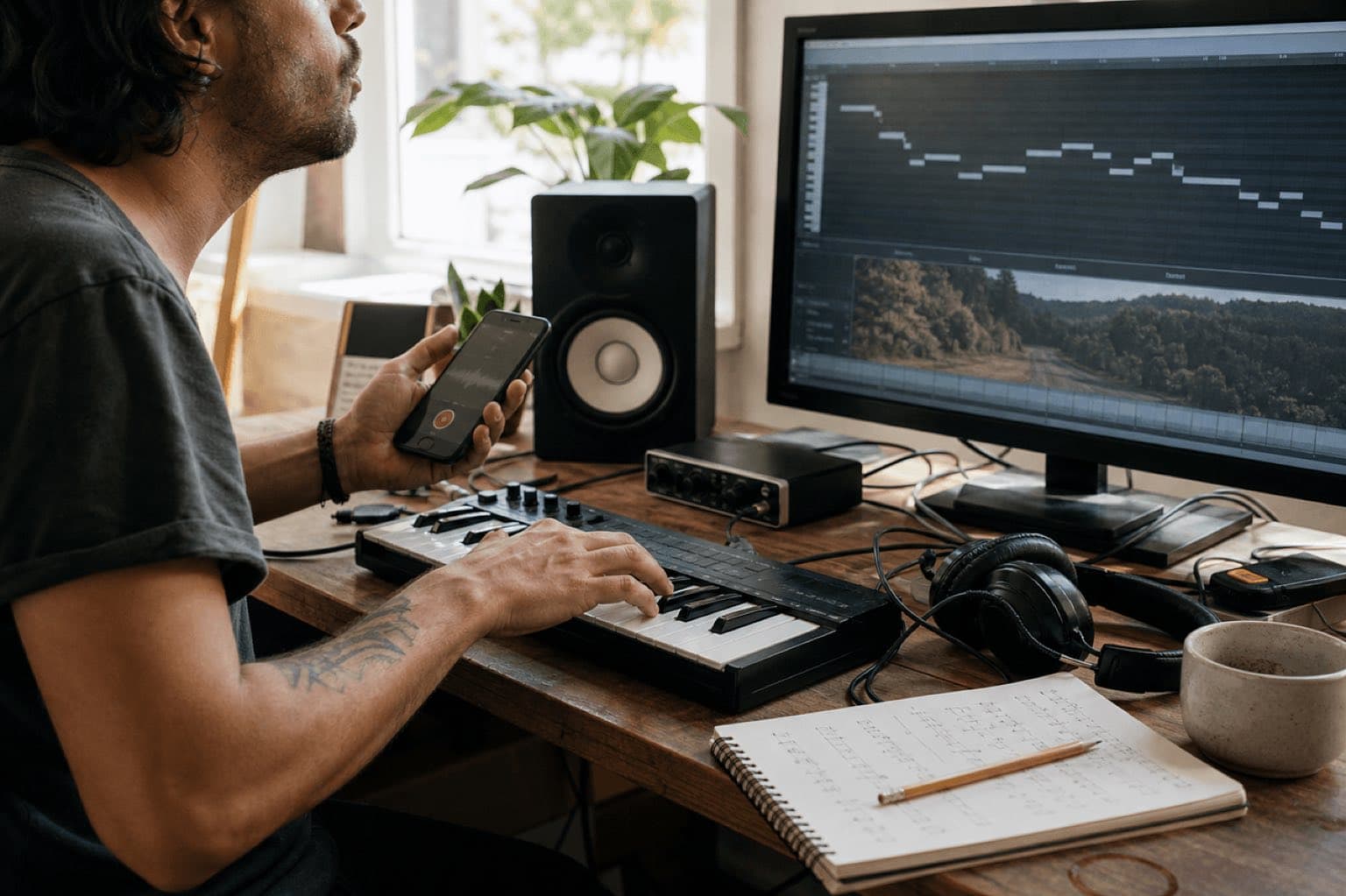
Hum before clicking notes. The voice naturally imposes breath, phrasing, range, and repetition. Record several rough passes without judging tone quality. Choose the phrase whose rhythm and contour remain memorable after a short break.
3. Extract one motif
Find the smallest recognizable fragment. It may be three pitches, but its rhythm is equally important. If removing a note preserves the identity, simplify. A motif is raw material, not a whole chorus.
4. Set scale, pulse, and range
A scale-aware grid reduces accidental clashes, but “all notes are in key” does not guarantee a strong line. Set a comfortable register and pulse, then place the motif. Test it slowly before adding decoration.
5. Repeat with one change
6. Create one peak
Choose where the phrase reaches its highest energy. The peak may be the highest pitch, longest note, strongest harmony, densest arrangement, or syncopated accent. If every phrase peaks, none feels special.
7. Remove notes
First drafts are often too busy. Mute every optional note and restore only what improves identity, motion, or arrival. Test the line without accompaniment; then test it with harmony and dialogue because context changes what feels crowded.
8. Build a phrase, then an arrangement
Connect motifs into a phrase with statement, response, departure, and conclusion. Only after the line works should orchestration multiply its impact. If you are generating full audio, ask whether the arrangement supports the motif or hides it under texture.
04
A prompt framework for melodic music
Create a [duration] [instrumental/song/score] for [scene and audience]. Lead with one [short/lyrical/rhythmic] motif played by [instrument]. Use a [rising/falling/arching/restrained] contour within a [narrow/moderate/wide] range. State it in [opening], vary it at [change], reserve the peak for [moment], and [resolve/loop/stop] at the end. Leave room for [speech/effects]. Avoid [busy runs, competing hooks, vocals, or cliché].
Product tutorial
One restrained two-bar plucked motif, narrow range, steady rhythm, soft electronic texture. Repeat with small timbral changes; no new lead under instructions. Lift only after the final spoken step and end cleanly at 00:50.
Documentary return
Felt-piano motif beginning with three close notes and a longer answer. Low register at first, one upward variation after 00:42, no sentimental strings until the subject smiles. Leave wide gaps for speech.
Podcast sting
Eight-second identity built from one syncopated four-note motif on muted synth and dry percussion. Immediate start, repeat once a fourth higher, decisive final hit. No vocal, riser, boom, or reverb tail.
Game exploration
Loopable melody for a quiet glasshouse ruin. Sparse bell-like motif with an arch contour and occasional missing beat. Moderate range, no final cadence, no dominant hook, and enough space for ambience.
Short ad
Warm piano-and-wood motif that starts on product detail, repeats with light bass as the room opens, and reaches one high note under the logo. Twenty seconds, no vocals and no corporate ukulele.
Suspense
Fragmented three-note low-register idea with uneven spacing. Repeat closer together as the search continues, but withhold resolution and avoid melodic flourish. Let sound effects carry the reveal.
05
Make the melody serve the scene
For picture, melodic quality includes placement. A strong hook can weaken a scene if it enters before the audience understands the subject, competes with dialogue, or resolves before the edit does. Sonilo’s guide to writing better melodies for video scenes starts from scene function rather than decoration. Its soundtrack timing guide focuses on making musical changes follow the cut.
Mark four points: when music becomes useful, when the scene changes meaning, where the melodic peak belongs, and how the final frame should feel. During dialogue, reduce note density or move the lead away from the voice’s most active register. During action, rhythm may communicate more clearly than a long lyrical line. During a reveal, silence before the motif can create more impact than adding layers.
Three fast tests before you keep a melody
The contour test: draw the line as a simple curve without naming notes. If every phrase has the same shape, introduce a real departure; if the shape is chaotic, simplify the direction changes. The rhythm test: tap the phrase on one pitch. If its identity disappears, the melody may rely too heavily on timbre or harmony. The scene test: mute the arrangement except the lead and play it with picture. If the line tells the audience more emotion than the scene has earned, reduce density, range, or repetition.
Then reverse each test. Play the rhythm without pitch, the contour in another key, and the scene without melody. A useful motif should retain some identity when its surface changes, while the scene should remain understandable when the music leaves. That balance makes the melody supportive rather than indispensable for basic comprehension.
06
A melody review scorecard
- IdentityCan you hum or tap the core idea after one listen?
- FunctionDoes the line help the scene, lyric, character, brand, or gameplay state?
- RhythmDoes the phrase have a recognizable pattern and useful rests?
- ContourIs there a readable shape rather than random up-and-down movement?
- VariationDoes repetition preserve identity while changing one meaningful element?
- PeakIs the highest-energy point intentional and correctly placed?
- ContextDoes harmony, arrangement, dialogue, and sound design leave it clear?
- DeliveryAre MIDI/audio format, duration, loop, ending, stems, and rights correct?
07
Common melody mistakes and fixes
| Problem | Why it happens | Fix |
|---|---|---|
| Random notes in one scale | Pitch safety is mistaken for structure. | Choose one rhythmic motif and a contour before adding notes. |
| Too many hooks | Every instrument tries to provide identity. | Keep one lead idea; make other parts support pulse, harmony, or texture. |
| No breathing space | The creator fills every grid division. | Delete notes at phrase boundaries and before important words or edits. |
| Endless repetition | The motif never changes role or destination. | Transpose, stretch, reharmonize, thin out, or alter the final response. |
| Peak in the wrong place | Musical structure ignores the scene or lyric. | Map the reveal, chorus, cut, or final line before arranging intensity. |
| Wrong deliverable | A finished audio generator is chosen for a MIDI task, or vice versa. | Specify editable notes, full audio, video timing, stems, and license before selecting a tool. |
08
Where Sonilo fits—and where it does not
| Need | Sonilo fit | Reason |
|---|---|---|
| Complete music from a melodic brief | Good fit | Text-to-music turns plain-language direction into audible music options. |
| Music whose melodic activity follows video | Strong fit | Video-to-music uses duration, pacing, transitions, scenes, and voice-over space as context. |
| Draw and export exact MIDI notes | Not the documented workflow | Public Sonilo pages do not present a dedicated piano-roll or MIDI melody editor. |
| Exact notation, bespoke leitmotif, or live performance | May need composer/DAW | These require deeper authored control, revision, and delivery. |
| Commercial content | Plan-dependent | Commercial permission must be confirmed under the plan-specific terms or written agreement that applied when the output was generated. |
09
Evidence and editorial standards
Musical concepts use Open Music Theory, an open undergraduate-level textbook, for motives, contour, phrase organization, and transformation vocabulary. Tool-category examples illustrate different output types, not a quality ranking. Sonilo capability and rights statements use current official pages. Advice about memorability and scene fit is editorial guidance, not a universal scientific guarantee.
Sources
Sources
- Open Music Theory: motives and phrase-level form.
- Open Music Theory: melody and phrasing in popular music.
- Titan Audio Melody Creator as a current example of a note-grid/MIDI workflow.
- Compoxer as a current example of text-to-MIDI output.
- Sonilo text-to-music and video-to-music.
- Sonilo licensing.
Human review checkpoint: before production publication, a credentialed songwriter, composer, or music educator should review the theory guidance; a qualified music-rights reviewer should verify commercial-use language for material projects.
FAQ
Frequently asked questions
A melody creator may be a piano-roll or MIDI tool for writing individual notes, a random or AI idea generator, or a full-audio music generator. Choose based on whether you need editable notes, a finished sound, or music fitted to video.
Memorable melodies usually have a short recognizable motif, clear rhythm, manageable range, purposeful contour, repetition with variation, useful space, and a convincing point of arrival. Genre and context change how those ingredients are used.
Yes. Start by humming a short phrase, record it, identify its rhythm and contour, and repeat it with one change. A scale-locked grid can help with note entry, while a text-to-music tool can turn descriptive direction into audible options.
Sonilo’s public pages do not document a dedicated note-by-note piano-roll or MIDI melody export workflow. Use a MIDI melody creator when editable notes are required; use Sonilo when you need generated music from text or video.
Describe the melody’s role, phrase length, contour, range, rhythmic character, repetition pattern, lead instrument, emotional change, duration, and exclusions. Ask for one clear motif rather than several competing hooks.
Yes. Sonilo’s video-to-music page says the workflow considers duration, pacing, transitions, scene structure, and voice-over space. The creator should still review whether the melodic activity helps or distracts from the scene.
Commercial permission depends on the tool, plan, project, and current terms. Sonilo says Commercial permission must be confirmed under the plan-specific terms or written agreement that applied when the output was generated. Copyrightability and similarity risks are separate questions requiring case-specific review.
Related
Keep reading
Build the complete musical context
Turn a melodic direction into music for your brief or video.
Keep the motif clear, control when it changes, leave space for speech, and review the result in its real scene.