This page is published by Sonilo, which makes an AI soundtrack product for video creators. No artist, label, director, or platform paid for placement. Sonilo does not sell any music video on this list; product links are clearly separated from the ranking.
Artist names, song and video titles, factual commentary, and links to official uploads are used for identification, criticism, and reference. This page does not host the videos or grant permission to copy, download, sample, edit, redistribute, or commercially reuse any song, recording, video, choreography, artwork, performance, or likeness. A viewing link, public availability, or inclusion in this list is not a license.
Sonilo is not affiliated with or endorsed by the artists, labels, directors, or YouTube. Creators should use music and media they own, commissioned under suitable written terms, separately licensed for the intended release, or generated under an eligible Sonilo plan after checking the current licensing page and Terms. Do not recreate a protected recording or video, imply endorsement, or treat stylistic inspiration as permission to copy protected expression.
Editorial and source review: August 28, 2026. Release-specific rights remain the publisher's responsibility.
01
The short answer
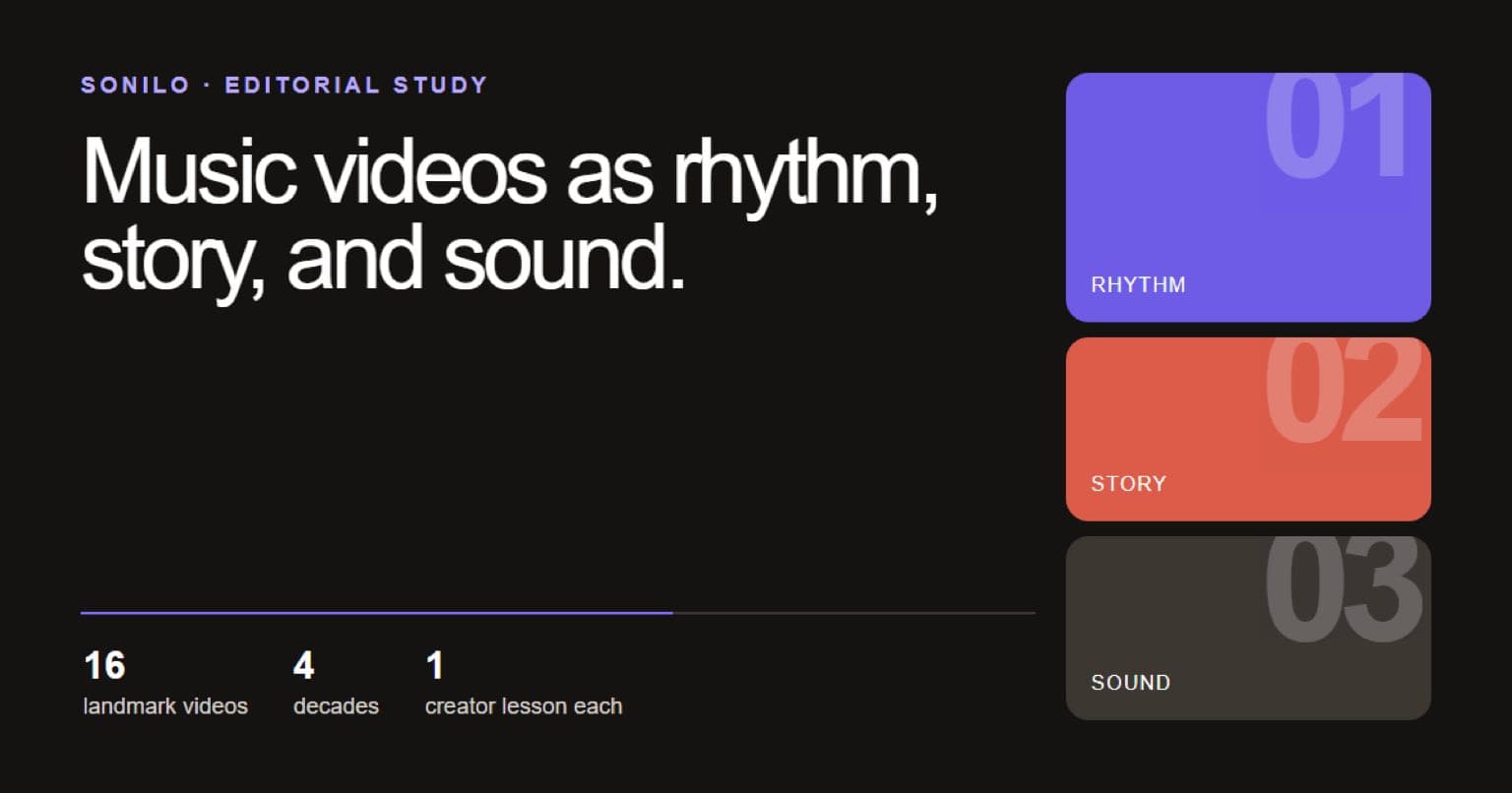
For directors, editors, musicians, and independent creators, those choices are reusable. We ranked 16 landmark videos by concept, execution, music-image fit, and lasting influence, then translated each one into a practical lesson you can apply to pacing, transitions, performance, production design, and soundtrack planning.
- Best overall: Michael Jackson — “Thriller”
- Best animation/live-action hybrid: a-ha — “Take On Me”
- Best practical-effects showcase: Peter Gabriel — “Sledgehammer”
- Best choreography-led concept: Beyoncé — “Single Ladies (Put a Ring on It)”
- Best recent visual performance: FKA twigs — “Cellophane”
02
How we chose the greatest music videos
We started with videos that recur across major critics’ lists, awards histories, filmmaking discussions, and audience memory. Each of the 16 finalists was then assessed against the same four-part framework. A famous song did not guarantee a place, and view count was not used as a proxy for quality.
| Criterion | What we looked for |
|---|---|
| Concept | Can the visual premise be explained in one clear sentence? |
| Execution | Do camera, performance, design, editing, and effects serve that premise? |
| Music-image fit | Do cuts, movement, and visual escalation respond to the track? |
| Afterlife | Did the video change expectations, inspire imitation, or remain legible years later? |
Scope: this is a selective canon, not a complete history. We favored one defining entry per creative idea, which means several extraordinary artists and directors appear only once.
The 16 best music videos of all timeRanked 1–16 01Michael Jackson — “Thriller”
1983Directed by John LandisShort-film spectaclePLAYWatch the official “Thriller” video on YouTube
Why it belongs“Thriller” treats the music video as cinema: prologue, transformation, ensemble choreography, practical makeup, and a final joke all have room to land. The United States Library of Congress selected it for the National Film Registry in 2009—the first music video to receive that recognition. Its influence is visible whenever a release is framed as an event rather than a promotional clip.
Creator takeawayBuild one unforgettable set piece and earn it with structure. The dance works because the video first creates a world, a threat, and anticipation.
02a-ha — “Take On Me”
1985Directed by Steve BarronRotoscope romancePLAYWatch the official “Take On Me” video on YouTube
Why it belongsA woman at a café is pulled into a comic-book world, and the boundary between paper and reality becomes the story’s emotional engine. The pencil animation is not decoration: it creates a place the lovers may lose. Few videos fuse a technical device and a simple romantic narrative this completely.
Creator takeawayIf you mix media, give the transition a dramatic purpose. The effect feels timeless because crossing between styles changes what the characters can do and what they risk.
03Peter Gabriel — “Sledgehammer”
1986Directed by Stephen R. JohnsonStop-motion inventionPLAYWatch the official “Sledgehammer” video on YouTube
Why it belongsEvery lyric becomes an excuse for a new tactile illusion: clay, fruit, painted backgrounds, pixilation, and stop-motion bodies. Yet the constant is Peter Gabriel’s face, which keeps the formal experiment playful and human. The result feels less like one effect repeated than a handmade visual album compressed into a few minutes.
Creator takeawayVariation needs an anchor. When every shot can transform, hold onto one stable element—a face, color, framing rule, or rhythm—so invention does not become noise.
04Madonna — “Vogue”
1990Directed by David FincherMonochrome iconographyPLAYWatch the official “Vogue” video on YouTube
Why it belongsBlack-and-white photography, sculptural lighting, Art Deco geometry, and exact posing turn every frame into a fashion image. The restraint is the point: instead of competing with the choreography, the set and camera create a polished stage for bodies, hands, and glances. Its images remain immediately recognizable even without the track.
Creator takeawayA limited palette can increase impact. Decide what the viewer should notice first, then remove color, props, or camera movement that weakens that hierarchy.
05Nirvana — “Smells Like Teen Spirit”
1991Directed by Samuel BayerControlled collapsePLAYWatch the official “Smells Like Teen Spirit” video on YouTube
Why it belongsA school assembly starts in sickly order and disintegrates into smoke, sweat, fire, and teenage release. The visual arc mirrors the song’s quiet-loud dynamics without cutting mechanically on every beat. The video did not simply document a performance; it gave a generation a room in which alienation could become collective energy.
Creator takeawayLet production design carry the emotional progression. A location that changes state—from clean to wrecked, empty to crowded, still to chaotic—can become a narrative by itself.
06Beastie Boys — “Sabotage”
1994Directed by Spike JonzeGenre parodyPLAYWatch the official “Sabotage” video on YouTube
Why it belongsFake mustaches, crash zooms, foot chases, and aggressively earnest title cards turn a 1970s cop-show imitation into perfect music-video velocity. The joke never pauses for explanation. Every prop, lens choice, and performance commits to the same cheap, overheated television world, so a modest production feels complete rather than small.
Creator takeawayReference a genre at the level of grammar, not costume alone. Camera behavior, editing rhythm, typography, and acting style have to agree on the same fiction.
07Jamiroquai — “Virtual Insanity”
1996Directed by Jonathan GlazerImpossible roomPLAYWatch the official “Virtual Insanity” video on YouTube
Why it belongsJay Kay appears to glide while sofas threaten to cross the room, yet the camera maintains the calm gaze of a stage observer. The illusion is conceptually simple—the set moves around a fixed camera—but its timing is so clean that the room feels physically wrong. Performance, blocking, and engineering become one trick.
Creator takeawayA single spatial rule can sustain an entire video if you keep finding new consequences. Reveal the idea early, then escalate its difficulty instead of abandoning it for unrelated setups.
08Daft Punk — “Around the World”
1997Directed by Michel GondryMusic made visiblePLAYWatch the official “Around the World” video on YouTube
Why it belongsFive groups of performers embody separate parts of the arrangement, turning a repetitive dance track into a living diagram. Movement drops out and returns as musical layers change. The staging is whimsical, but the underlying logic is rigorous enough that viewers can almost “see” the mix.
Creator takeawayAssign visual meaning to sound. A character, color, motion, or location can represent each musical layer, giving editors a system for translating arrangement changes into images.
09Fatboy Slim — “Weapon of Choice”
2001Directed by Spike JonzePerformance surprisePLAYWatch the official “Weapon of Choice” video on YouTube
Why it belongsChristopher Walken sits alone in a quiet hotel lobby, then launches into a dance that moves from deadpan footwork to impossible flight. The contrast between performer, location, and action creates the pleasure. Minimal cutting lets viewers believe the physical performance before the video gently breaks reality.
Creator takeawayCast against expectation and protect the reveal. A surprising performer can be the concept, but the camera must give that person time and space to own the frame.
10Coldplay — “The Scientist”
2002Directed by Jamie ThravesReverse narrativePLAYWatch the official “The Scientist” video on YouTube
Why it belongsThe action runs backward while Chris Martin appears to sing forward, transforming a familiar reverse-motion device into an unfolding tragedy. Early images are emotionally ambiguous; their causes only become clear as the video approaches the beginning of the story. Technique and narrative reveal are inseparable.
Creator takeawayChoose a device that controls information. Reverse motion matters here because it withholds cause, not simply because reversed footage looks unusual.
11OK Go — “Here It Goes Again”
2006Directed by Trish SieOne-take ingenuityPLAYWatch the official “Here It Goes Again” video on YouTube
Why it belongsEight treadmills, four performers, one locked-off camera, and no visible edits: the constraints are immediately understandable. That clarity turns every slide, near miss, and formation change into a small thrill. It became a defining early example of a music video designed to be replayed and shared online without needing blockbuster scale.
Creator takeawayMake the difficulty legible. Viewers enjoy precision more when they understand the rule and can see that the performance is happening in real time.
12Beyoncé — “Single Ladies (Put a Ring on It)”
2008Directed by Jake NavaChoreography as imagePLAYWatch the official “Single Ladies” video on YouTube
Why it belongsThree dancers, a seamless studio, black-and-white photography, and an extraordinarily controlled camera prove that spectacle can come from bodies rather than sets. The framing expands and contracts with the choreography, while the lighting shift near the end supplies the escalation. Every visual choice protects the dance’s silhouette.
Creator takeawayWhen performance is the asset, simplify everything around it. A clean stage, disciplined wardrobe, and readable full-body framing can make movement more memorable than rapid coverage.
13Lady Gaga — “Bad Romance”
2009Directed by Francis LawrenceFashion-world narrativePLAYWatch the official “Bad Romance” video on YouTube
Why it belongsA sterile bathhouse, sculptural fashion, enlarged eyes, and a sequence of increasingly confrontational looks build a pop nightmare with its own visual vocabulary. The costumes are not interchangeable styling moments; each one marks a new phase of control, display, or retaliation. The final image resolves the story with dark precision.
Creator takeawayTreat styling as narrative information. Wardrobe, makeup, and production design should reveal changing power—not merely provide more looks for the edit.
14Kendrick Lamar — “HUMBLE.”
2017Directed by Dave Meyers & the Little HomiesPrecision tableauxPLAYWatch the official “HUMBLE.” video on YouTube
Why it belongsReligious iconography, a fisheye bicycle shot, a flaming head, and a beauty-retouching split screen arrive as discrete, impeccably composed statements. The video is dense, but each setup has a clean silhouette and a clear visual punchline. Hard cuts make the track’s force feel architectural.
Creator takeawayIf a video uses many setups, make each readable in one frame. Strong composition lets an edit move quickly without making the viewer work to decode every location.
15Childish Gambino — “This Is America”
2018Directed by Hiro MuraiForeground and backgroundPLAYWatch the official “This Is America” video on YouTube
Why it belongsThe camera follows Donald Glover’s dancing while violence, panic, and neglect accumulate behind him. Entertainment becomes a mechanism of distraction inside the frame itself. Long, fluid movement forces viewers to decide where to look, and repeat viewing reveals how carefully the background action was staged.
Creator takeawayUse depth as meaning. Foreground and background can tell conflicting stories, creating tension without a cut or explanatory dialogue.
16FKA twigs — “Cellophane”
2019Directed by Andrew Thomas HuangVulnerable transformationPLAYWatch the official “Cellophane” video on YouTube
Why it belongsA pole performance stretches upward into a surreal encounter, then collapses into a muddy underworld where other hands reshape the fallen body. The visual effects extend the physical performance rather than replacing it. Its scale grows with the song while preserving an exposed, intimate emotional center.
Creator takeawayLet effects continue the performer’s motion and emotion. The most persuasive digital image often begins with a real gesture the audience already believes.
03
What these music videos teach video creators
Start with the song structure, not a mood board. Write one visual rule, mark the track’s changes, and decide which visual element will answer each one.
- Name the image system. “Each dancer represents an instrument” gives the team a usable rule; “make it surreal” does not.
- Map the track. Mark the intro, first lift, quietest passage, largest peak, and ending before placing transitions.
- Choose one controlled reveal. Save a lighting change, new space, transformation, or impossible movement for a musical turn that deserves it.
- Protect the core image. If the idea is unreadable at phone size, simplify the frame before adding coverage.
- Design the last five seconds. Let the final musical gesture and final image resolve together.
04
Turn a visual reference into a soundtrack brief
Do not ask for music that is only “cinematic” or “energetic.” Describe what the cut is doing and what the soundtrack should make the viewer feel at each structural moment.
| Edit moment | Visual signal | Soundtrack direction |
|---|---|---|
| Opening | World, character, or visual rule appears | Establish pulse and palette without spending the biggest idea |
| First turn | New location, motion, or visual medium | Add or remove a layer so the change is felt, not just seen |
| Peak | Largest movement, reveal, or montage | Reserve the strongest rhythmic or harmonic lift for this point |
| Dialogue | Voice or key information takes priority | Reduce density and leave space around speech |
| Ending | Final pose, cut, or visual consequence | Land a clean cadence or deliberate unresolved tail |
05
Sources and viewing notes
All video links point to official artist or label uploads on YouTube. Selection context and historical checks were reviewed on August 28, 2026.
Sources
Sources
- Library of Congress: 2009 National Film Registry selections — recognition of “Thriller.”
- Recording Academy: GRAMMY Awards database — official award history reference.
- Peter Gabriel official site: “Sledgehammer” credits and award history.
- Michael Jackson — “Thriller” (official video) and the 15 other official watch links embedded above.
- How AI music from video works — related Sonilo guide for creators planning a soundtrack workflow.
- Cinematic music licensing and fit checklist — practical checks before publishing a video.
Corrections: If a credit or official link needs updating, contact info@sonilo.com. We record material corrections and update the observation date.
FAQ
Questions about the best music videos of all time
Michael Jackson’s “Thriller” is the strongest consensus choice because it combines cinema-scale storytelling, choreography, makeup effects, and event viewing. It was also the first music video selected for the United States National Film Registry. Any ranking remains subjective, but its historical case is unusually strong.
We evaluated 16 videos across four criteria: visual concept, execution, relationship between picture and music, and lasting influence. Cultural fame alone was not enough; every selection needed a visual idea that still reads clearly today. We also limited repetition so one artist or technique did not dominate the list.
Memorable music videos usually have one legible visual rule, strong alignment between musical changes and visual changes, and at least one image or movement viewers can recall without hearing the song. Bigger budgets can help, but a precise concept matters more than the number of sets or effects.
Owning or streaming a song does not normally grant synchronization rights for a new video. Creators should license the music they use or create an original soundtrack with terms that cover the intended platforms and commercial use. For a real project, confirm the current agreement before publishing.
Related
Keep reading
Apply the lesson to your edit
Upload your cut. Generate music around its timing.
Sonilo starts from the video you have already edited. Upload the cut, describe the musical direction, and generate an original soundtrack shaped around its duration, pacing, and key moments.