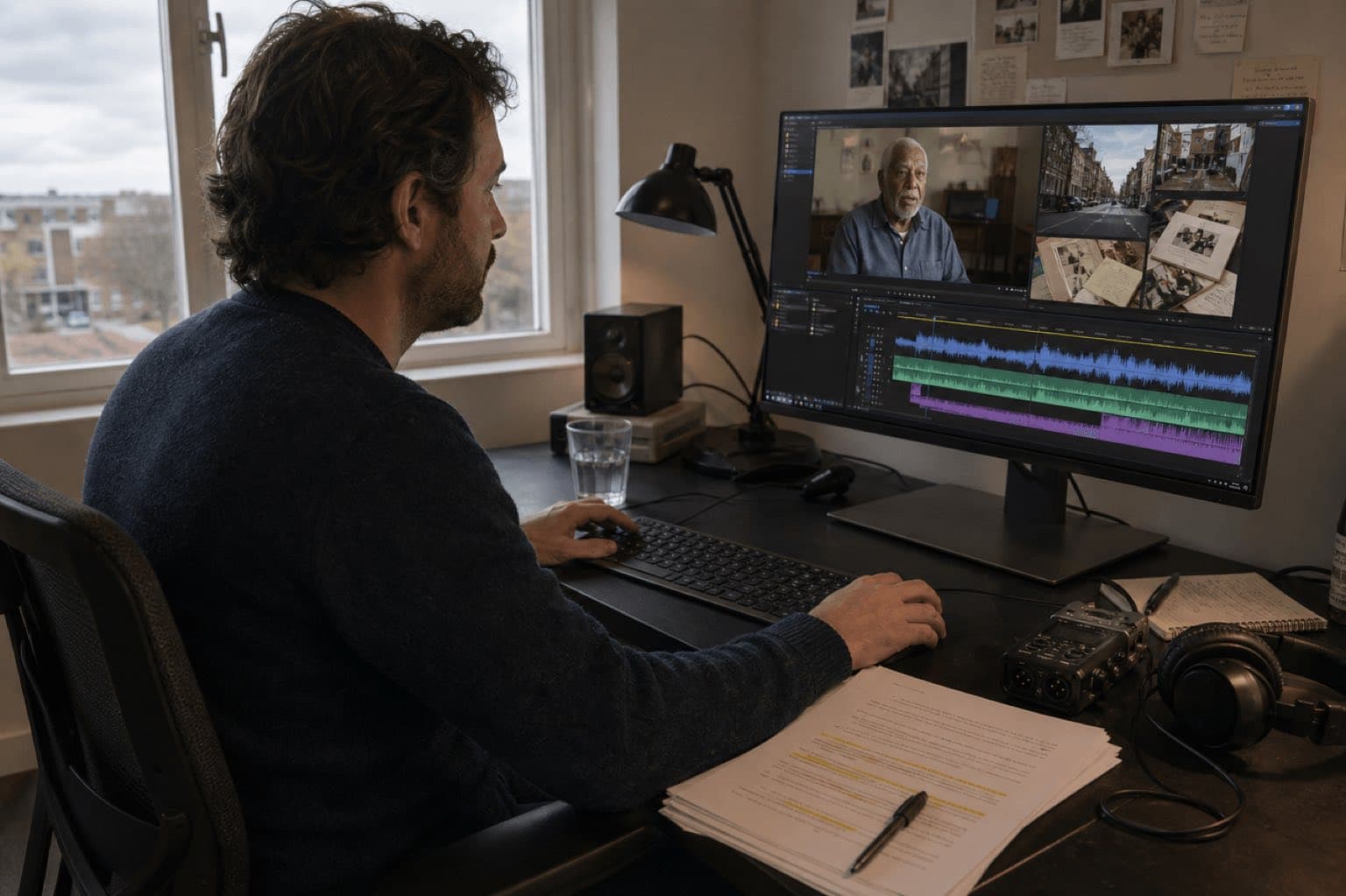
This guide provides general production information, not legal advice. Interfaces, libraries, and licenses can vary by account, region, placement, plan, and date. Verify the current platform or vendor terms and the rights for the exact audio before publishing. Sonilo commercial use applies only to eligible output under applicable plan terms and remains subject to the current Terms. It does not guarantee exclusivity, copyright protection, or freedom from claims.
Policy review: August 28, 2026. Material campaigns, broadcast, sublicensing, or disputed uses should be reviewed by qualified counsel.
Sonilo publishes this guide and appears as one option for generating music from an edited documentary sequence. PBS, BBC, the Center for Media and Social Impact, WIPO, and other cited organizations did not sponsor or review this page, and there are no affiliate links. Their standards and resources apply in their own contexts and are not universal production rules. This is editorial workflow guidance, not legal advice, E&O approval, or a substitute for the commissioning editor, distributor, music supervisor, rights holder, broadcaster, or qualified counsel.
Last verified: August 21, 2026. Sonilo had no live English or Spanish page at this URL when checked, so this is a new guide rather than a duplicate canonical. Current PBS Production Guidelines point producers to its Producer’s Handbook, broadcast standards, and technical deliverables. BBC accuracy guidance says factual editing must not give a materially misleading impression. U.S. fair use, music licensing, cue sheets, broadcaster requirements, and Sonilo plan terms must be verified for the real project and distribution date.
Use music for structure and perspective, not as proof
Let reality lead when it can
Room tone, breath, weather, work, crowds, machinery, silence, and the contributor’s voice can carry a scene more honestly than a continuous music bed.
Search for editable, traceable cues
Choose a library or existing work only after checking the exact documentary use, distribution, edits, term, territory, client, and evidence required for delivery.
Develop a specific point of view
Use a composer when the film needs a recurring motif, cultural specificity, live players, stems, revisions, detailed collaboration, exclusivity, or feature-length continuity.
Generate candidates around the cut
Use Sonilo Video to Music when a stable sequence needs timing-aware options. Review each result for editorial implication, speech space, rights, and release fit.
The useful question is not “Does this cue feel emotional?” It is “What claim does the combination of picture, words, sound, and music invite the audience to make?” Music always frames perception. Responsible scoring makes that framing intentional and reviewable.
01
Run an editorial truth test before approving a cue
A documentary can have a clear point of view and still test how its craft changes the audience’s interpretation. Music is not neutral: harmony, rhythm, instrumentation, register, dissonance, and silence can imply threat, innocence, progress, loss, intimacy, irony, or certainty. That expressive power is useful, but it must not stand in for facts that the edit has not established.
Evidence
What can the audience actually see, hear, or verify? Is the cue reinforcing documented material or supplying an unsupported conclusion?
Contributor
Would the person recognize the scene’s intended context? Does music turn hesitation, accent, age, class, culture, or vulnerability into a stereotype?
Sequence
Has juxtaposition plus score created causation, chronology, danger, or triumph that the source material does not establish?
Audience
Can viewers tell what is actuality, archive, reconstruction, illustration, allegation, uncertainty, or editorial interpretation?
BBC accuracy guidance is one useful benchmark for factual work: commentary and editing should not give a materially misleading impression, and reconstructions should be identifiable and based on substantial, verifiable evidence. That document governs BBC output, not every documentary. The broader lesson is to review the total effect of the edit—including music—rather than fact-checking words while ignoring what the soundtrack implies.
Use an emotion statement
Before searching, write one sentence that distinguishes the scene’s supported emotion from an easy cliché. For example: “The scene should feel unresolved because the witnesses disagree, not sinister because we are telling the audience one person is lying.” Or: “The sequence should preserve the family’s warmth without turning hardship into sentimental uplift.” This gives the composer, editor, or generator a constraint that genre labels cannot provide.
A film can be investigative, personal, advocacy-led, essayistic, or observational. Transparency about point of view is different from using a cue to smuggle an allegation, motive, or causal link past the evidence review. If removing the music changes a factual conclusion rather than only its emotional weight, inspect the scene closely.
02
Spot the documentary from dialogue and natural sound outward
Spotting means deciding where music begins, develops, recedes, ends, or stays absent. Do it after the editorial spine is strong enough to evaluate. Start with clean interviews, narration, essential actuality, archive context, and location sound. Then watch the sequence once without music and mark only the transitions or ideas that need another layer.
| Scene type | Music may help with | Editorial risk to test |
|---|---|---|
| Interview disclosure | Holding continuity before or after the key answer | Scoring the person as fragile, deceptive, heroic, or tragic |
| Observational work | Connecting time or repeated activity across a sequence | Replacing the texture of labor and location with generic inspiration |
| Archive and history | Clarifying period change, distance, or thematic continuity | Using nostalgia or threat to flatten contradictory historical evidence |
| Investigation | Organizing complex transitions and unresolved questions | Implying guilt, danger, or proof through suspense conventions |
| Nature and environment | Supporting scale, duration, migration, weather, or reveal | Turning ordinary behavior into false peril or heroic destiny |
| Impact or nonprofit story | Connecting problem, agency, and possible action | Reducing contributors to suffering or using uplift to bypass accountability |
Make a cue sheet before a music search
Record the in and out time, scene purpose, dialogue to protect, natural sound to preserve, supported emotional movement, prohibited implication, desired density, and approval owner. This working cue sheet is different from the final rights and royalty cue sheet, but it makes later delivery more accurate.
| Time | Scene function | Music direction |
|---|---|---|
| 00:00–00:24 | Contributor begins in room | No music; preserve room, breath, and first complete thought |
| 00:25–00:48 | B-roll of daily routine | Sparse pulse enters after the answer, no sentimental melody |
| 00:49–01:18 | Context and archive | Add restrained texture; keep date and uncertainty legible |
| 01:19–01:42 | Conflicting account | Remove pulse; do not imply which speaker is truthful |
| 01:43–02:06 | Return to present-day location | Reuse motif quietly with location sound in front |
| 02:07–02:24 | Open ending | Thin arrangement and unresolved but non-ominous tail |
Do not fill every gap. Silence can preserve uncertainty, respect grief, expose room tone, or allow a contributor’s answer to remain unprocessed. A long documentary also benefits from contrast: a continuous bed makes changes in place, time, and argument harder to hear.
03
Choose documentary music by scene job, not topic label
“History,” “science,” “nature,” “true crime,” and “human interest” are content categories, not complete musical briefs. Two films about the same subject may have opposite ethics, perspective, pace, and audience relationship. Search by what the cue must do: hold uncertainty, connect locations, maintain attention under explanation, mark a time shift, reveal scale, release tension, or leave a question open.
Leave room for language
Fewer layers, restrained lead melody, and controlled dynamics are easier to place under interviews and narration.
Match the film’s actual stance
Personal memory, investigation, observation, education, and advocacy require different degrees of musical assertion.
Avoid sonic shorthand
Do not use an instrument, scale, or rhythm as a generic marker for a community. Work with informed collaborators when cultural specificity matters.
Ask for useful versions
Stems, underscore, reduced mixes, clean endings, loopable sections, and alternate durations give the editor control without destructive cuts.
Audition three versions
- Full candidate: test the intended score in the complete scene.
- Reduced candidate: mute the lead, percussion, or harmonic layer and listen for clearer meaning.
- Silence or natural sound: remove the cue and ask what the scene loses—and what it regains.
If the full candidate makes the scene feel polished but the reduced version makes the contributor easier to understand, choose clarity. If silence makes the evidence more powerful, keep silence. If the cue adds a necessary temporal or thematic connection without dictating a verdict, it may be doing useful documentary work.
Different documentary forms need different restraint
An observational scene may need only one transition after several minutes of production sound. An explanatory sequence may use a stable low-density bed to organize narration. A personal essay can foreground subjective musical memory, provided the point of view is clear. A nature sequence may use development that follows motion and scale; the music for drone footage guide applies when aerial movement is part of the evidence rather than spectacle. An impact film may need momentum, but the nonprofit video music guide should not become permission to flatten people into need or triumph.
04
Protect interviews, narration, archive, and natural sound
In nonfiction, the voice often carries both information and human presence. Fix dialogue before adding music. Remove distracting noise carefully, preserve intelligible breaths and pauses when they matter, build consistent room tone, and avoid making different recording conditions sound like different levels of credibility.
Dialogue
Keep every key word effortless to understand. Lower musical density as well as level; a soft but busy piano can still compete with speech.
Natural sound
Use actuality to establish place, work, scale, and continuity. Do not erase the environment simply because a score sounds cleaner.
Archive
Respect the source’s texture and context. If restoration or added sound changes audience interpretation, document and signpost the treatment where appropriate.
Music
Automate entry, exit, and internal dynamics around meaning. Avoid surprise crescendos under factual qualifiers or a contributor’s most vulnerable words.
The dedicated background music for interview videos guide covers speech-first arrangement in more detail. A practical sequence is:
- Set dialogue and narration to a stable reference.
- Balance room tone, actuality, archive, and essential effects.
- Add the music at a conservative level and listen through complete sentences.
- Automate downward before important words rather than reacting after they are masked.
- Let music recover in transitions or pauses only when the emotional movement is justified.
- Review on monitors, headphones, laptop, television, and phone; include captions in the review but never use captions as an excuse for unclear audio.
Sonilo Audio Ducking can create a file-based first pass when music competes with dialogue, but it cannot decide which hesitation, room sound, interruption, or silence has editorial meaning. Keep automation editable and perform the final listen in context.
05
Generate documentary music from a stable sequence with Sonilo
Use Sonilo Video to Music when a stable or locked sequence needs soundtrack candidates shaped around its duration, pacing, cuts, and key moments. Sonilo’s current frame-synced scoring page describes music following scene changes, voice-over space, reveals, transitions, and the final frame. Treat that as a production starting point, not automatic editorial judgment.
Prepare an authorized sequence
Use a reviewable cut with essential dialogue and natural sound. Confirm permission before uploading confidential interviews, unreleased investigations, sensitive contributors, minors, archive, or client material.
Write the editorial constraint first
State what the scene establishes, what remains uncertain, whose point of view is present, which words and sounds must stay clear, and what the music must not imply.
Describe musical behavior
Specify density, instrumentation, pace, entry, exit, development, cultural boundaries, dialogue pockets, desired ending, and elements to avoid. Do not rely on “emotional documentary music.”
Generate contrasting candidates
Compare restrained, textural, rhythmic, and silence-adjacent directions. Include one option that is less emotional than the initial instinct so the review has a real control.
Run picture, truth, and rights reviews
Listen with the full scene, check factual implication and contributor treatment, mix against voice and actuality, confirm current plan and terms, obtain approvals, and retain the output and decision record.
Restrained documentary underscore for a 75-second sequence about a neighborhood repair workshop. Preserve interview and natural tool sounds. No music for the opening answer from 0:00–0:12. Enter with warm muted guitar harmonics and a very light pulse under work B-roll at 0:13. Reduce to texture beneath the sentence at 0:31–0:42. Add subtle forward movement as apprentices enter at 0:48, then end on an open, modest chord at 1:13. No triumphant charity tone, sentimental piano, lyrics, claps, or oversized cinematic rise.
Neutral, low-density transition score for a factual sequence moving from public records to two conflicting interviews. Begin with a dry repeating two-note texture at 0:00, leave dates and narration fully clear, remove the pulse before the first disputed statement at 0:18, return only a quiet room-like tone during document close-ups at 0:27, and stop before the second contributor answers at 0:42. Maintain uncertainty without implying danger, guilt, conspiracy, or resolution. No heartbeat, ticking clock, dark braams, alarm, or horror dissonance.
The broader video-to-music workflow guide explains how to review music generated from an edit. Use the cinematic music fit and licensing checklist when a sequence needs a larger arc, but keep the documentary truth test as the governing editorial layer.
06
Clear music and preserve a documentary delivery trail
Rights clearance starts long before final mix. List commissioned score, library tracks, existing songs, performances, archive audio, incidental capture, public-domain claims, generated output, and any temp music embedded in picture or screen recordings. For each item, identify the composition, recording, source, owner or licensor, planned use, and evidence.
Asset
- Title, writers, performers
- Composition and master owners
- Track, archive, or generation ID
- Exact version in the master
Use
- Background, feature, theme, or source
- In and out time and duration
- Edits, loops, stems, and cut-downs
- Promos, trailers, clips, and extras
Release
- Festival, theatrical, broadcast, streaming
- Education, nonprofit, client, and paid media
- Territory and term
- Distributor and sublicense path
Proof
- Agreement, certificate, or opinion
- Receipt and dated terms
- Contributor and archive permissions
- Cue sheet and final master
Treat incidental music and fair use as project-specific
The Documentary Filmmakers’ Statement of Best Practices in Fair Use describes circumstances where undirected, integral, incidental media captured in an unstaged scene may support fair use, with qualifications. It also warns that captured music should not become a substitute sync track—for example, by cutting a later sequence to its beat. That is professional guidance, not a court ruling or blanket clearance. U.S. Copyright Office guidance says fair use depends on all circumstances. Document the facts, intended use, amount, context, transformation, attribution, and editorial necessity; obtain qualified review for the real film and E&O process.
Delivery requirements are destination-specific
PBS’s current Production Guidelines direct accepted producers to its handbook and delivery specifications; the published handbook materials include music cue-sheet and other deliverable responsibilities. WIPO’s current rights-clearance guide for independent filmmakers explains that licensed song details may be required in a cue sheet. Do not generalize one broadcaster’s form to every release. Ask the commissioning editor, distributor, sales agent, broadcaster, platform, and insurer for the exact music report, cue sheet, split-track, M&E, certificate, chain-of-title, and archive documentation they require.
For Sonilo output, verify the current Commercial Use page and plan rather than relying on an old export note. Commercial permission does not remove editorial review, contributor permission, input authorization, exclusivity, copyrightability, broadcaster, territory, or contract checks.
07
Troubleshoot documentary music before final mix
| Problem | Likely cause | Useful next action |
|---|---|---|
| Scene feels manipulative | Cue supplies a verdict or stereotype | Run the scene silent, rewrite the emotion statement, and reduce or remove the cue |
| Interview is tiring to follow | Dense arrangement or constant bed | Fix voice, use lower-density music, automate phrases, and restore silence |
| Archive feels falsely nostalgic | Music overrides contradictory context | Recheck source, chronology, labels, natural texture, and point of view |
| Investigation implies guilt | Suspense conventions lead the evidence | Remove heartbeat, ticking, threat tones, and unearned impacts; review fairness |
| Location loses authenticity | Music replaces actuality | Bring forward room, weather, work, and community sound; score fewer moments |
| Captured song blocks delivery | Rights facts were never reviewed | Document capture and function; seek qualified review, clear, replace, or re-edit |
| Cue sheet does not match master | Late edits or wrong version | Reconcile against final timeline, licenses, titles, owners, usage, and timings |
| Localized version masks speech | New voice timing meets old automation | Keep stems and clean mixes; rebuild ducking and cue boundaries per language |
If the sequence lacks context, verification, contributor fairness, or a clear editorial purpose, a stronger cue will usually make the weakness more persuasive rather than more truthful. Return to reporting, structure, labels, narration, archive context, or the decision to omit the scene.
Retain the editorial cue map, emotion statements, silent comparison, source URLs, composition and master data, agreements, fair-use analysis where applicable, plan and dated terms, input authorization, generated output, prompt, review notes, contributor concerns, approval owner, distribution scope, cue sheet, split tracks, localized versions, final master, and replacement path.
Sources
Sources
- BBC Editorial Guidelines: Accuracy
- PBS Production Guidelines
- Documentary Filmmakers’ Statement of Best Practices in Fair Use
- U.S. Copyright Office: Fair Use FAQ
- WIPO: Rights Clearance for Independent Filmmakers
- Sonilo: Video to Music, Interview music, Audio Ducking, and Commercial Use
Human review needed for publication: a named documentary editor and mixer should repeat the spotting, silent comparison, interview, actuality, archive, cue, localization, and delivery workflow on a current project; a documentary standards or commissioning editor should review the truth test; a qualified rights reviewer should verify fair use, composition, master, archive, generated output, E&O, broadcaster, festival, theatrical, streaming, cue-sheet, territory, and Sonilo language.
FAQ
Frequently asked questions
The best documentary music supports the film’s specific point of view without overpowering evidence, contributors, dialogue, or location sound. Sparse, editable instrumental music is often practical, but no genre is universally correct. Audition the scene with the cue, with a reduced version, and in silence before deciding.
Only when it adds a justified layer and the words remain effortless to understand. Start with clean dialogue, choose a low-density arrangement without competing lyrics or lead melody, automate around key phrases, and allow important answers or pauses to stand without music.
Music can change how viewers interpret a person, event, archive, or reconstruction. It becomes an editorial risk when it implies danger, guilt, certainty, sentiment, or causation that the evidence does not support. Review the scene for accuracy, fairness, point of view, and disclosed reconstruction before final mix.
Do not assume incidental capture is automatically cleared. U.S. fair use is fact-specific. Documentary best-practice guidance describes circumstances where integral, undirected incidental capture may support fair use, with limitations, but the production should document the facts and obtain qualified project-specific review, especially before distribution and E&O approval.
Sonilo can generate music from an uploaded edit so candidates follow duration, pacing, scene changes, interview space, and key moments. Review every output against dialogue, natural sound, editorial truth, contributor treatment, current plan and terms, and the final distribution scope.
Yes. Royalty-free is a licensing model, not an absence of copyright or universal permission. Check the exact agreement for documentary, client, festival, theatrical, broadcast, streaming, education, nonprofit, paid promotion, cut-down, territory, term, attribution, editing, and transfer uses.
Related
Keep reading
Music that follows the nonfiction edit
Generate a restrained score around interviews, natural sound, transitions, and the final frame.
Upload an authorized sequence, compare several directions—including a quieter one—and review the selected output for speech, truth, rights, and delivery.