Comparisons
Best AI Music Generation Platforms for Video Teams in 2026
- Written by
- Sonilo Team
- Published

Platform adoption becomes real after the first track is generated. Another editor must be able to find the source cut, approved audio, revision history, and usage record without calling the person who made it. When the deliverable is a promotional trailer rather than a general team track, start with the how to choose and edit trailer music workflow.
That requirement changes what “best” means. The best AI music generation platforms 2026 are not simply the tools with the most styles or the fastest demo. For a video team, the stronger platform is the one that fits its production system and leaves a usable record behind.
This guide compares the platform capabilities that support adoption. It does not rank music quality or repeat a personal creator checklist.
When a team needs a platform instead of a tool
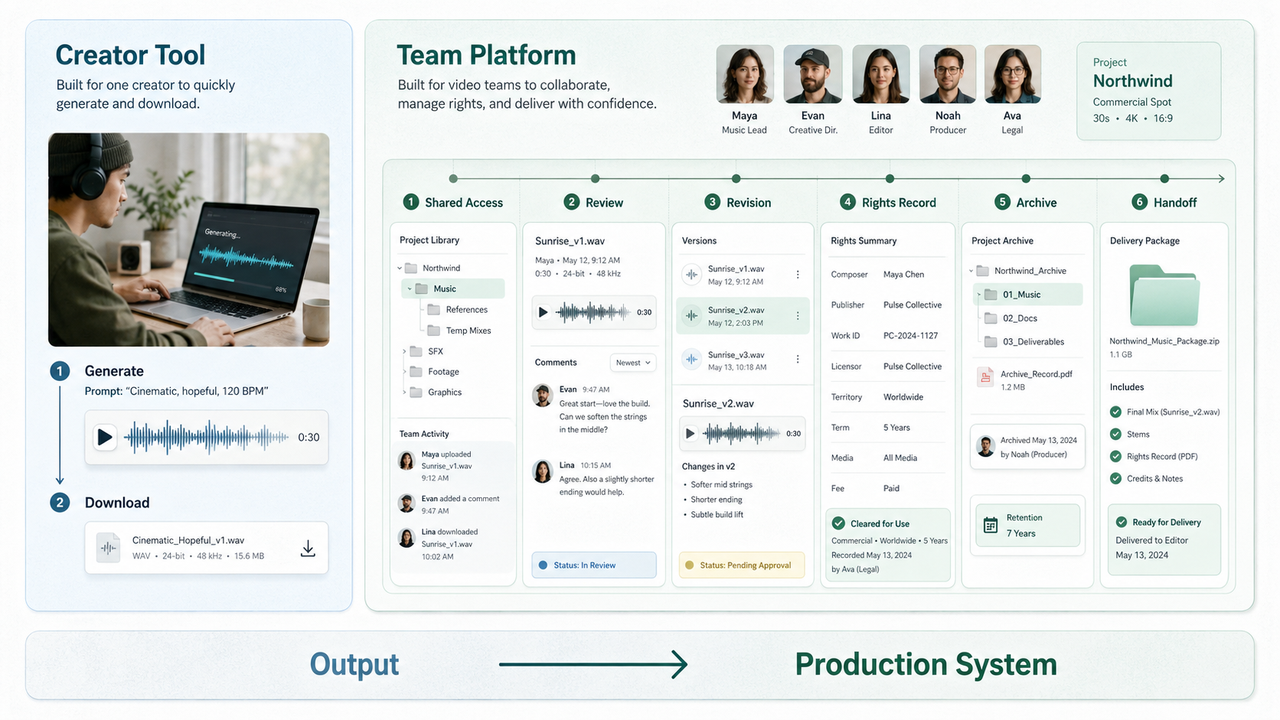
A creator tool solves an individual task. A platform supports a process that multiple people must operate, review, and maintain.
A small team may not need an enterprise system for every video. The threshold appears when work involves shared access, campaign variants, client delivery, automated generation, or later audits. At that point, the team needs more than a download button.
Use this editorial adoption matrix to identify the missing layer. It is a workflow framework, not a vendor standard.
| Team requirement | Platform evidence to request | Record the team must own |
|---|---|---|
| Several editors or reviewers | Roles, seats, or documented account structure | Owner, approver, access list, and offboarding route |
| Repeated or high-volume output | API, job handling, limits, and failure states | Request ID, source cut, status, result, and cost center |
| Client or campaign delivery | Stable export and revision workflow | Raw output, approved master, review date, and destination |
| Rights review | Current terms, plan rules, or enterprise agreement | Applicable source, account, intended use, and capture date |
| Vendor replacement | Exportable files and metadata | Team archive that remains usable after access ends |
The platform does not need to provide every column itself. It must expose enough reliable information for the team to complete the record in its own project system.
Platform features that matter for video teams
Current official materials show several valid platform models. They should be treated as evidence examples, not as an overall ranking.
Editorial disclosure: Sonilo publishes this guide and appears below as a video-first platform example. The comparison uses current official documentation and does not claim an independent performance benchmark.
| Platform example | Documented platform capability | Adoption boundary |
|---|---|---|
| Sonilo | Its API documentation covers video-to-music, video-to-SFX, task records, account services, and usage | Current public docs use task polling and do not document webhooks or a complete approval system |
| Mubert | Its API v3 documentation describes company and customer identities, track records, license objects, webhooks, and a pre-generated Track Store | Available features and deployment permissions can depend on the customer agreement |
| ACE Studio | Its Team Plan guide documents owners, seats, and separate personal or team identities; Video Composer keeps generated clips in an editable timeline | Video Composer remains labeled Beta, and separate identities require deliberate asset-transfer testing |
| SOUNDRAW | Its enterprise page separates a company web app from an API integration route | A team still needs to verify which account, API plan, and license document governs its deployment |
These pages were checked on August 28, 2026. The date matters because ACE Studio still labels Video Composer Beta, while Sonilo's current API reference documents polling rather than callbacks. Recheck those specific dependencies before adoption.
Team workflow and handoff
Team access must answer three questions: who can generate, who can approve, and what survives when either person leaves.
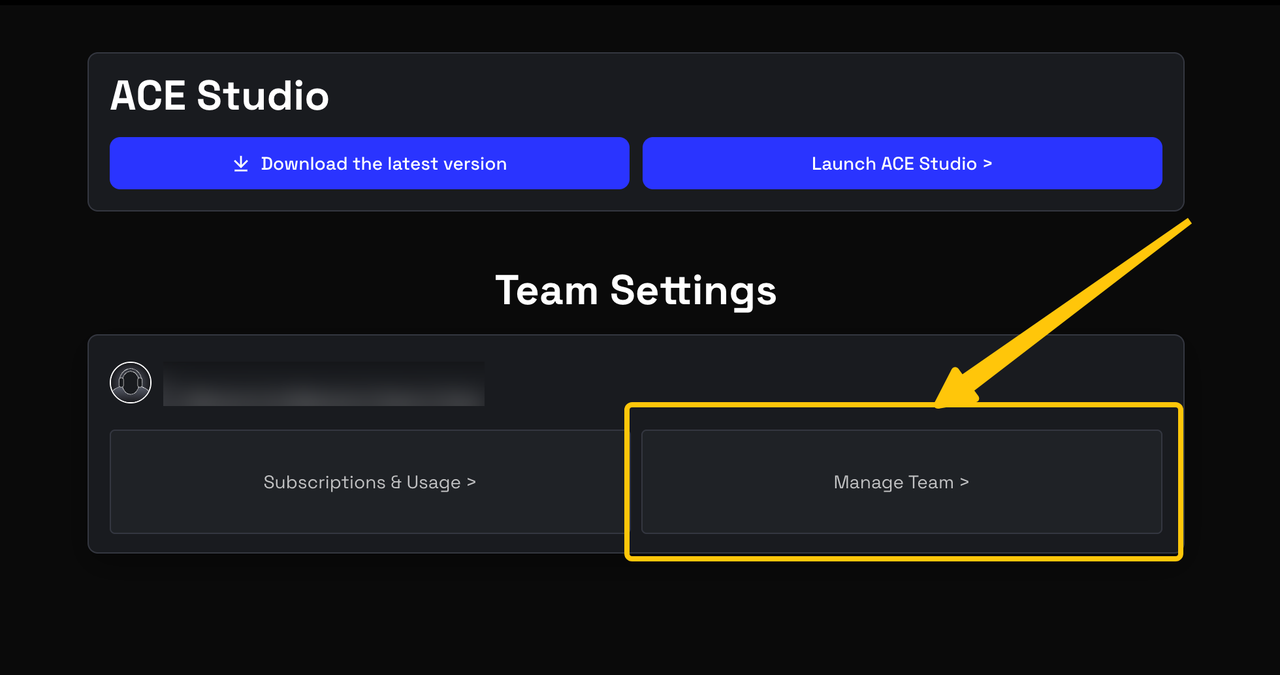
ACE Studio illustrates why account structure matters. Its support guide separates personal and team identities, with credits and assets tied to the selected identity. That can support a managed workspace, but it also creates a handoff test. Remove a trial member, then confirm that the owner can open the project, locate its audio, and understand its approval state.
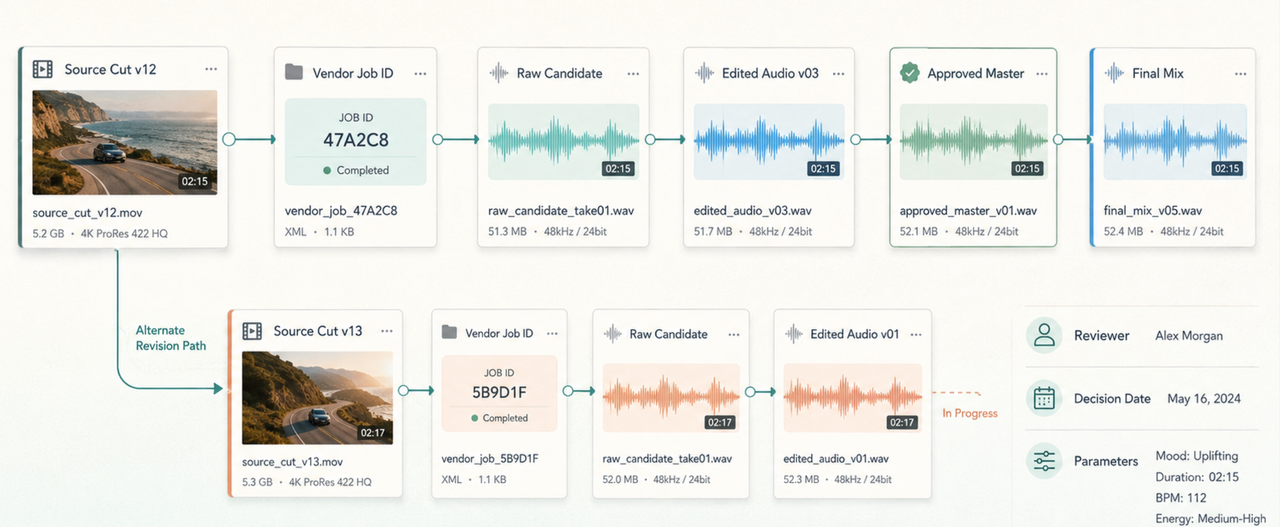
An AI music workflow should keep approvals outside private messages. Store the selected track beside the source cut, reviewer, decision date, and reason for replacement. The vendor workspace can remain part of the process without becoming the only archive.
API or batch generation needs
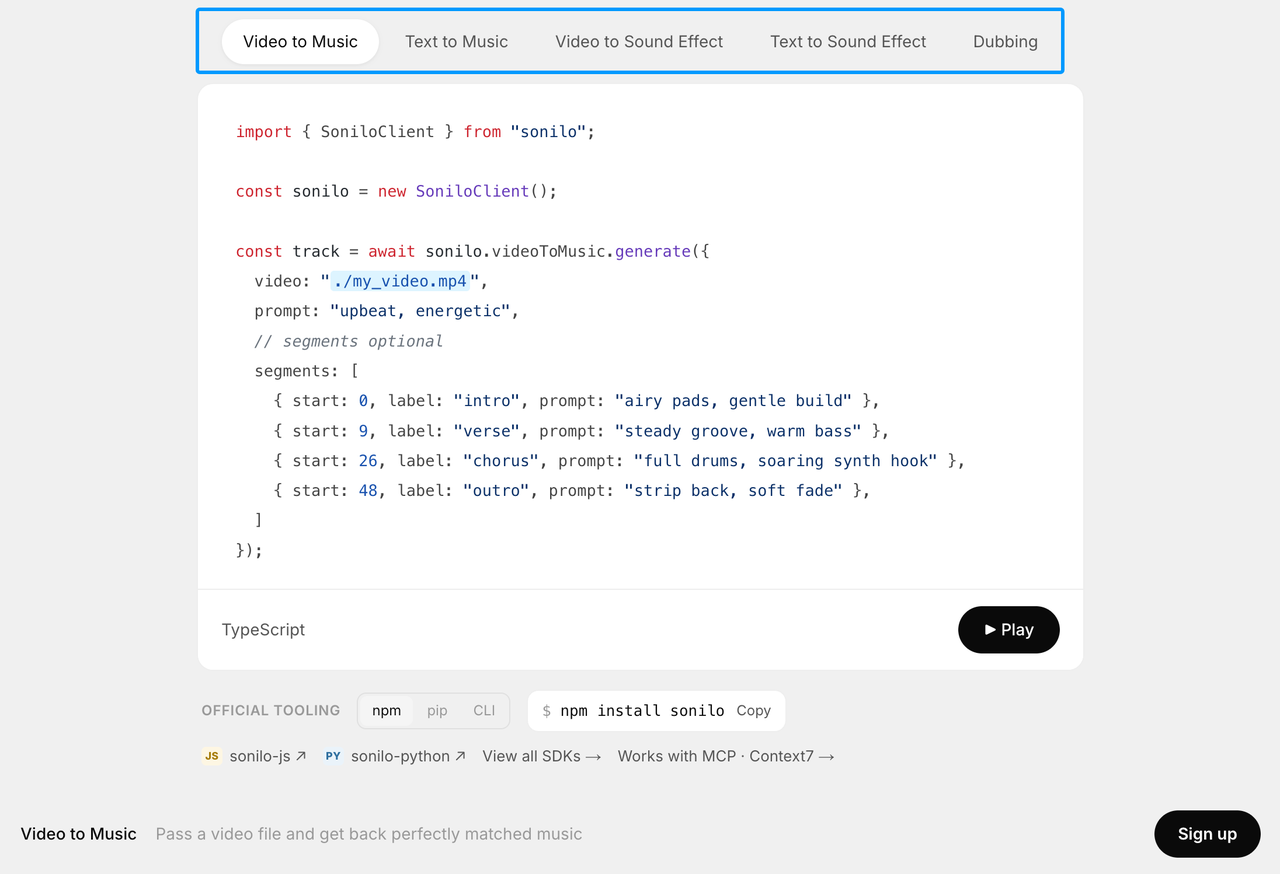
A video music API is useful when generation belongs inside a larger production pipeline. The engineering question is not merely whether an endpoint exists. The team must know how the system authenticates requests, reports failures, returns results, and exposes usage.
The current Sonilo reference documents streaming and asynchronous endpoints plus task polling. Mubert documents webhooks, customer identities, tracks, and a buffer of pre-generated music. SOUNDRAW presents its API as an integration route for products and multi-user services.
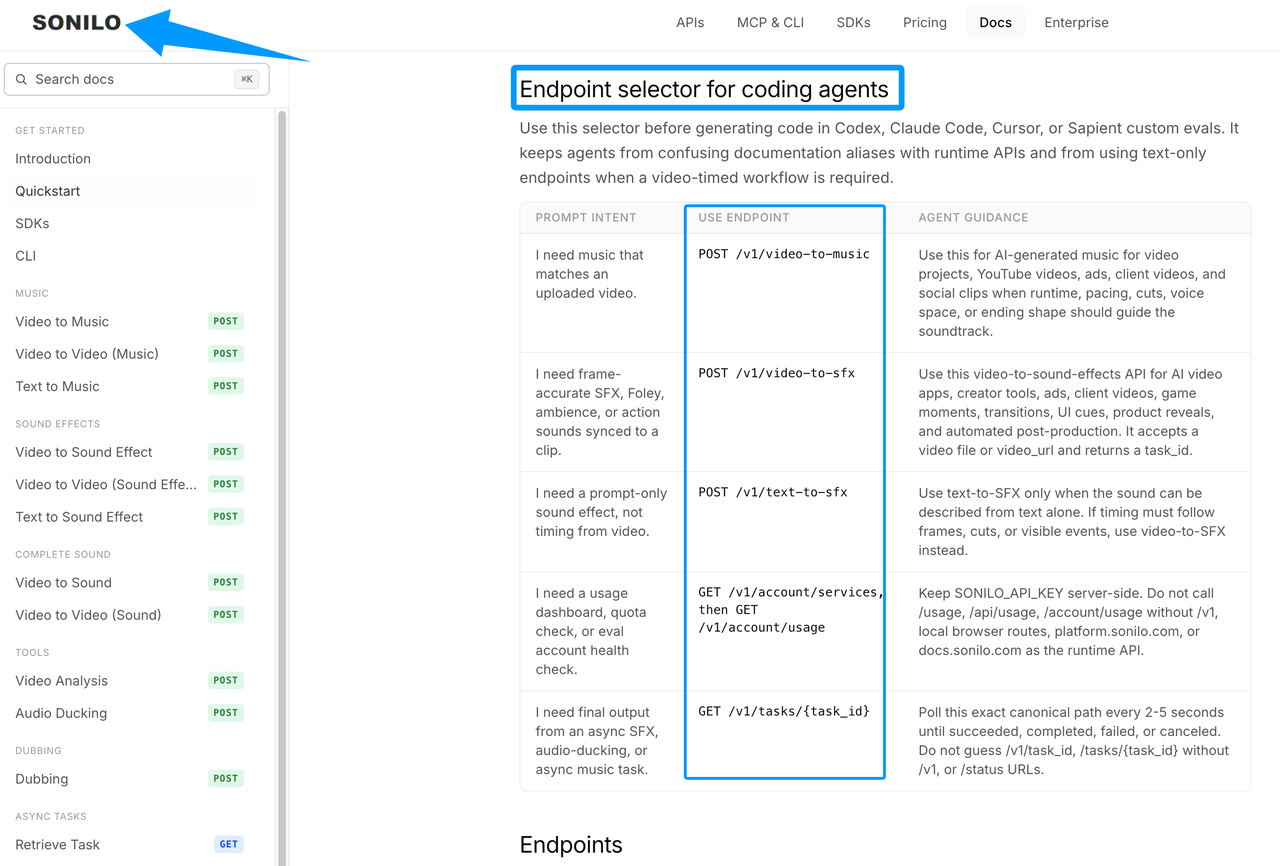
Those are different operating models. A polling service needs retry intervals and timeout ownership. A webhook service needs signature checks, duplicate-event handling, and a recovery path when delivery fails. Batch volume also needs agreed limits and cost monitoring; an API logo does not prove unlimited throughput.
Export and version control
Audio version control is usually a manifest, not source-code versioning. Give every candidate an internal asset ID, then link it to the vendor job or track ID, source-video version, parameters, export, reviewer, and decision.
Keep the untouched generation, the edited audio master, and the final mixed video as separate files. Never replace the approved master when the picture changes. Create a new version that records the new cut and explains whether the music was regenerated, trimmed, or remixed.
This structure also exposes a platform gap early. If a vendor cannot return stable identifiers or usable exports, the team must decide whether filenames and local metadata provide enough traceability before production begins.
Rights documentation
A licensed AI music platform is not established by a marketing badge alone. The record should identify the generating account, applicable plan or agreement, current terms URL, intended video use, and any restriction that affects delivery or reuse.
Vendor structures vary. Mubert's API can expose license-related objects while separate agreements may govern API use. ACE Studio maintains a feature-specific license page. Sonilo separates usage by account or plan through its licensing page and current Terms. SOUNDRAW publishes general and product-specific materials that teams should reconcile for the chosen workflow.
This is a documentation workflow, not legal advice. Review the current vendor terms, account or enterprise agreement, and destination-platform rules for the intended release. Before uploading client, confidential, unreleased, or third-party footage, also confirm input rights, confidentiality requirements, retention, and data-use terms.
How platforms differ from creator apps
A creator app optimizes the path from idea to output. A platform must also support the people and systems surrounding that output.
| Workflow layer | Creator app emphasis | Team platform requirement |
|---|---|---|
| Access | One account starts creating quickly | Team-owned credentials, roles, revocation, and a named owner |
| Generation | Prompt, style, or media input produces a track | Repeatable requests, limits, failure handling, and usage visibility |
| Review | Creator auditions and downloads | Reviewers compare candidates against the same source cut |
| Revision | User regenerates or edits a result | Each revision retains its source, status, and approval history |
| Archive | File remains in downloads or account history | Files, metadata, and rights records move to controlled storage |
| Exit | User cancels or changes apps | Team can retrieve approved assets and understand prior decisions |
Some products span both columns. ACE Studio combines an editor-facing workspace with team identities. SOUNDRAW distinguishes enterprise web use from API integration. Sonilo provides a video-first AI soundtrack platform route through its API, but the customer must supply review and asset governance.The distinction is therefore operational, not cosmetic. A polished interface can be useful to a team, while an API can still be unsuitable if nobody owns failures, approvals, or retention.
What to verify before adopting a platform
Run a limited pilot with production, engineering, operations, security, and the person responsible for commercial approval. Use a real but non-sensitive cut unless the data terms have already been cleared.
The pilot should produce evidence for these checks:
- Confirm that the required team feature, endpoint, or export still appears in current official material.
- Create, revoke, and rotate access without relying on one employee's personal account.
- Trigger a failed or delayed job and confirm who sees it, retries it, and records the outcome.
- Export the raw result and metadata into team-controlled storage.
- Recut the video, create a new soundtrack version, and preserve the earlier approval.
- Match each request to a source cut, requester, reviewer, usage destination, and cost record.
- Archive the applicable terms, plan information, agreement, and review date.
- Test the exit path by reconstructing one delivered soundtrack without vendor account history.
Call the pilot successful only when another team member can complete the reconstruction. A good track proves that generation worked once. A complete record proves that the workflow can be handed over.
If edit matching is the primary need, a team can run one approved test cut through Sonilo's video-to-music workflow and store the task record with competing outputs. Judge timing, revision effort, failure handling, export usability, and documentation together.
FAQ
How should audio records transfer after team changes?
Move them to a team-owned repository before access changes. Transfer the source-cut version, raw candidates, approved master, vendor identifier, parameters, review history, terms record, and release destinations. Assign a new owner, remove obsolete credentials, and ask that owner to reconstruct one decision before closing the handoff.
What if a vendor page disappears later?
Keep the original URL, capture date, plan name, agreement, and a dated PDF or screenshot in the project archive. That record shows what the team reviewed; it does not independently create usage rights. If the missing page affects an active release, request current written clarification before relying on the old summary.
How can old soundtrack decisions be traced months later?
Use one asset manifest that links the source cut, platform, request data, generated candidates, comments, approval, final master, and release locations. Stable internal IDs are more dependable than filenames such as “final-v4.” A future editor should not need personal chat history to understand why a track was retained.
Who updates source records after a project ships?
Name one asset owner in the release checklist. Depending on the team, that may be the producer, production-operations lead, or delivery editor. The owner closes the record at release and updates it when the soundtrack's destination, vendor agreement, or approved file materially changes.