Guides
Check Music to See If Its AI Generated or Not: 7 Checks
- Written by
- Sonilo Team
- Published
If you need to check music to see if it's AI generated or not, do not start by hunting for an uncanny vocal or a suspiciously smooth drum pattern. Start with where the file came from, what the source disclosed, and which creation records still exist.
Listening still has a role. So does an AI music detector. Neither should carry the conclusion alone.
Hi, I am Nico, and my rule is simple: build a defensible evidence trail rather than turning one technical signal into an accusation. In some cases, the most accurate classification will remain “undetermined.” That is a better result than false certainty.
Disclosure: Sonilo publishes this guide. Sonilo is mentioned only as an example of retaining generation records and is not an AI music detection service.
Can You Prove Music Is AI-Generated?
Sometimes you can reach a well-supported classification, but finished audio alone rarely proves the complete production history.
The strongest case comes from evidence that connects the file to its creation history: a disclosure from the source, a verifiable provenance record, generation or project records, and a consistent chain of delivery. Audio analysis can support that evidence or reveal a reason to investigate further.
This is where music provenance matters. The C2PA Content Credentials explainer describes provenance as information about an asset’s origin, modifications, and use of AI. It also makes two important limits clear: provenance is not a value judgment, and the absence of Content Credentials does not automatically make a file untrustworthy.
Use evidence levels instead of a binary guess:
| Classification | What supports it |
|---|---|
| Disclosed AI-generated | The creator, provider, or verifiable creation record identifies generative AI as the source |
| Disclosed AI-assisted | Records show AI was used for part of the process, but not necessarily the complete composition |
| Documented workflow without disclosed generative AI | Reliable project, session, contributor, and source records support the stated creation process, while not proving the absence of undisclosed AI use |
| Needs further review | Evidence conflicts, records are incomplete, or technical checks raise unresolved questions |
| Undetermined | Available evidence cannot support a responsible classification |
These labels describe the evidence you have. They do not decide ownership, licensing, authorship, or whether somebody complied with a platform policy.
7 Practical Checks for AI-Generated Music
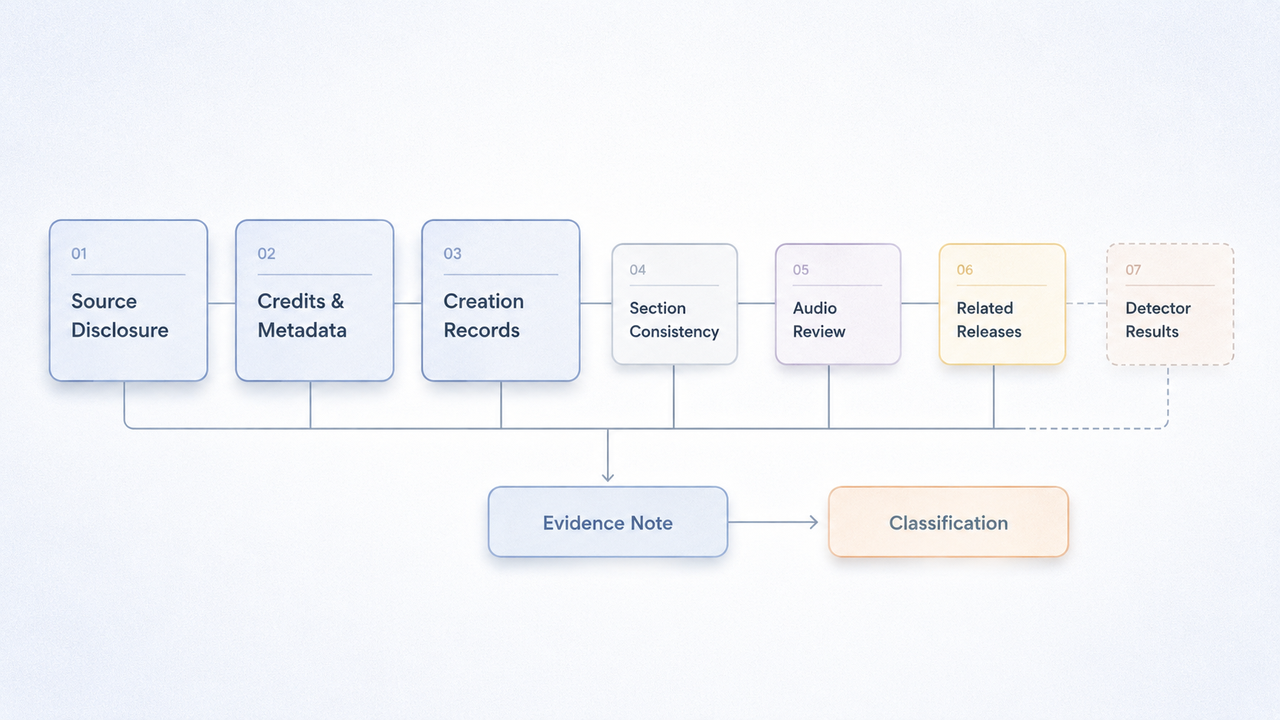
1. Review Source Disclosures
Start with the place where the track was obtained. Check the creator’s page, distributor listing, licensing page, delivery email, release notes, and any declaration attached to the asset. Look for specific language about whether the music was generated, edited, mastered, or assisted with AI.
Save the statement with its URL and review date. A disclosure can change or disappear, and a vague label such as “made with AI” does not explain which parts of the workflow involved it. Record the wording without expanding it into a stronger claim.
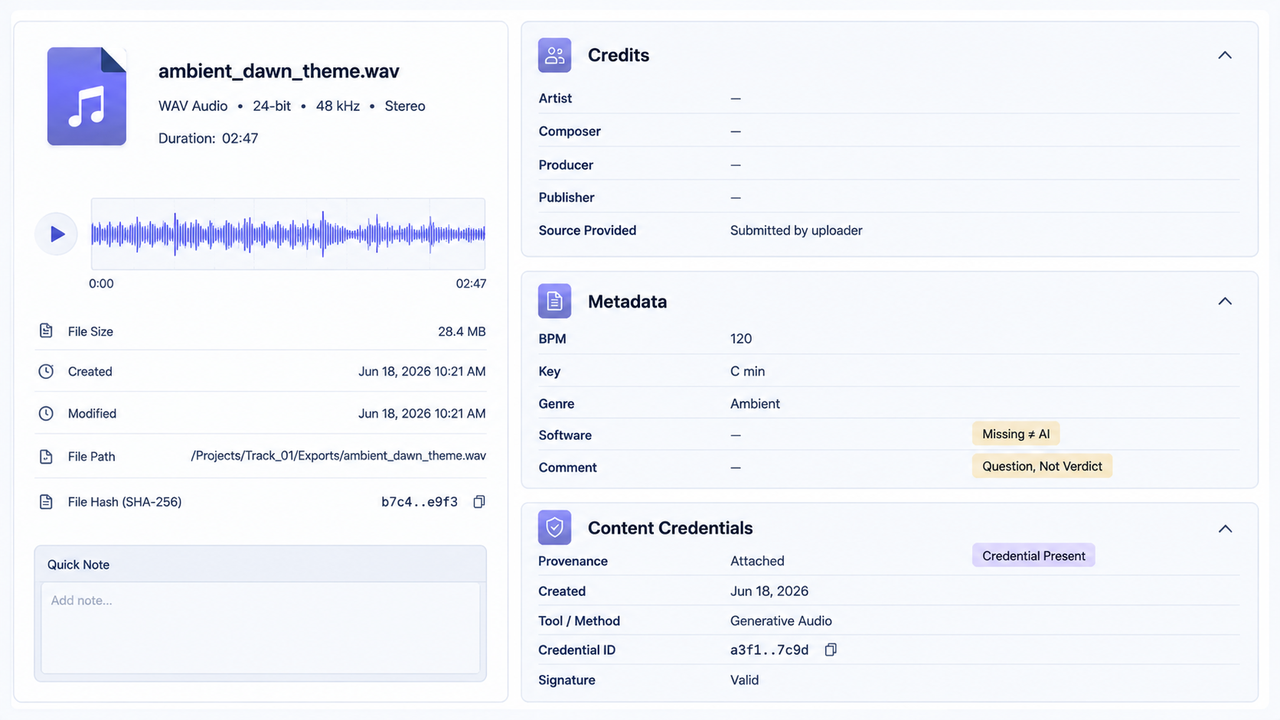
2. Inspect Credits and Metadata
Inspect the file’s visible credits and technical music metadata. Useful fields may include title, artist, composer, publisher, ISRC, creation software, comments, export date, and embedded provenance information. Compare those fields with the source page and delivery records.
Ordinary metadata is a clue, not proof. It may be missing, copied forward, changed during export, or removed by a platform. A valid signed provenance credential can provide stronger evidence that the credential and linked asset have not been altered. It does not establish that every assertion inside the credential is factually true, and C2PA notes that provenance may be incomplete or removed from a file.
Missing metadata should therefore create a question, not a verdict.
3. Request Creation Records
For client, publishing, distribution, or other higher-stakes use, ask the provider for records that explain how the track was made. Depending on the workflow, that could include a project file, dated exports, stems, session screenshots, revision history, generation job records, prompts, invoices, contributor credits, or a written production declaration.
Do not demand one particular artifact as universal proof. A traditional composer may not have generation logs, while an AI-assisted production may still contain human performance, arrangement, and mixing records. What matters is whether the materials form a coherent timeline around the delivered audio.
4. Compare Sections for Consistency
Listen across the whole track rather than judging the opening. Compare recurring choruses, instrumental returns, transitions, vocal identity, ambience, stereo placement, and the way notes or effects decay. Mark changes that are difficult to explain from the arrangement alone.
This check can reveal where closer review is useful, but inconsistency is not exclusive to generated music. Sampling, aggressive edits, stem replacement, restoration, time stretching, and deliberate sound design can produce similar results. Treat the observation as a timestamped question for the source or reviewer.
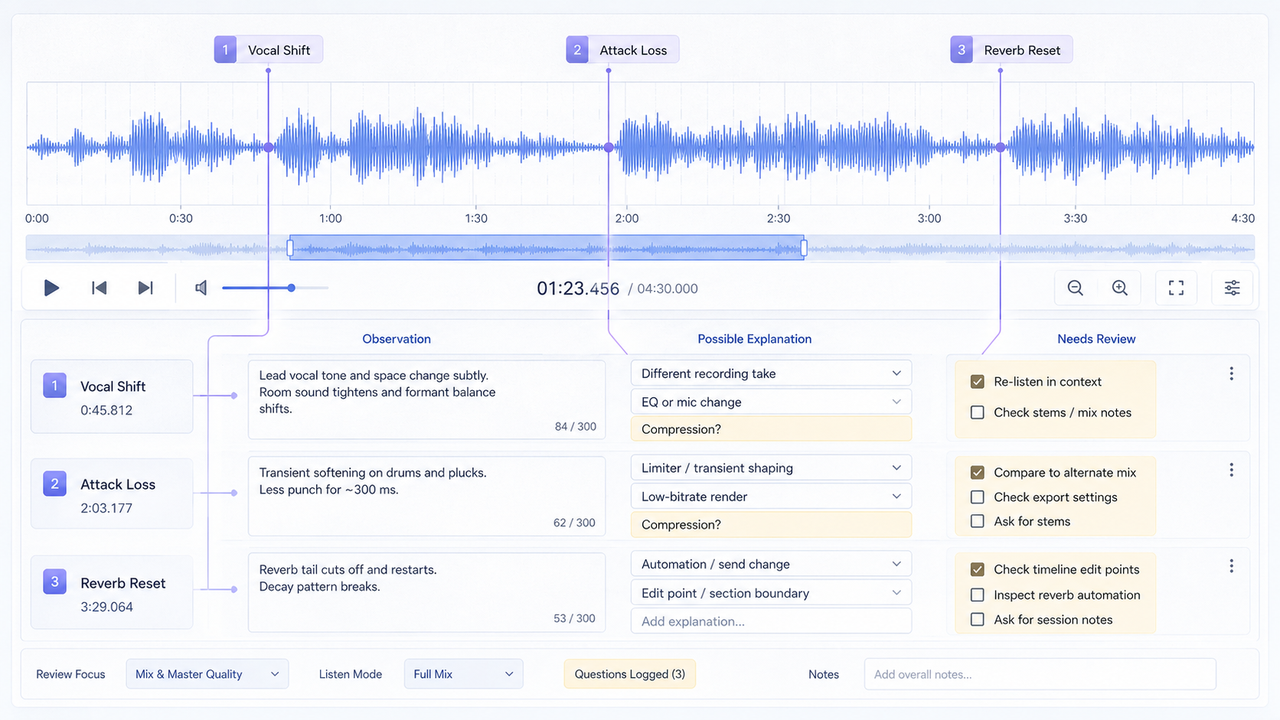
5. Identify Audio That Needs Further Review
Flag specific moments rather than writing “sounds AI.” Examples might include a vocal timbre that changes mid-phrase, an instrument that loses its physical attack, a reverb tail that resets abruptly, or a repeated passage that returns with unexplained internal differences.
Then test ordinary explanations. Compare the lossless file with the platform copy, listen before and after the mastering stage if both versions exist, and check whether compression or source separation introduced the artifact. AI audio detection begins with disciplined elimination, not pattern matching by instinct.
6. Compare Related Releases
When the source has other releases, compare credit conventions, production notes, vocal identity, arrangements, and delivery records across them. A sudden change may justify a question, especially if the disputed track also lacks normal documentation.
It still does not prove generation. Artists change collaborators, instruments, studios, genres, and production methods. Use related releases to test whether the supplied story is internally consistent, never to decide that a creator “does not sound capable” of making the track.
7. Treat Detector Results as Secondary Evidence
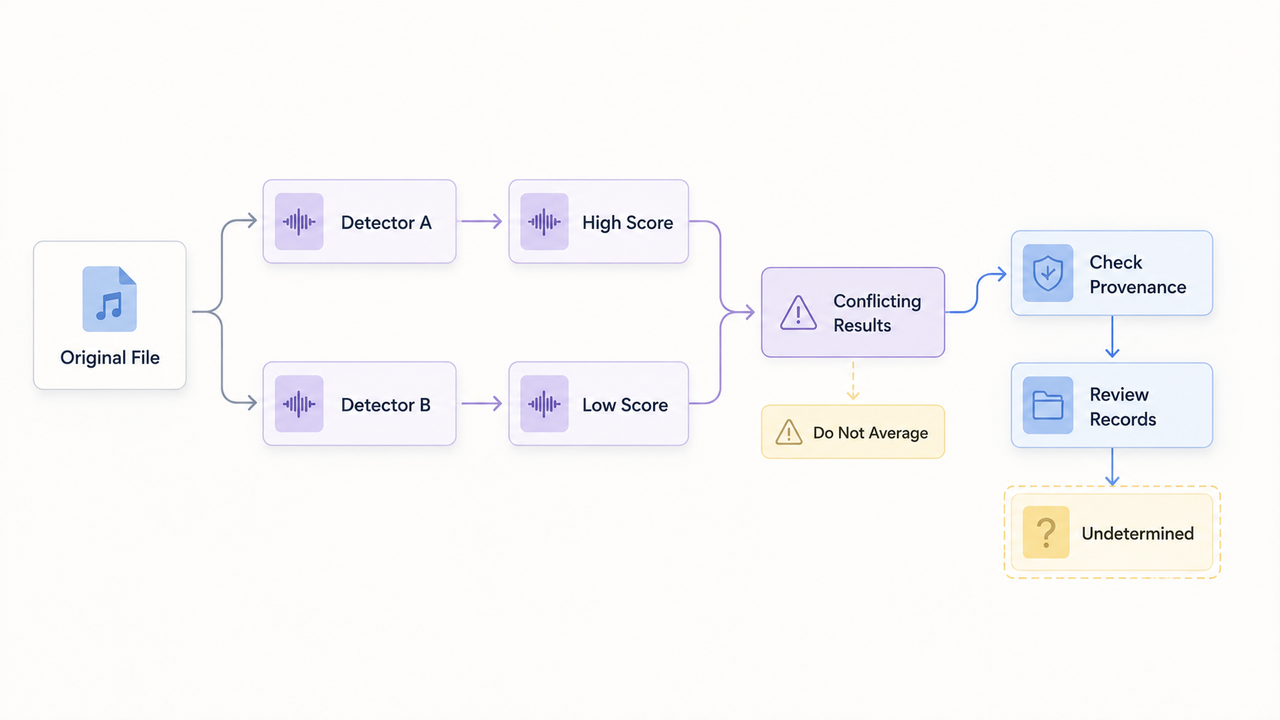
Use a detector only when the stakes justify it, preferably one with published validation relevant to the type and quality of audio being reviewed. A second detector may reveal disagreement, but multiple tools do not become independent proof merely because their scores agree.
Record each tool’s name, model or version, date, file format, duration analyzed, threshold definition, and complete output. Do not reduce a probability score to a factual label unless the provider clearly defines and validates that threshold for the material in question.
Detector performance depends on training data, audio quality, compression, post-processing, and whether the system has seen outputs from the relevant generator. The ICML 2026 MusicDET paper reports that conventional discriminative detectors can suffer substantial performance degradation when tested on music from previously unseen generators.
That finding supports caution about false positives and false negatives. It does not establish a universal accuracy rate for every detector, generator, or post-processed audio file.
If detector results disagree with one another or with stronger provenance records, report the conflict. Do not average the scores until they look decisive.
What Detection Results Cannot Prove
A detector result cannot establish who wrote the melody, who performed a part, who owns the recording, or whether the person supplying it has the required rights. It also cannot reliably distinguish every form of assistance from full generation.
The same limit applies in the other direction. A low AI probability does not prove a fully human workflow. A high score does not identify the generator or establish misconduct. The system is classifying patterns according to its own training and threshold, not interviewing the people involved.
Provenance records answer different questions. They may show what a signed workflow declared and whether that record remained attached without tampering. C2PA itself explains that provenance cannot determine whether the underlying content is true or accurate. Rights and compliance decisions still require the applicable agreement, tool terms, contributor records, and platform rules.
Build a Documented Soundtrack Review Process
Use the same review sequence for every submitted track:
- Preserve the original file and record where and when it was received.
- Save the source disclosure, credits, metadata, and available provenance.
- Request creation records when the intended use or risk level requires them.
- Log audio observations with timestamps and possible non-AI explanations.
- Run detectors only as supporting checks and retain their full reports.
- Assign a classification with an evidence note and a named reviewer.
- Escalate disputed or high-impact cases instead of publishing an accusation.
Keep “undetermined” available. A review process becomes unreliable when the team feels forced to produce a yes-or-no answer from incomplete material.
Do not publicly identify a track or creator as AI-generated, deceptive, or non-compliant based only on detector scores, missing metadata, or stylistic impressions. Keep unresolved findings in neutral evidence categories and obtain qualified review before communicating a high-impact allegation outside the review team.
Sonilo is a music and sound-effects generation service, not an AI music detection service. Its inclusion here does not support any detection claim. For a soundtrack generated through Sonilo, retain the available project and export records, source disclosure, plan information, and the applicable Terms of Service reviewed for that use.
Those records support traceability for that soundtrack. They do not establish facts about an unrelated audio file.
FAQ
Can Partially AI-Assisted Music Be Classified as Fully AI-Generated?
Not from the label “AI-assisted” alone. Record which stages used AI, such as ideation, stem generation, editing, restoration, or mastering, and which contributions came from people or other sources.
Use “fully AI-generated” only when reliable disclosure or creation records support that scope. A detector score cannot reconstruct the complete creative workflow.
Does Mastering Remove Useful Provenance Clues?
Mastering can change spectral balance, dynamics, loudness, encoding, and other signals a detector may use. Exporting or platform processing may also remove ordinary metadata.
That can make some technical clues less reliable, but it does not erase external records such as project history, signed statements, invoices, or archived disclosures. Compare pre-master and master files when both are available.
Who Should Review a Disputed Classification?
Use a reviewer who is independent of the initial decision and understands the type of evidence in dispute. That may be an audio engineer, provenance specialist, forensic audio examiner, platform-policy owner, or legal professional for a high-risk rights matter.
The reviewer should receive the original file, records, detector reports, and decision log, not only a screenshot of one score.
What Records Should Video Teams Retain After Accepting a Track?
Keep the original and accepted exports, source URL, creator or provider disclosure, credits, relevant metadata, contract or license, invoice, project or generation record, and the applicable terms reviewed at acceptance.
If detectors were used, retain their versions, dates, inputs, and full outputs. Document who approved the track and why. This is operational guidance, not legal advice.
The responsible question is not “Can I make this look conclusive?” It is “What does the available evidence actually support?”
Where does your current soundtrack intake process leave the biggest gap: source disclosures, creation records, or review ownership?