Guides
Sound Effects for Games: Where AI Fits and Fails
- Written by
- Sonilo Team
- Published
Game audio has to tell the player something. A hit confirms contact. A menu click confirms input. A distant warning changes where the player looks next.
That makes sourcing sound effects for games a production choice, not a contest between old and new tools. Recording gives you a performance. Libraries give you familiar building blocks. AI can produce variations when the event is hard to find or describe with one stock label.
The best source depends on what the sound must communicate, how stable the game is, and how much cleanup the team can afford.
Decide What the Game Sound Must Communicate
Start with the player's decision. Is the sound confirming success, warning about danger, locating an object, selling physical weight, or simply filling the world?
A sword impact used for combat feedback needs a readable attack. An environmental drip can be softer and less exact. A menu confirmation should remain clear after hearing it hundreds of times. Those jobs lead to different source choices even when all three files sound impressive alone.
Separate functional sounds from decorative ones. Functional audio carries gameplay information and deserves early testing. Decorative audio supports character and atmosphere, but it should not disguise an unclear cue.
Compare Recorded, Library, and AI Sound Effects
No source wins every category. Small teams usually get better results by mixing them deliberately.
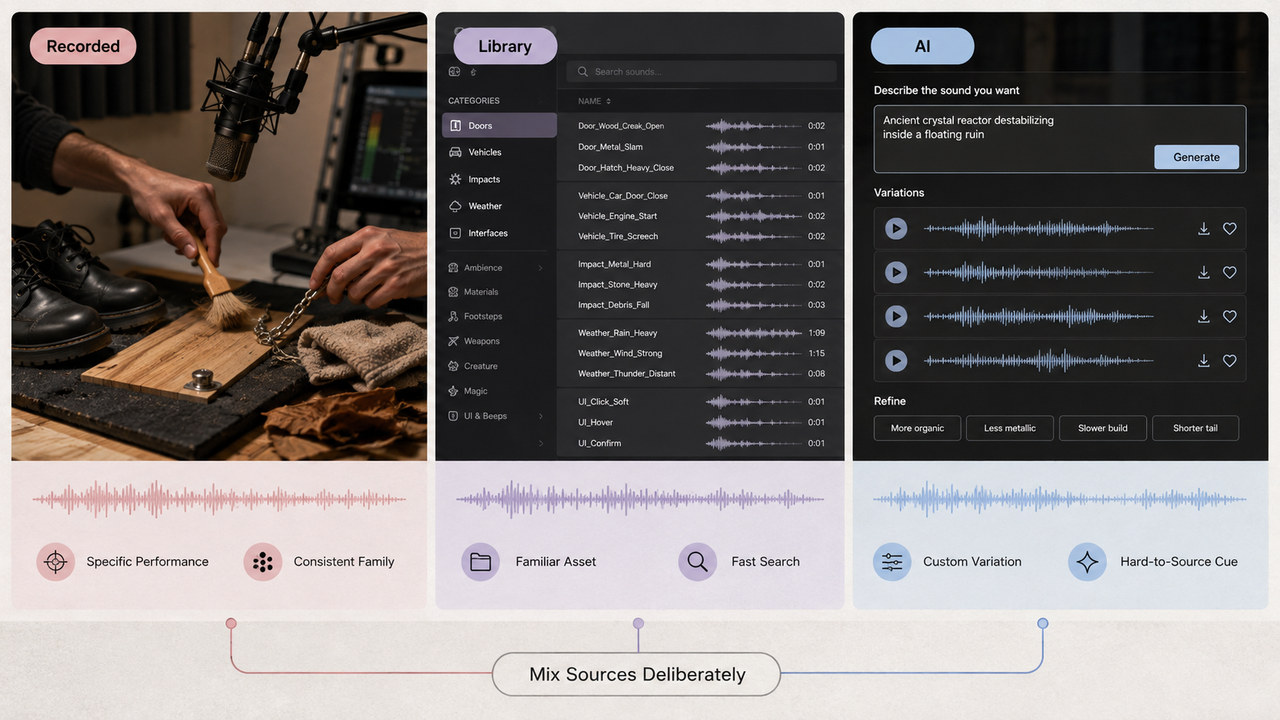
Recorded Audio for Specific Performances
Record when the performance itself matters: a particular creature breath, prop movement, vocal effort, or tactile interaction. A performer can react to pacing and character in ways a search result cannot.
Recording also gives the team raw material for a coherent family. Several footsteps captured with the same shoe, surface, room, and microphone naturally belong together.
The cost is time and control. Noise, room reflections, inconsistent distance, clipping, and weak takes can create more editing than expected. Recording identifiable voices or performances also requires the appropriate permission and release terms.
Libraries for Familiar Production Assets
Libraries work well for common assets such as doors, weather, vehicles, impacts, room tones, interfaces, and mechanical movement. They are especially useful when the team needs a proven sound quickly and can shape it to fit.
The search can become the expensive part. Similar filenames may hide very different perspectives, tails, and recording conditions. A strong file may still clash with the rest of the game because it sounds too cinematic, too realistic, or recorded in another acoustic space.
Treat “royalty-free” as a licensing model, not a promise of unlimited use. Check whether the asset covers commercial games, team sharing, modification, engine distribution, attribution, and downloadable source files.
AI for Custom Variations and Hard-to-Source Events
AI game sound effects are useful when a team needs several directions for a fictional event, an unusual texture, or a sound that sits between library categories. Text-to-SFX can help with standalone ideas. Video-to-SFX becomes relevant when an animation, cinematic, or captured gameplay moment should guide timing.
Sonilo's current API documentation lists both text-to-SFX and video-to-SFX. The first uses a description and duration; the second accepts video input for synchronized effects. Those inputs were verified on September 2, 2026. They establish available workflows, not independent proof of output quality.
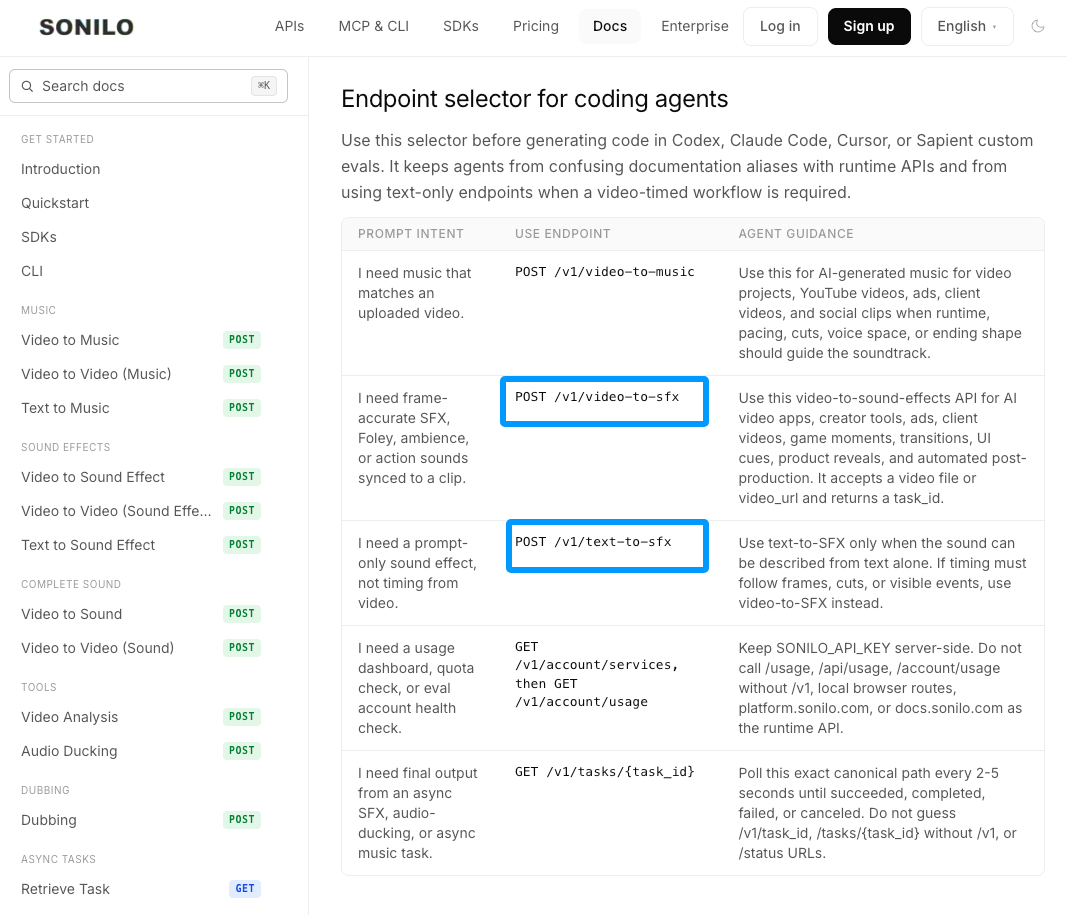
Editorial disclosure: Sonilo publishes this guide.
AI is weaker when the asset needs a repeatable performance language, guaranteed exclusivity, or precise continuity across many related cues. Generation can produce options quickly, but the team still has to choose, edit, organize, and test them.
Match the Source to the Game's Production Stage
During prototyping, speed matters more than polish. Library placeholders and rough AI variations can make an interaction audible before the art and animation are final. Label them as temporary so a convenient placeholder does not quietly become a shipping asset.
As mechanics stabilize, replace or refine the sounds that carry player feedback. This is the point to record signature performances, build consistent variations, and remove cues that no longer match the animation.
Near release, new generation becomes more expensive. A replacement sound can affect mix levels, subtitles or accessibility cues, localization notes, memory budgets, and every scene that references the asset. Freeze critical families early enough to test them as a system.
Evaluate Consistency Across an Asset Family
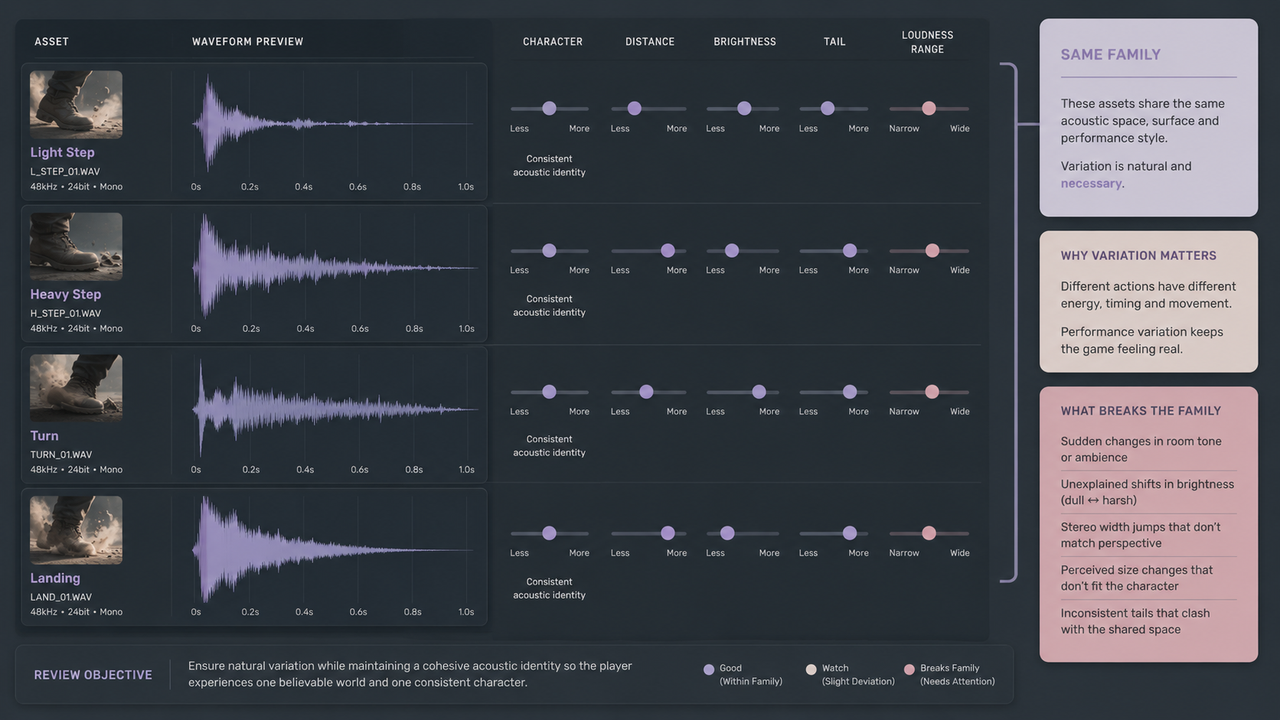
One good footstep is not a footstep system. The set needs enough variation to avoid obvious repetition while preserving the same character, distance, surface, and loudness range.
Review related assets in sequence: light and heavy attacks, menu confirm and cancel, small and large pickups, or several creature reactions. Listen for sudden changes in room tone, stereo width, brightness, tail length, and perceived size.
AI variations may drift even when the description stays similar. Library files may come from different collections. Recorded takes may change as the performer or microphone moves. Normalize only after deciding whether the underlying performances actually belong together.
Review Looping, Noise, and Playback Risks
Ambience, machinery, engines, magical hums, and menu beds may need seamless loops. A file can have the right mood and still click at the seam, pulse unnaturally, or reveal a repeating event too quickly.
Check the beginning and ending at normal speed, then listen through several cycles. Remove DC offsets, abrupt level changes, and tails that cannot reconnect cleanly. Do not assume an AI-generated duration is automatically loop-ready.
Test the asset inside the game, not only in an audio editor. Pitch variation, random playback, spatial attenuation, compression, device speakers, and simultaneous effects can expose noise or harshness that solo listening hides.
Plan for Engine and Team Constraints
Before approving a source, confirm the file formats, channel layout, sample-rate policy, compression settings, naming rules, memory targets, and version-control limits the project actually uses.
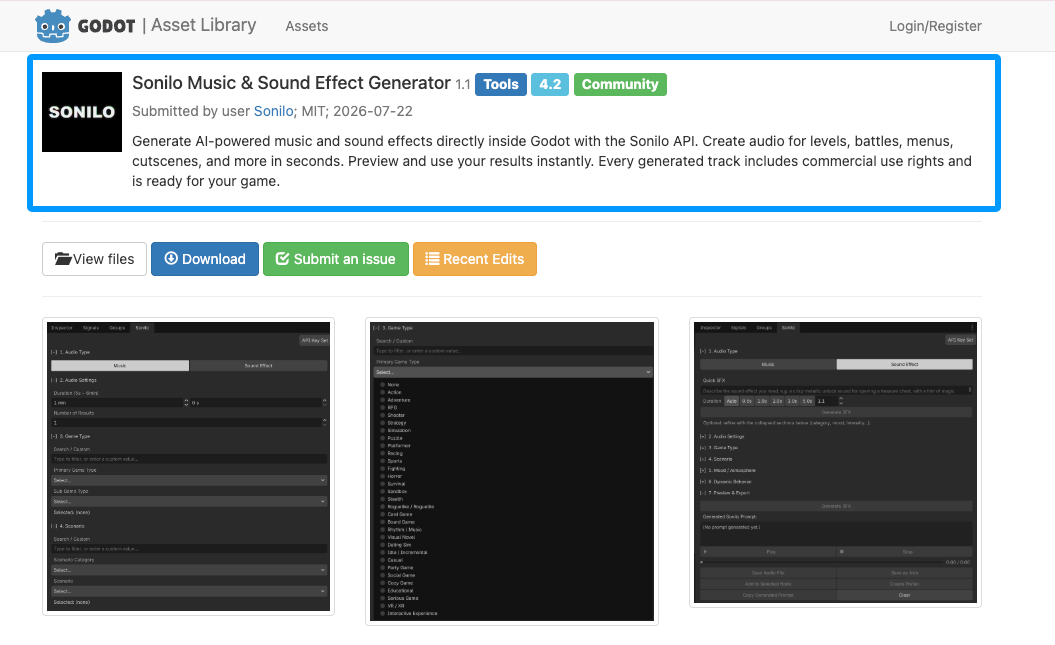
The official Godot Asset Library lists Sonilo Music & Sound Effect Generator 1.1 as a community tool for Godot 4.2. The entry identifies its license as MIT. That listing is evidence of an available integration, not a guarantee for every Godot release or production setup. Recheck the supported version and current files before adopting it.
Keep generated, recorded, and licensed source masters outside the engine import cache. The project should retain the editable master, game-ready export, source information, and notes explaining where each asset is used.
Verify Rights Before Production Use
For every source, record who created or supplied the asset, which license or agreement applies, whether attribution is required, and whether commercial game distribution is covered. Also check modification, sublicensing, team access, storefront, DLC, trailer, and source-file restrictions where they matter.
Do not assume an AI output is exclusive. For Sonilo, review the current licensing page together with its Terms of Service. The Terms state that similar or identical outputs may be generated for other users. The applicable account, plan, and terms still control permitted use. Other providers may define these points differently.
Upload only gameplay, animation, audio, or reference material the team has permission to provide. For a distinctive branded sound or asset intended to carry long-term identity, obtain appropriate professional advice rather than relying on a general product page.
This section provides general information, not legal advice. Verify the current license, attribution, commercial scope, and exclusivity terms before the asset enters production.
FAQ
Should accessibility reviewers evaluate critical game sounds?
Yes. Sounds that communicate danger, success, navigation, timing, or status should be reviewed alongside visual and haptic alternatives. The goal is not to make every cue louder. It is to confirm that essential information remains available when players cannot hear, distinguish, or comfortably tolerate the original sound.
Who should resolve conflicts between audio style and gameplay feedback?
The audio lead and gameplay designer should decide together, with the creative director involved when the choice affects the game's identity. If a stylish cue hides timing or direction, gameplay readability usually deserves priority. Preserve the stylistic version as a reference rather than quietly mixing both goals into an unclear sound.
When should playtesters evaluate sound without music?
Test without music when combat, navigation, interfaces, or hazards depend on precise cues. Removing the score reveals weak attacks, confusing priorities, and missing ambience. Then restore the music and repeat the test, because a cue that works alone may disappear inside the full mix.
When is a specialist sound designer worth the added cost?
Bring in a specialist when the game needs a recognizable sonic identity, complex interactive systems, difficult recording, extensive implementation, or a final mix across many platforms. A smaller consultation can also help establish an asset family and technical standard before the team produces hundreds of files.
How should a team budget for late audio revisions?
Reserve time for replacement generation or recording, editing, engine setup, mix changes, regression testing, and updated rights records. Budget by affected asset family rather than by file count alone. One changed player action may require several variations, platform exports, scenes, and accessibility checks.