Guides
How to Make a Similar Song With AI Without Copying
- Written by
- Sonilo Team
- Published
“Make it like this song” sounds clear until you ask what “like” means. The client may want its quiet confidence, its steady climb, or simply the way it makes a product reveal feel expensive.
If you need AI to make a similar song, do not feed the request back as an artist name or near-copy instruction. Treat the AI reference track as a video brief: keep abstract traits and replace recognizable parts.
That process lowers avoidable risk; it does not guarantee originality or rule out infringement. This is practical production guidance, not legal advice.
Start With the Video, Not the Song You Want to Copy
Open the locked cut before the music generator. Mark the scenes that need restraint, movement, contrast, or resolution. Then ask what the reference is doing at those points.
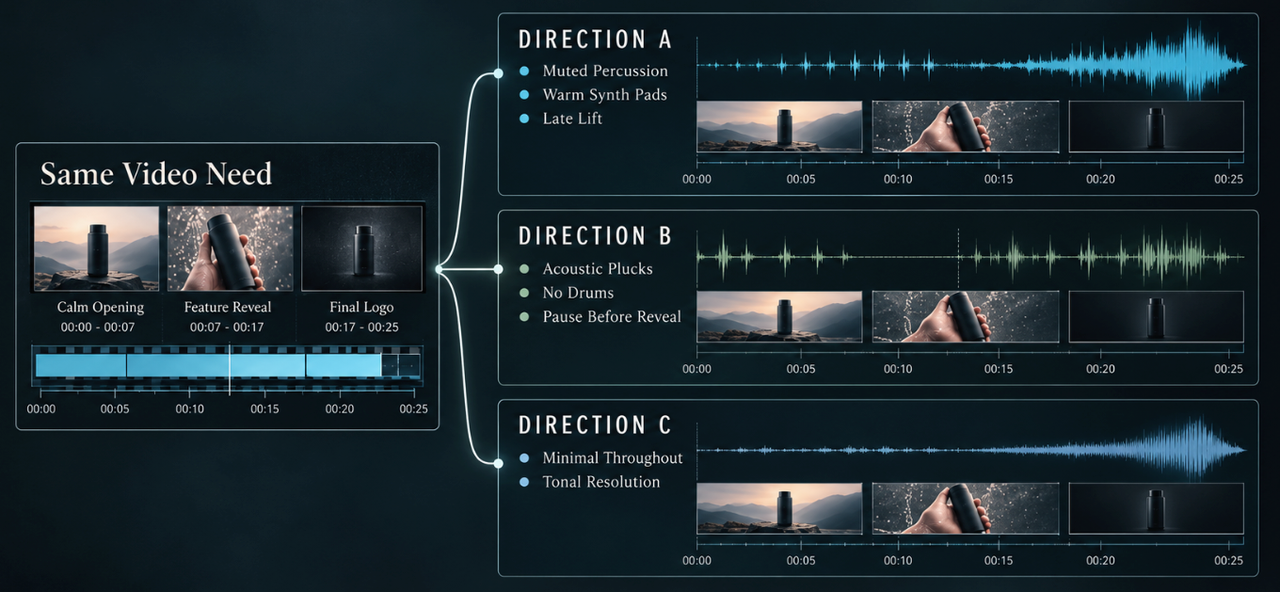
A product video may need a calm opening, a lift under the feature reveal, and a clean logo ending. That is a better brief than “make something like Track X.” It describes what the video needs without asking for somebody else’s expression.
If the cut itself should guide timing, a video-first soundtrack brief can help separate visual markers from musical imitation. Sonilo publishes this guide and offers video-to-music generation; that relationship is disclosed here, and its product page is not proof of legal clearance.
Define What the Reference Is For
Give each reference one or two jobs. A track used for energy should not quietly become the template for melody, arrangement, sound design, and mix at once.
Mood and Energy
Describe emotional movement in plain terms: restrained to hopeful, uneasy to relieved, or steady with one brief lift. Add where that change belongs in the picture.
Avoid copying an unusual sequence of dramatic turns. Keep the function—“make the reveal feel earned”—while designing a different route to it.
Tempo and Instrument Palette
Use a tempo range or movement level, not a command to duplicate the exact pulse. “Moderate pace with room for speech” is more useful than chasing one BPM number from the reference.
Treat instruments as roles. You may want a soft rhythmic bed, a warm low register, and a light accent at transitions. Choose different timbres, articulations, and combinations rather than rebuilding a distinctive ensemble sound.
Arrangement and Emotional Arc
Map what each section does for the video: establish, support, lift, release, stop. Do not copy the reference’s bar-by-bar order or the exact timing of its breaks.
For a 45-second product edit, your arc might use three video markers instead of a song structure: opening problem, feature demonstration, final benefit. The picture now owns the arrangement.
Turn the Reference Into an Original Soundtrack Brief
To make music from a reference song, use a brief that still works after removing its title and artist. This is Sonilo’s editorial method, not a legal test.
| Reference observation | Brief language to keep | What to replace |
|---|---|---|
| The track feels controlled, then opens up | Restrained opening; wider energy at the product reveal | Its exact build, chord movement, and transition sound |
| The mix leaves room for narration | Sparse midrange under speech; accents between sentences | Its melody, vocal cadence, and instrument voicing |
| The ending feels decisive | Short resolved ending at the final logo | Its signature hook, final phrase, and recorded sound |
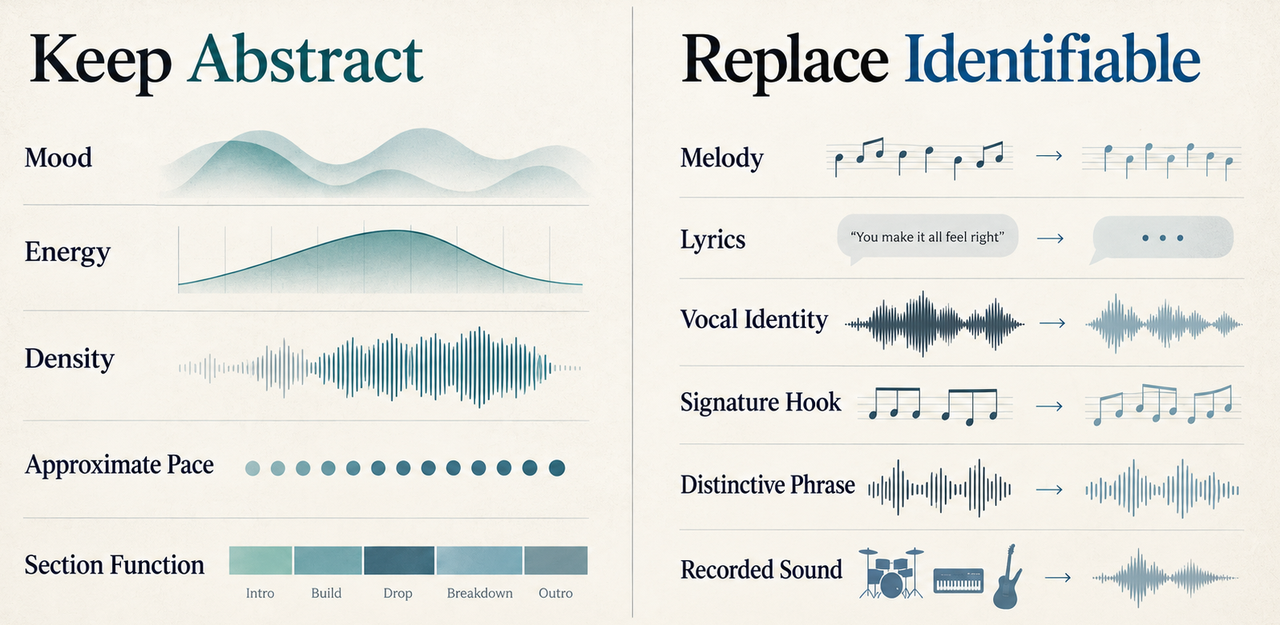
Keep Abstract Musical Traits
Mood, broad energy, density, approximate pace, and section function can communicate intent. Use several references when possible, each answering a different question. One might clarify narration space; another might clarify the ending.
Abstract does not mean automatically safe. A highly specific combination of choices can still produce a result that feels recognizably close. Listen to the whole combination, not only each field in isolation.
Replace Identifiable Creative Elements
Exclude the reference melody, lyrics, sampled audio, vocal identity, signature hook, and distinctive recurring phrase. Do not ask the model to paraphrase lyrics or remake a chorus with small note changes.
Changing key, BPM, or instruments is not a reset button. The U.S. Copyright Office distinguishes the underlying musical work from the sound recording. A new recording does not erase questions about copied composition, and a new composition does not authorize use of the old recording.
Generate Several Distinct Directions
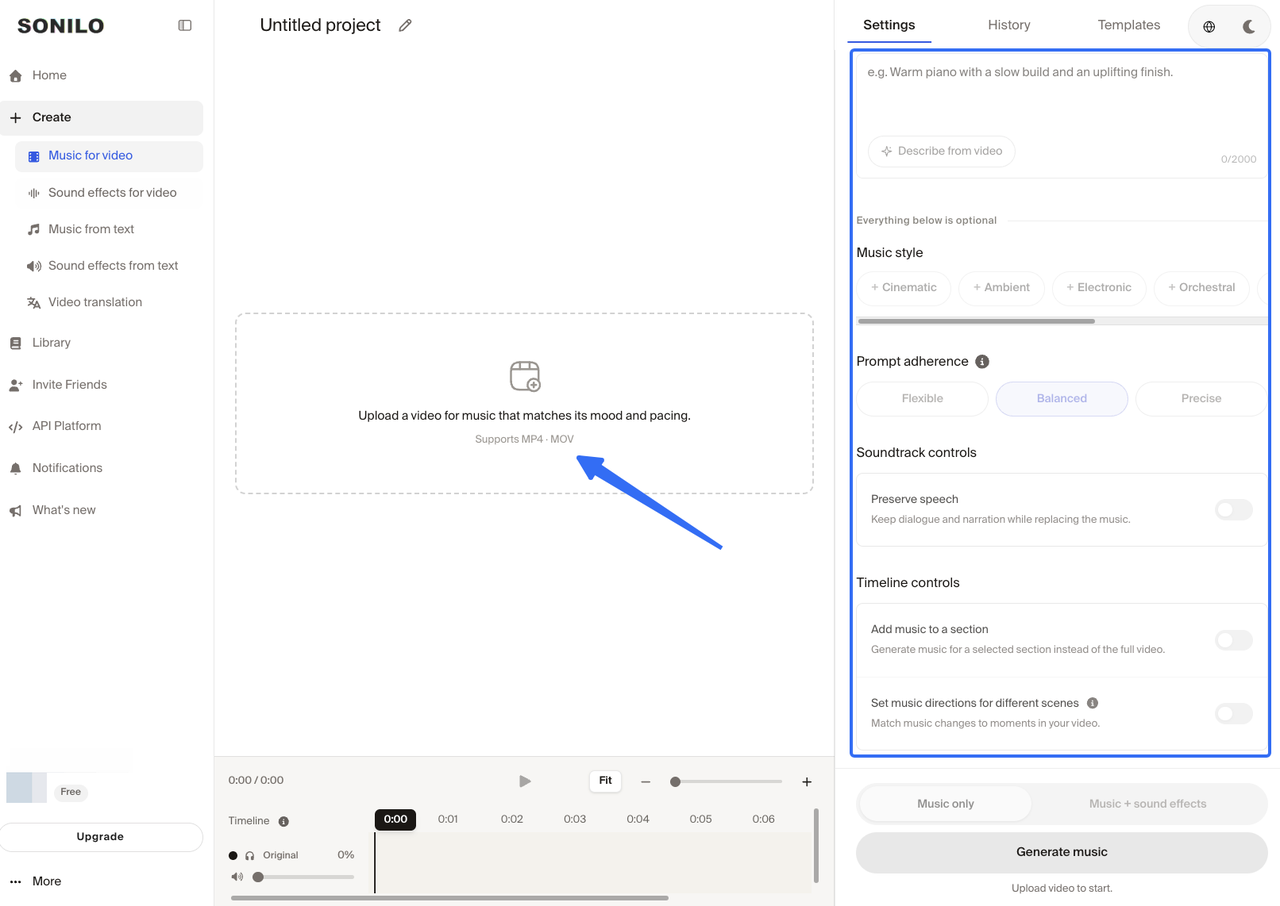
Do not generate tiny variations of the same instruction. Write two or three briefs that solve the video differently, then label what makes each route distinct.
Change the Instrumentation and Structure
Direction A might use muted percussion and warm synth pads with a late lift. Direction B could use plucked acoustic textures, no drums, and a short pause before the reveal. Direction C might stay minimal throughout and resolve with a single tonal change.
The goal is not difference for its own sake. Each direction should solve the same visual problem while avoiding one inherited musical shape.
Test Each Option Against the Edit
Place each candidate beneath the same locked picture at a comparable listening level. Check the opening, densest voiceover, reveal, and final frame. If the edit also needs non-musical details such as a click, impact, or room texture, you can source them separately from Sonilo’s royalty-free sound effects library rather than asking the music to imitate those cues.
Reject a beautiful track if it makes the edit imitate the reference more closely. The right original AI soundtrack should fit your video’s decisions, not pull the cut toward somebody else’s song.
Check the Result for Unwanted Similarity
Listen once without the reference, then compare them after a break. Familiarity can make obvious borrowing feel normal when the two files have played back-to-back for an hour.
Compare Melody, Lyrics, and Signature Hooks
Check the lead melody, bass motif, lyric phrases, vocal cadence, chord movement, rhythmic hook, transition sound, and ending. Do not treat one changed element as proof that the whole result is distinct.
Keep notes with timecodes. “Feels similar” is hard to act on; “the four-note lead at 0:18 follows the same contour as the reference hook” tells the team what to remove or regenerate.
Ask for a Human Review When the Risk Is High
Escalate when the reference is central to a campaign, the output still evokes one identifiable song or artist, or the release has meaningful exposure. A qualified music professional or lawyer can assess issues this workflow cannot settle.
The Copyright Office also warns that there is no fixed minimum amount of music that is always safe to use without permission. A similarity percentage, changed tempo, or short borrowed phrase should not become a homemade legal threshold.
Limits and Trade-Offs of Reference-Based AI Music
A reference can communicate faster than adjectives. It can also anchor the team so strongly that every “new” option circles the same hook, build, and palette.
AI adds another uncertainty: the provider may restrict uploads, artist-name prompts, or reference-audio features. It may also handle uploaded files under terms that do not fit confidential client work. Check the current feature page, Terms, Privacy Policy, and license before supplying any audio or link.
If a reference keeps dominating the result, remove it from generation. Use the written brief, change the musical route, and return to the reference only for a final distance check. An AI soundtrack workflow can keep the video—not the borrowed song—at the center.
FAQ
Can a streaming link be used as an AI music reference?
A similar music generator may accept a streaming link, but use one only when the documented input and intended use are permitted. A public link is access, not automatic permission to copy, download, or upload the recording elsewhere. The lower-risk route is to write down abstract traits and avoid transferring audio unless you have the necessary rights.
Do AI music tools retain uploaded reference audio?
There is no universal answer. Check the current Terms and Privacy Policy for storage duration, model training, human review, deletion, and account controls before uploading. If those points are not disclosed clearly enough for confidential work, do not supply the file; ask the provider or use a text-only brief.
Can a client-owned demo be used as a reference for a new soundtrack?
Potentially, but confirm more than ownership. The client should authorize the specific upload and generation use, and the agreement should cover every contributor, performance, sample, and confidential element involved. Also check whether the AI provider receives training or reuse rights that conflict with the commission.
What should a creator save to document an original generation process?
Keep the written brief, excluded-elements list, prompts, model and version, generation dates, all candidate exports, rejection notes, timeline versions, similarity review, approvals, and applicable terms. Records can show how the team worked and what it tried to avoid; they do not guarantee a legal outcome.
Can an AI tool block a prompt that names a living artist?
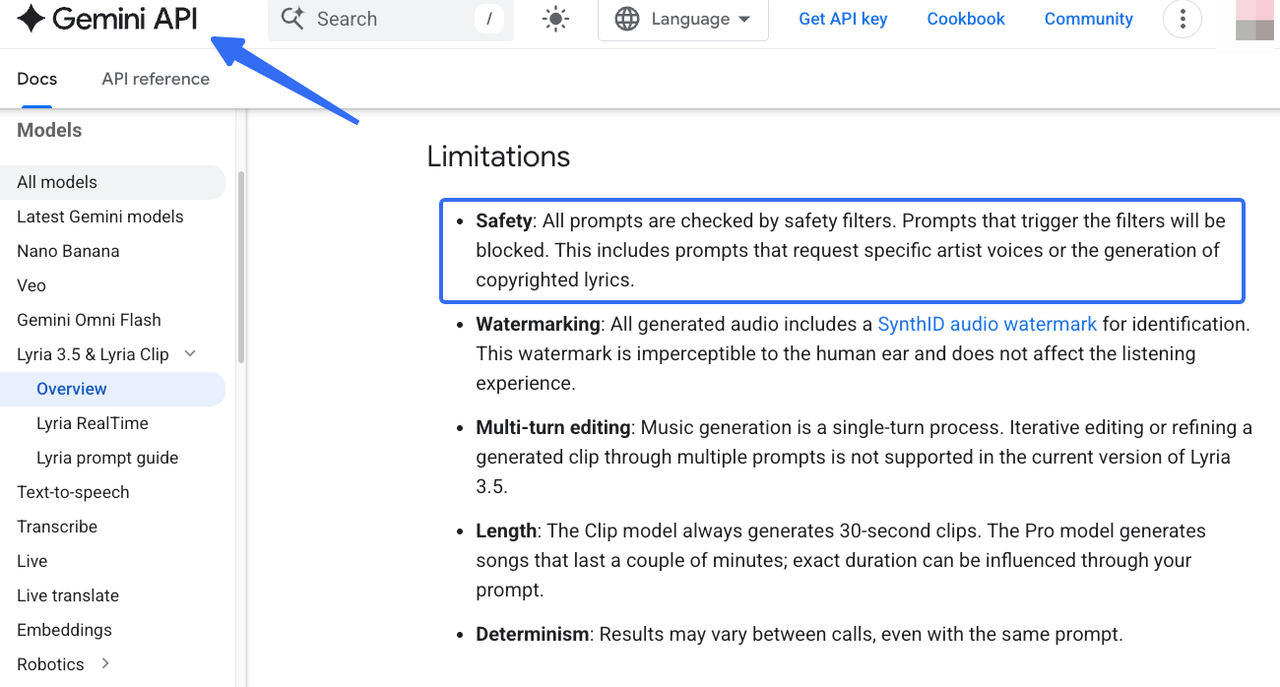
Yes. Policies differ by provider, but Google’s current Lyria 3.5 documentation says safety filters block prompts requesting specific artist voices or copyrighted lyrics. Do not disguise the artist request to evade a block. Translate the legitimate need into mood, energy, instrumentation, density, and video function instead.
Conclusion
The useful part of a reference track is not its melody waiting to be rewritten. It is the reason the director reached for it: the pace, space, tension, lift, or ending they want the picture to have.
To use a reference track without copying, start with video needs, replace identifiable elements, generate distinct routes, and compare each result with the cut and reference. If the distance still feels arguable, do not publish on confidence alone. Change direction or get qualified review before the soundtrack becomes the most expensive part of the edit.